
Uttarakhand at a Critical Monsoon Moment: Rain Disrupts Roads, Police Face Questions, Flights Expand and Cybercrime Control Wins Recognition
Doonited News | Uttarakhand | News Feature
Dehradun, August 22: Uttarakhand is experiencing one of those moments when several very different stories begin to tell the same larger story.
The monsoon is continuing to disrupt roads and travel. A confrontation involving an ABVP worker and police personnel has triggered questions about police conduct and accountability. Political friction within the ruling establishment is attracting attention. Better air connectivity promises to bring Pithoragarh closer to Dehradun and Delhi. And, on a more positive note, Uttarakhand Police has earned a place among India’s top five states for cybercrime management in the latest PRAGATI review.
Five developments.
One state.
And one underlying question:
Can Uttarakhand balance rapid development, public safety, political administration and the extraordinary pressures created by its geography?
1. Heavy Rain: The Mountains Are Again Sending a Warning

The immediate concern remains the weather.
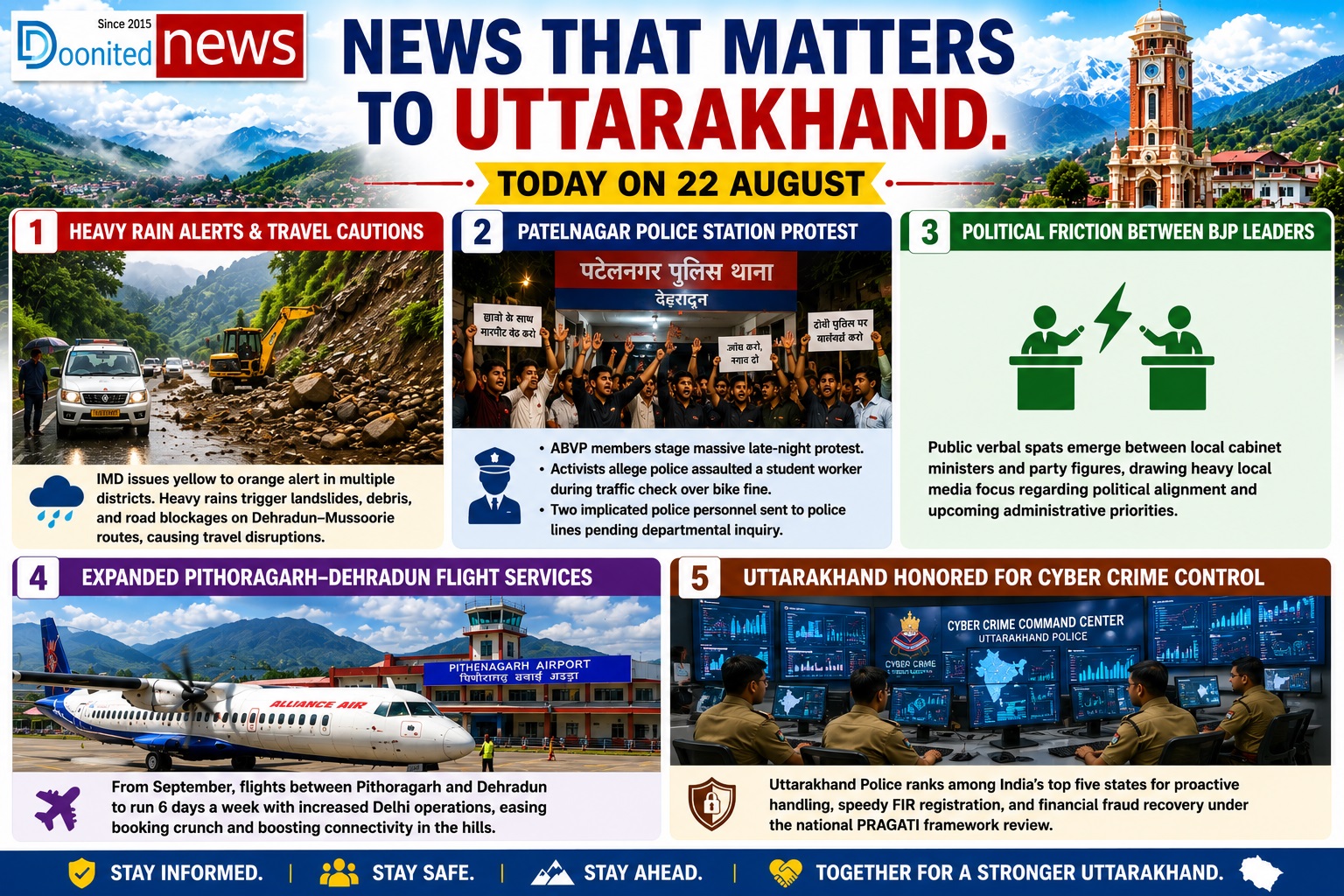
The Meteorological Department has placed several Uttarakhand districts under orange and yellow rainfall warnings, with heavy to very heavy rainfall expected in vulnerable areas. A recent weather alert placed Dehradun, Tehri, Pauri, Nainital and Bageshwar under orange warning, while other districts were under yellow alert.
The consequences are already visible on the ground.
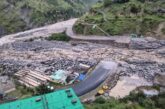
Landslides, debris and road damage have repeatedly disrupted movement around Dehradun and Mussoorie. On August 20, heavy rainfall caused a major road washout on the Mussoorie-Kempty Highway near Dimta Band, prompting a traffic advisory for travellers.
Across the state, the situation has been broader still. A recent PTI report said 132 roads, including four national highways, were blocked after heavy rain, while major rivers including the Alaknanda and Bhagirathi were running high.
This is not simply a tourism problem.
A mountain road is a lifeline.
When it closes, the consequences reach ambulances, schoolchildren, traders, villagers, tourists and emergency-response teams.
The question Uttarakhand must answer
Why are some stretches repeatedly failing?
Emergency clearance is necessary. But if a particular road repeatedly develops cracks, suffers landslides or loses its approach during every intense monsoon, the solution cannot remain limited to sending earthmovers after the event.
The state needs:
- Geological assessment
- Better drainage
- Slope stabilisation
- Retaining structures where technically appropriate
- Continuous monitoring
- Early traffic restrictions
- Clear travel advisories
The monsoon is not an unexpected event in Uttarakhand. The state’s infrastructure must be designed with that reality in mind.
2. Patelnagar Police Station Protest: The Question of Accountability

The second story is more uncomfortable because it concerns the institution responsible for maintaining law and order.
A late-night demonstration by ABVP members at Patelnagar police station followed allegations that a student worker was assaulted or mistreated during a traffic-related interaction.
According to the report supplied for this story, the student had questioned why his motorcycle was being fined during a routine traffic check. The allegation of police assault has triggered action against two personnel, who were reportedly sent to the police lines pending a departmental inquiry.
Because the incident is under inquiry, allegations should not be treated as established findings.
That distinction is essential.
A departmental inquiry exists precisely to determine what actually happened.
But accountability must work both ways
Traffic enforcement is a legitimate police responsibility.
Citizens are expected to follow traffic laws and cooperate with officers.
But police officers also exercise extraordinary authority over ordinary citizens.
That authority comes with an equally extraordinary responsibility to behave lawfully and professionally.
If the allegations are proved, disciplinary action should follow.
If they are not proved, that should also be made clear.
The answer cannot be decided by street protests, political pressure or social-media outrage. It must be decided by evidence.
Why this case matters beyond one police station
Public trust in policing is built through thousands of small interactions.
A traffic stop.
A complaint at a police station.
A verification request.
A roadside dispute.
A missing-person report.
Most citizens never encounter the senior police hierarchy.
They encounter the constable or sub-inspector standing on the road.
That interaction shapes their perception of the entire institution.
Therefore, professional conduct at the lowest operational level is not a minor issue.
It is the foundation of public confidence in policing.
3. Political Friction: Governance Must Be Bigger Than Internal Rivalry

Political disagreements within any ruling party are not unusual.
Ministers have competing responsibilities.
Leaders have different constituencies.
Party organisations have their own priorities.
And political ambitions inevitably exist.
Recent local reports have highlighted verbal exchanges and friction involving BJP leaders and cabinet figures in Uttarakhand.
However, the exact claims and context of the reported verbal spats are not sufficiently established from authoritative sources for us to present them as settled fact.
That caution is important.
Political reporting should distinguish between:
disagreement,
public criticism,
political positioning,
and
an actual governance crisis.
They are not the same thing.
The public has a more important concern
People are less interested in who won a political argument than in whether the government is functioning.
They want roads repaired.
They want safe schools.
They want reliable electricity and water.
They want hospitals that work.
They want tourism infrastructure that survives the monsoon.
They want police who treat them fairly.
Political competition is part of democracy.
Administrative paralysis is not.
The test for any ruling establishment should therefore be simple:
Does political energy ultimately translate into better governance?
4. Pithoragarh–Dehradun Air Connectivity: A Potential Game Changer for the Hills

Amid the monsoon disruptions comes a more encouraging development: efforts to strengthen air connectivity between the hills and the state capital.
The reported expansion of Pithoragarh–Dehradun flight services to six days a week from September could be significant for residents of Kumaon.
Air connectivity is not simply about convenience.
For a mountainous state, it can affect:
- Medical travel
- Business
- Education
- Government work
- Tourism
- Emergency movement
- Family connections
Current booking data shows Alliance Air services operating between Pithoragarh and Dehradun on multiple dates, demonstrating that the route is active.
The Delhi–Pithoragarh route is also operating, with current flight schedules showing Alliance Air services between the two cities.
But there is an important lesson from Uttarakhand’s aviation history.
Connectivity must be reliable, not merely announced.
Earlier launches of regional air services have sometimes faced operational interruptions, creating uncertainty for passengers.
For people living in remote mountain districts, a flight service that operates consistently is far more valuable than a spectacular launch ceremony.
What Pithoragarh really needs
The long-term goal should be dependable connectivity.
If flights operate regularly, passengers can plan around them.
Hospitals can schedule appointments.
Businesses can arrange meetings.
Tour operators can build packages.
Tourists can confidently book trips.
That is when air connectivity becomes an economic asset rather than simply a transport service.
5. Uttarakhand Police Among India’s Top Five for Cybercrime Management

The fifth story is one Uttarakhand can legitimately celebrate.
According to the State/UT Performance Matrix for January 1 to July 31, 2026, presented during a PMO-chaired PRAGATI review, Uttarakhand was placed among the top five states in India for cybercrime management.
The review assessed implementation of several national cybercrime initiatives, including:
- S4C
- e-Zero FIR
- Grievance Redressal Module
- Money Restoration Module
- Sahyog Portal
- Samanvaya
- Information sharing
- CyTrain capacity building
- Cyber-awareness initiatives
The achievement is particularly important because cybercrime is no longer an urban-only problem.
A fraud victim in a remote Uttarakhand village can lose money to a criminal sitting hundreds or thousands of kilometres away.
A fake investment scheme can target a retired government employee.
A digital payment fraud can affect a small shopkeeper.
A phishing call can reach anyone with a smartphone.
The money-restoration question matters most
For victims, a successful investigation is important.
But so is recovering the money.
The state’s reported implementation of the Money Restoration Module and grievance-redressal systems is therefore significant. Uttarakhand has also notified the establishment of a dedicated Uttarakhand State Cyber Crime Coordination Centre (US4C), according to the police-related announcement.
This is the direction policing needs to take.
Not simply registering cases.
Preventing fraud, responding quickly and helping victims recover losses.
The most important question is not whether Uttarakhand is developing.
It clearly is.
The question is:
Is the state developing intelligently enough for its geography and its people?
A new road is useful only if it remains usable.
A police force is effective only if people trust it.
A flight is valuable only if it operates reliably.
A political government succeeds only if administration remains functional.
And cybercrime control matters only if the ordinary victim actually receives help.
These are the standards that citizens ultimately use to judge governance.
Uttarakhand is often described through its mountains.
But the real Uttarakhand is built by its people.
The driver trying to get through a landslide.
The student questioning a traffic fine.
The family waiting for a flight from Pithoragarh.
The police officer tracking a cyber fraud.
The shopkeeper worrying about digital payments.
The tourist trying to reach Mussoorie.
The villager waiting for a road to reopen.
These are the people who experience government not through speeches, but through everyday services.
That is why the current moment matters.
The monsoon is testing the roads.
The Patelnagar episode is testing police accountability.
Political disagreements are testing administrative focus.
New flights are testing the state’s ability to build reliable connectivity.
Cybercrime is testing whether technology can make policing faster and more effective.
Uttarakhand does not need perfection.
It needs institutions that learn.
It needs infrastructure that anticipates risk.
It needs police accountability without weakening legitimate law enforcement.
It needs political competition without losing sight of governance.
And it needs connectivity that works beyond headlines.
The real measure of a modern Uttarakhand is not how quickly it grows—but how safely, fairly and intelligently it grows.