
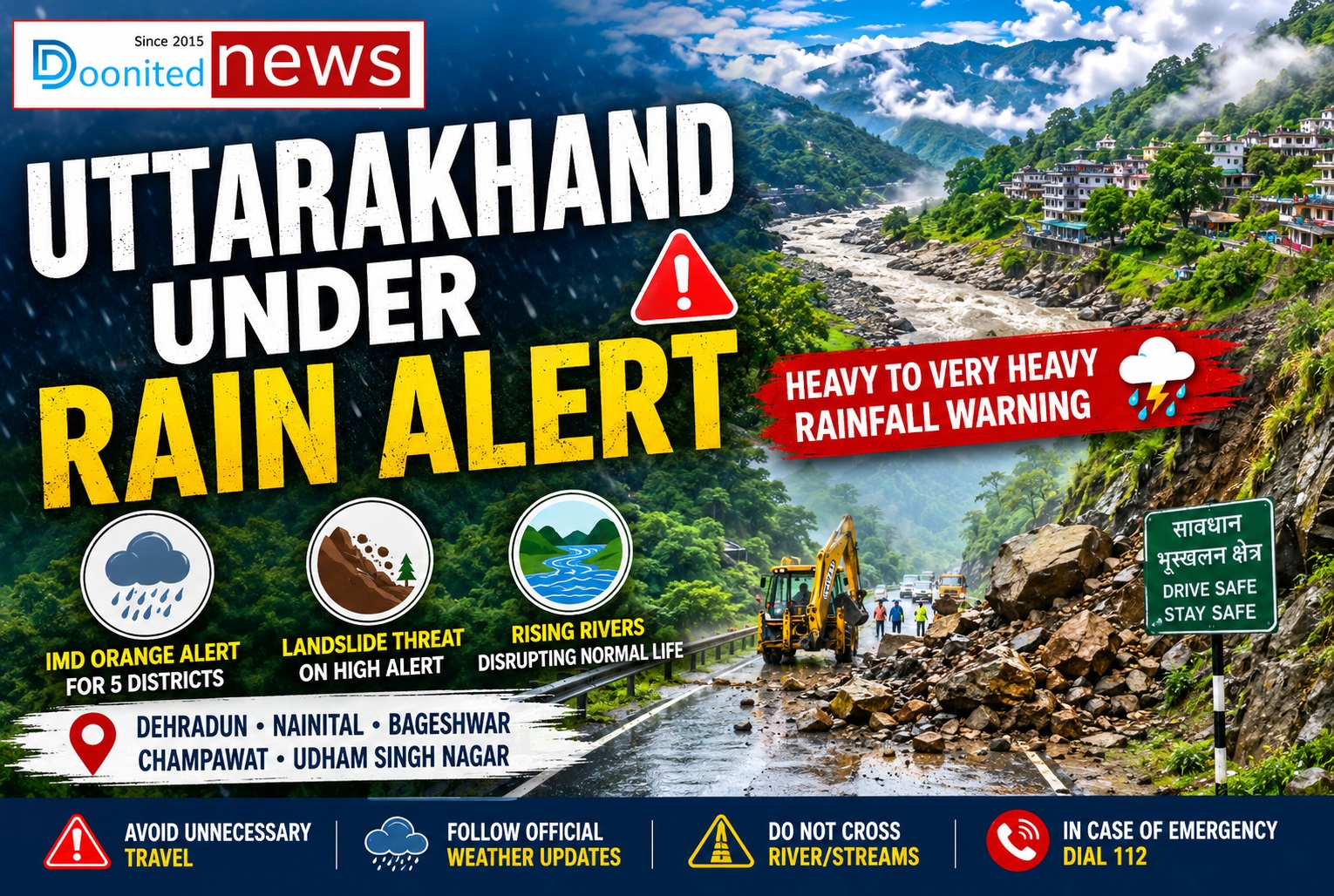

Uttarakhand Under Rain Alert: Orange Warning, Rising Rivers and Landslides Put Roads to the Test
Doonited News | Uttarakhand | Weather & Disaster Watch
Dehradun, August 17, 2026: Uttarakhand is once again facing the familiar but increasingly serious monsoon challenge: heavy rainfall, unstable mountain slopes, rising rivers and roads that can disappear under mud and debris within minutes.
The India Meteorological Department has issued an orange alert for Dehradun, Nainital, Bageshwar, Champawat and Udham Singh Nagar, warning of heavy to very heavy rainfall at isolated places, along with thunderstorms, lightning and intense to extremely intense spells of rain. The IMD has also warned of the possibility of landslides and flash floods in vulnerable areas.
The warning comes at a time when Uttarakhand’s mountain infrastructure is already under considerable pressure from repeated monsoon damage.
The Warning Is Not Just About Rain
An orange alert is not simply a forecast to carry an umbrella.
In a Himalayan state, intense rainfall can quickly translate into a chain of secondary hazards: slope failures, rockfalls, debris flows, swollen streams, damaged roads and sudden interruptions to electricity, drinking-water and communication networks.
The recent weather pattern has already demonstrated how quickly conditions can deteriorate. The IMD had forecast an increase in monsoon activity across Uttarakhand from August 14 to 17, with heavy to very heavy rainfall possible at isolated locations.
For residents of vulnerable mountain settlements, the real concern is therefore not only how much rain will fall, but where that rain will fall and what happens to the water after it reaches the slopes.
Rivers Rising, Roads Under Pressure
The threat is particularly serious near rivers and seasonal streams.
In Bageshwar, heavy overnight rainfall recently caused the Saryu River to swell close to danger levels, prompting authorities to clear vulnerable areas along the riverbanks and place police and disaster-response teams on alert.
At the same time, landslides continue to threaten road connectivity.
The Mussoorie–Dehradun corridor, one of Uttarakhand’s most important tourism and commuter routes, has experienced repeated landslides this monsoon. A fresh landslide near Pani Wala Bend recently produced several kilometres of traffic congestion, while earlier incidents left commuters stranded for hours.
This is where Uttarakhand’s geography becomes unforgiving.
A road may be perfectly functional in the morning and become unusable after a few hours of intense rain.
The Mountain Road Problem Is Bigger Than One Landslide
The recurring disruption raises a larger infrastructure question.
Uttarakhand’s roads are cut into steep, geologically fragile mountain slopes. When rainfall saturates the soil, drainage systems become overwhelmed and the underlying slope loses stability. Add repeated road cutting, construction pressure and inadequate slope protection, and the margin for safety becomes smaller.
Recent reporting from the Mussoorie region illustrates the problem. Roads leading to the hill station have remained vulnerable to repeated landslides, while commuters have faced dangerous stretches and temporary traffic arrangements.
The issue, therefore, cannot be solved permanently by sending an excavator every time a landslide occurs.
Clearing debris is emergency response. Preventing repeated slope failure is infrastructure policy.
When Tourism Meets Monsoon Risk
For Uttarakhand, this is also a tourism issue.
Dehradun, Mussoorie, Nainital and other destinations depend heavily on road connectivity. During periods of heavy rain, tourists may find themselves trapped between landslides, while hotels, restaurants, taxi operators and local suppliers face disruptions.
The problem becomes more complicated when visitors continue travelling despite official warnings.
A scenic mountain road covered in mist may look beautiful in a photograph. During an orange alert, however, the same slope can become a potential rockfall zone.
Authorities have repeatedly advised residents, pilgrims and travellers to avoid unnecessary movement in landslide-prone areas and to follow official advisories.
The Question Uttarakhand Must Answer
Every monsoon, the state spends enormous resources reopening roads.
But the bigger question is: why are the same roads repeatedly failing?
Recent incidents have shown that road closures are not confined to remote mountain tracks. Major routes and highways have also faced landslides, debris blockages and structural damage during intense rainfall.
During a severe monsoon spell in July, more than 100 roads were reported closed across Uttarakhand, while key Char Dham routes were disrupted by landslides and debris.
That should be treated as more than a seasonal inconvenience.
It is a warning about the resilience of the state’s infrastructure.
What Needs to Change
1. Drainage Must Come Before Road Expansion
Mountain roads cannot be engineered only around the carriageway. Proper surface drainage, culverts and slope-water management are fundamental to road safety.
2. Vulnerable Slopes Need Permanent Treatment
Repeatedly clearing the same landslide location is not a long-term solution. Geotechnical assessment, retaining structures, rock protection, vegetation-based stabilization and appropriate drainage should be considered according to site conditions.
3. Real-Time Road Information Must Reach Travellers
During extreme weather, travellers need accurate information about which roads are open, partially open or unsafe.
4. Tourism Advisories Must Be Stronger
When an orange or red alert is issued, tourists should receive clear guidance about whether travel to particular mountain destinations is advisable.
5. Rivers and Seasonal Streams Must Be Respected
Construction and temporary activities near active drainage channels increase vulnerability. Monsoon planning must account for the possibility that apparently small streams can become dangerous torrents.
The Cost of Treating Every Disaster as an Exception
There is a pattern that Uttarakhand cannot afford to ignore.
Heavy rain arrives.
A landslide occurs.
A road closes.
An excavator arrives.
Traffic resumes.
And after the next major rainfall, the same cycle begins again.
That is not resilience.
It is repeated recovery from predictable risk.
The Himalayan environment will always present natural hazards. Uttarakhand cannot stop the monsoon or eliminate every landslide. But it can make infrastructure, warning systems and travel planning more resilient.
An Editorial Word
Uttarakhand does not need to choose between development and environmental protection. It needs mountain-sensitive development.
Roads are essential. Tourism is essential. Connectivity is essential. But infrastructure designed without sufficient attention to geology, drainage and slope stability ultimately puts both people and investment at risk.
The current orange alert should therefore be seen not merely as a weather warning but as a reminder.
In Uttarakhand, rain is natural. Disaster does not have to be.
For residents and travellers, the immediate priority is simple: follow official weather and road advisories, avoid riverbanks and landslide-prone slopes during intense rainfall, and do not attempt to cross a road or stream that authorities have declared unsafe.