
Uttarakhand’s Monsoon Test: 10 Dead in Chamoli Tunnel, Pauri Tragedy and a State Under Pressure
Doonited News | Uttarakhand | Editorial

Dehradun, August 19, 2026: Uttarakhand’s monsoon story has moved far beyond flooded roads and disrupted traffic. In the latest 24-hour news cycle, the state is confronting a deadly tunnel disaster in Chamoli, a rain-triggered house collapse in Pauri Garhwal, school closures because of severe-weather warnings and continuing disruption along mountain and pilgrimage routes.
At the same time, the state government is attempting to strengthen another critical line of defence: its healthcare infrastructure.
Five developments, seemingly separate, point toward one larger question:
Is Uttarakhand becoming better prepared for the risks that its geography and increasingly disruptive weather repeatedly expose?
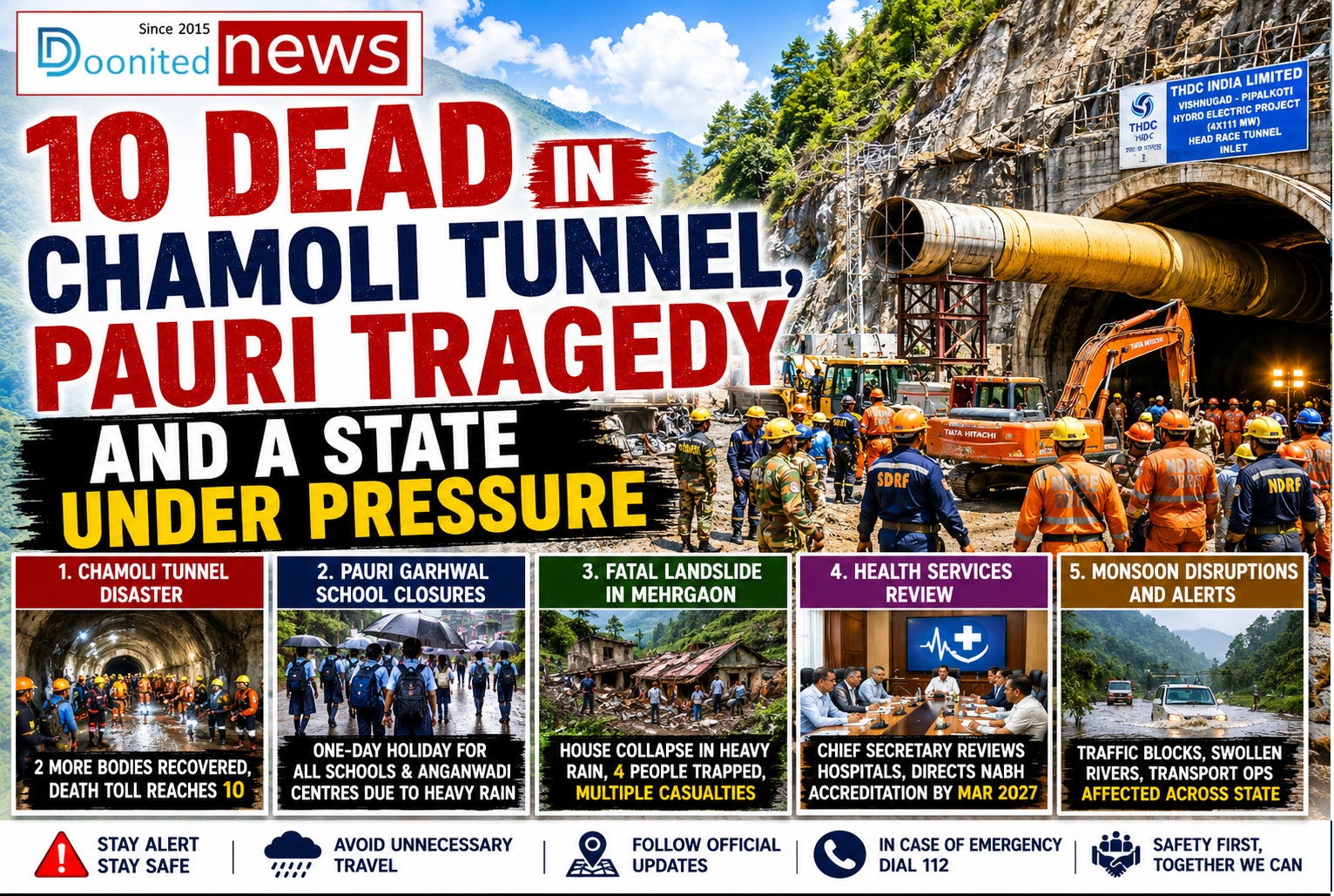
1. Chamoli Tunnel Disaster: Death Toll Reaches 10

The most devastating story is coming from Mayapur-Pipalkoti in Chamoli, where a sudden influx of water and debris into an under-construction THDC tunnel trapped workers on August 13.
The rescue operation has now ended with the recovery of the bodies of the final two missing workers, taking the death toll to 10. Reports say the bodies were recovered after days of search and rescue operations inside difficult and unstable tunnel conditions.
The tragedy once again puts the spotlight on the enormous engineering challenge of constructing infrastructure inside the young, fractured and geologically complex Himalayan landscape.
But there is an important distinction.
The geological fragility of the Himalayas may explain the risk. It does not, by itself, establish the cause or responsibility for this particular accident.
That must come from a proper technical and independent investigation.
The question that cannot be postponed
Hydropower and tunnel infrastructure are important to Uttarakhand’s economy and energy system. But every project operating beneath a mountain carries a responsibility that goes beyond engineering calculations.
Worker safety must remain non-negotiable.
The Chamoli disaster should therefore lead to a detailed examination of tunnel design, geological assessment, water-management systems, emergency escape arrangements, communication systems and construction-site safety protocols.
A rescue operation can save lives. A better safety system can prevent workers from needing rescue in the first place.
2. Pauri Garhwal: Schools Closed as Rain and Lightning Threats Intensify

In Pauri Garhwal, authorities ordered a one-day closure of schools up to Class 12 and Anganwadi centres for August 19 because of the forecast of heavy rain and associated severe-weather risks.
This is not a statewide school shutdown. It is a district-level precautionary decision, which is important because weather impacts in Uttarakhand vary dramatically from one district and valley to another.
The decision reflects a basic principle of disaster management:
When the risk of travel becomes greater than the benefit of keeping schools open, prevention must come first.
In mountain districts, a child’s journey to school may involve narrow roads, steep slopes, streams and areas vulnerable to landslides.
A weather warning therefore cannot be treated merely as information on a forecast screen.
It must translate into action.
3. Mehr Village Tragedy: Three Members of a Family Killed

One of the most painful consequences of the current weather has emerged from Mehr village in the Satpuli area of Pauri Garhwal.
A house collapsed after heavy rainfall on Tuesday evening, killing three members of a family: 80-year-old Mathura Devi, her 44-year-old son Dhirendra Singh and a five-year-old boy whose identity had not yet been established in the report.
This is an important correction to the initial description of the incident: reports available today confirm three fatalities, not four.
The tragedy is a stark reminder that monsoon danger is not confined to highways and major infrastructure.
It enters homes.
For families living on vulnerable slopes or in structures weakened by prolonged rain, the threat can come without warning.
And once a house collapses, rescue becomes extraordinarily difficult in terrain already saturated by water.
The uncomfortable question
How many vulnerable homes across Uttarakhand have been identified before disaster strikes?
How many families living near unstable slopes have received evacuation warnings?
How many old or structurally vulnerable houses are being systematically assessed?
These are questions that cannot be answered only after a tragedy.
4. Healthcare: Can Uttarakhand Build a Stronger Safety Net?
The fourth development is less dramatic but potentially just as important.
Chief Secretary Anand Vardhan has been associated with efforts to strengthen the state’s health administration and hospital systems, including the push toward higher standards and digital healthcare services.
What can be established is that NABH accreditation is a formal quality framework for healthcare organisations, and the national NABH system maintains accreditation and certification programmes for hospitals and other healthcare facilities.
The broader objective is important.
A state that regularly faces disasters needs hospitals capable of absorbing sudden surges in patients.
That means:
- Emergency preparedness
- Trauma care
- Digital patient records
- Reliable referral systems
- Blood and medicine availability
- Trained emergency personnel
- Quality and patient-safety protocols
Healthcare resilience is disaster resilience.
When roads are blocked and remote communities are isolated, the nearest functioning hospital can become a lifeline.
5. The Monsoon Has Not Finished Testing Uttarakhand

The tunnel tragedy and Pauri deaths are unfolding against a broader period of monsoon disruption.
Rain has repeatedly caused landslides, swollen rivers and road blockages across Uttarakhand. Earlier this monsoon, authorities reported large numbers of roads being blocked, while pilgrimage routes were periodically affected by landslides and debris.
The state’s geography makes complete elimination of such disruption impossible.
But the repeated nature of the problem raises a more serious question:
Are we investing enough in prevention, or are we becoming increasingly efficient only at responding after something has already gone wrong?
That distinction matters.
The Common Thread: Risk Is Becoming a Governance Question
Look at these five stories together.
A tunnel collapses.
A family home collapses.
Schools close because children may be at risk.
Roads become impassable.
Hospitals are being asked to improve standards.
These are not five isolated administrative matters.
They are connected by the concept of resilience.
Uttarakhand needs infrastructure that can withstand extreme weather.
It needs communities that receive warnings before disaster.
It needs roads that recover quickly.
It needs hospitals prepared for emergencies.
And it needs construction projects where worker safety is treated as a fundamental requirement rather than an operational detail.
The Himalayas Are Not the Enemy
There is a temptation after every disaster to blame the mountain.
The Himalayas are indeed geologically young, tectonically active and inherently challenging.
But that explanation is incomplete.
The real risk comes from the interaction between:
natural hazard + human exposure + infrastructure vulnerability + preparedness.
A landslide in an uninhabited forest is a geological event.
A landslide that destroys a road carrying hundreds of vehicles becomes a disaster.
A house collapse that kills a family becomes a human tragedy.
A tunnel water-and-debris influx that kills workers becomes a workplace and infrastructure safety crisis.
The mountain creates the hazard.
Human planning determines how devastating that hazard becomes.
What Uttarakhand Needs Now
1. Independent investigation of the Chamoli tunnel disaster
The state must establish exactly what happened, whether all safety protocols were followed and what changes are required before similar underground projects continue.
2. Mapping of vulnerable homes
Families living in landslide- and slope-failure-prone areas should be identified and given clear evacuation protocols.
3. District-specific weather action plans
An IMD warning should automatically trigger locally appropriate decisions regarding schools, tourism, construction and vulnerable communities.
4. Permanent treatment of chronic landslide zones
Repeated debris clearance is necessary but cannot substitute for long-term geological and engineering solutions.
5. Stronger disaster-ready hospitals
The healthcare system must be prepared for the sudden patient surges that accompany floods, landslides and major accidents.
Uttarakhand’s monsoon is revealing two very different sides of the state.
One is the extraordinary courage of rescue workers who enter dangerous tunnels, swollen rivers and landslide zones when others are trying to escape.
The other is the vulnerability of a state where homes, roads and major infrastructure can all be overwhelmed by the same natural forces.
The answer is not to stop development.
The answer is to develop differently.
Hydropower is necessary.
Roads are necessary.
Tourism is necessary.
Hospitals are necessary.
But each must be designed around the realities of the Himalayas.
The deaths in Chamoli and Pauri should not become merely the next entries in a monsoon casualty count.
They should become a demand for better engineering, better warnings, stronger safety standards and more accountable planning.
Uttarakhand cannot stop the rain. It cannot flatten the mountains. It cannot eliminate every landslide.
But it can reduce the number of people standing directly in harm’s way.
And that is ultimately the real test of governance in the Himalayas.
A resilient Uttarakhand will not be measured by how many disasters it manages to respond to. It will be measured by how many tragedies it manages to prevent.
Editorial verification note: The Chamoli death toll of 10 and the Pauri/Mehr village fatalities have been checked against current reports published today. The specific March 2027 NABH deadline in the supplied material could not be independently confirmed from an authoritative current source, so I have deliberately not presented that detail as established fact. This follows your requirement that Doonited articles should not state unverified information as fact.