
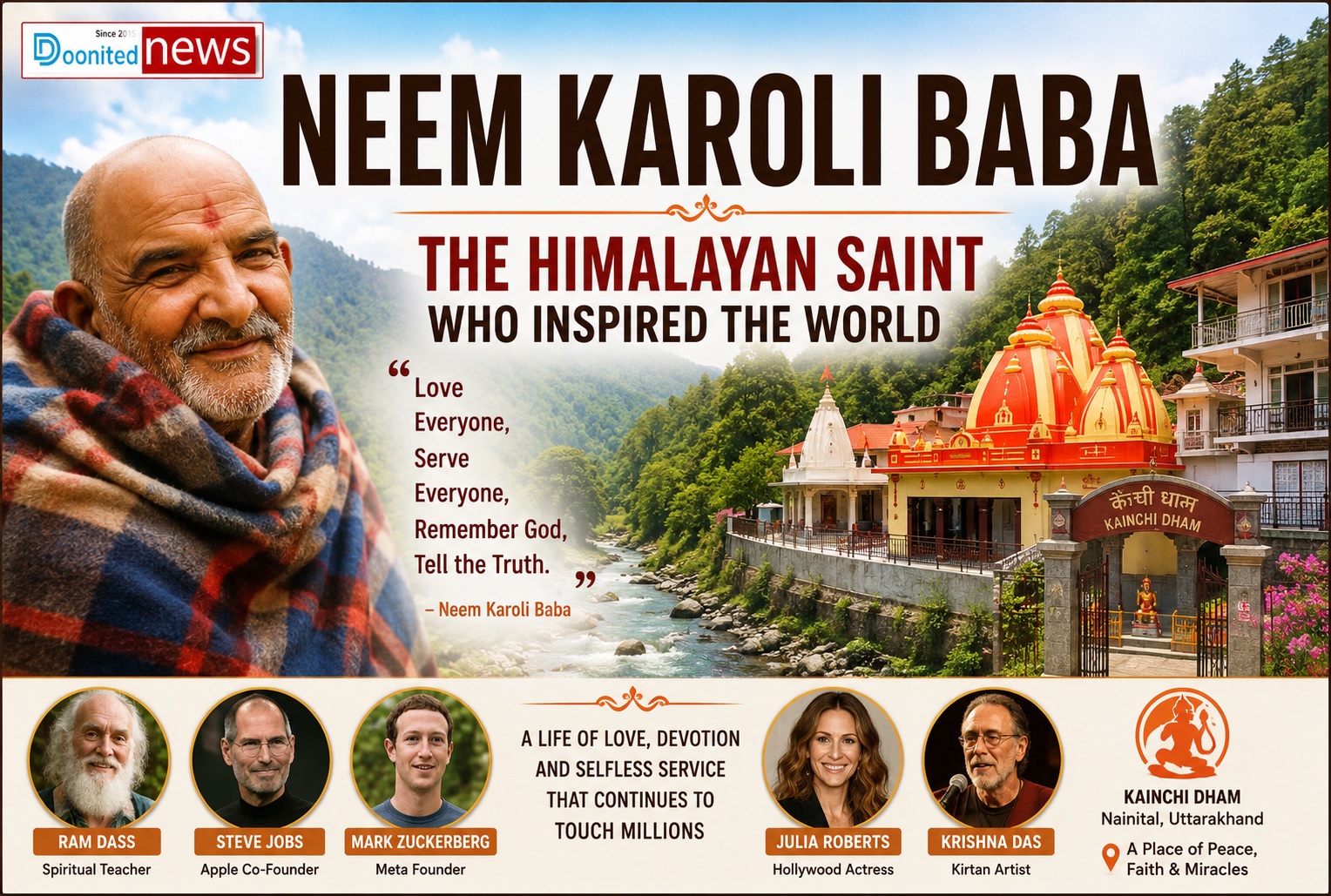
Neem Karoli Baba & Kainchi Dham: The Himalayan Saint Whose Message Travelled Around the World
By Doonited News | Devotional Uttarakhand

Hidden among the forested Kumaon hills of Uttarakhand is a spiritual destination whose influence reaches far beyond the Himalayas.
Kainchi Dham, near Nainital, is inseparably associated with Neem Karoli Baba, affectionately called Maharaj-ji by devotees.
He did not build his reputation through elaborate philosophical lectures. The teachings attributed to him were strikingly direct: love everyone, serve everyone, remember God and tell the truth. His tradition also emphasizes Sub Ek — “All is One.”
Decades after his death in 1973, Neem Karoli Baba’s influence remains international. His devotees included the spiritual teacher Ram Dass, while prominent figures including Steve Jobs, Mark Zuckerberg and Julia Roberts have also been publicly connected with his spiritual legacy.
But how did a saint associated with a quiet Himalayan ashram become such a globally recognized spiritual figure?
That story begins with a man whose life remains surrounded by both documented history and devotional tradition.
Who Was Neem Karoli Baba?
Neem Karoli Baba is also known as Neeb Karori Baba and Maharaj-ji.
Unlike modern spiritual personalities whose lives are extensively documented through interviews, recordings and autobiographies, many details of Maharaj-ji’s early life are difficult to establish independently.
What is clear is that he became a highly influential Hindu spiritual teacher associated particularly with bhakti — the path of devotion — and with Hanuman.
The Neem Karoli Baba Ashram describes his teachings as simple and universal and identifies love, service, remembrance of God and truth as central principles.
Stories of miracles and extraordinary powers form an important part of the devotional literature surrounding him. These should be understood as accounts preserved by devotees rather than independently verified historical facts.
The distinction matters journalistically.
One does not need to prove a miracle to understand the remarkable cultural influence of Neem Karoli Baba.
Kainchi Dham: The Himalayan Centre of His Legacy
For Uttarakhand, the place most strongly identified with Neem Karoli Baba is Kainchi Dham.
Situated in the Kumaon hills, the ashram occupies a secluded mountain setting roughly 38 kilometres from Nainital, according to the Neem Karoli Baba Ashram’s information about the Indian centre.
The first temple at Kainchi was inaugurated in June 1964. Today, large numbers of devotees visit during the pilgrimage season.
The setting is an essential part of its character.
Forested Himalayan slopes rise around the complex. The sound of prayer and temple bells mixes with the natural environment.
It feels very different from a large urban religious centre.
And perhaps that simplicity helps explain its appeal.
Why the Name “Kainchi”?

The word kainchi means “scissors” in Hindi.
The name is associated with the geographical configuration of the area, where the roads form a scissor-like crossing through the hills.
Yet the relatively small Himalayan location would eventually become internationally recognized because of Maharaj-ji.
Today, for countless devotees, saying “Kainchi” immediately evokes Neem Karoli Baba.
A Saint Closely Connected With Hanuman
Understanding Neem Karoli Baba requires understanding the importance of Hanuman in his devotional tradition.
Hanuman represents devotion, courage, humility and selfless service to Lord Rama.
Those same qualities — particularly seva, or selfless service — became central to the spiritual culture surrounding Maharaj-ji.
The Neem Karoli Baba Ashram continues to describe both bhakti yoga through devotional practices and karma yoga through seva as fundamental elements of its spiritual life.
This makes the philosophy practical.
Spirituality is not only meditation.
It is also service.
Not simply what you believe, but how you treat other people.
“Love Everyone, Serve Everyone”
Perhaps the most enduring legacy associated with Neem Karoli Baba can be expressed through a remarkably simple spiritual instruction:
Love everyone. Serve everyone. Remember God. Tell the truth.
There is little theological complexity in those words.
A person does not need to understand Sanskrit philosophy to grasp them.
That simplicity helped the message cross cultures.
It could speak to a villager in Uttarakhand.
It could also speak to a young Westerner searching for spiritual meaning thousands of kilometres away.
And during the 1960s and 1970s, some of those Western seekers began arriving in India.
One of them would profoundly change the international story of Neem Karoli Baba.
Ram Dass: The Disciple Who Took Maharaj-ji’s Story to the West
One of the most important figures in the international spread of Neem Karoli Baba’s teachings was Ram Dass, born Richard Alpert.
A former Harvard psychology professor, Alpert travelled to India during the 1960s and eventually encountered Neem Karoli Baba.
The meeting transformed his life.
He became known as Ram Dass and subsequently emerged as an influential Western spiritual teacher.
His writings and teachings introduced large numbers of Western readers to Indian spiritual traditions and to Maharaj-ji.
The connection was not superficial. Kainchi Dham’s own historical material specifically notes that Ram Dass and other Western devotees spent significant time there with Maharaj-ji.
Through Ram Dass, stories of a little-known Himalayan saint reached an international audience.
And that audience eventually included some extraordinarily influential people.
Steve Jobs and the Journey to India

Steve Jobs is perhaps the most famous technology figure associated with Neem Karoli Baba’s legacy.
Jobs travelled to India as a young man in 1974, searching for spiritual understanding.
Neem Karoli Baba had already died the previous year, so Jobs could not have personally met Maharaj-ji during that journey.
This is an important detail because simplified internet accounts sometimes imply otherwise.
Nevertheless, Jobs’ Indian spiritual journey became associated with Neem Karoli Baba and the Kainchi tradition, contributing significantly to later international curiosity about the ashram.
His story demonstrates something fascinating about Kainchi Dham.
A Himalayan spiritual centre established decades before the digital revolution would eventually become linked in popular culture with one of the central figures of that revolution.
Mark Zuckerberg and the Kainchi Dham Story
Another extraordinary connection involves Mark Zuckerberg.
Zuckerberg has publicly been associated with visiting the temple connected with Neem Karoli Baba during a difficult period in Facebook’s early development.
The story became especially widely known after Zuckerberg discussed advice he had received from Steve Jobs about travelling to the temple in India.
Contemporary reporting continues to identify Zuckerberg among the prominent public figures inspired by or associated with Neem Karoli Baba.
Again, accuracy requires an important distinction:
Zuckerberg was not a personal disciple who met Neem Karoli Baba, because Maharaj-ji had died decades earlier.
His connection is with Maharaj-ji’s continuing spiritual legacy and Kainchi Dham.
Julia Roberts and Neem Karoli Baba
Hollywood actor Julia Roberts has also been widely associated with an interest in Neem Karoli Baba.
Recent reporting continues to identify Roberts alongside Jobs and Zuckerberg among internationally known figures inspired by the Indian saint.
Her connection is particularly interesting because it demonstrates how Maharaj-ji’s influence moved far beyond the original circle of people who encountered him physically.
The saint died in 1973.
Yet new generations continued discovering him through photographs, books, devotees and stories.

Krishna Das: From Kainchi to Global Kirtan
Another important name is Krishna Das.
Unlike later admirers who encountered Maharaj-ji only through his legacy, Krishna Das belonged to the generation of Western seekers who travelled to India and became personally connected with Neem Karoli Baba.
He subsequently became internationally known for kirtan, bringing traditional devotional chanting to audiences around the world.
His journey represents another path through which the spiritual culture surrounding Maharaj-ji travelled beyond India.
Larry Brilliant and the Power of Seva
Physician and epidemiologist Larry Brilliant also became associated with Neem Karoli Baba.
His story is especially relevant because it illustrates the idea of seva — service.
Brilliant later participated in international public-health work, including the global campaign against smallpox.
For the Neem Karoli Baba tradition, this idea — spirituality expressed through service to others — is fundamental.
It connects devotion with action.
Famous Followers and Admirers: An Important Distinction
Articles about Neem Karoli Baba often place every famous person connected with him under the label “followers.”
That can be misleading.
There are at least two different categories.
Personal devotees included people such as Ram Dass and Krishna Das who encountered Maharaj-ji during his lifetime.
Later public figures such as Steve Jobs and Mark Zuckerberg encountered his legacy, teachings or Kainchi Dham after his death.
Making that distinction actually strengthens the story.
It demonstrates that Maharaj-ji’s influence did not disappear when his physical life ended.
It expanded.
The Miracles of Neem Karoli Baba
Numerous extraordinary stories surround Maharaj-ji.
Devotees recount incidents involving apparent knowledge of distant events, healing, unusual encounters and other experiences they interpreted as miraculous.
Indeed, devotional organizations acknowledge that he became popularly known as the “Miracle Baba.”
From a journalistic standpoint, these accounts belong to the realm of faith and testimony.
They cannot all be independently verified.
Doonited News therefore treats them respectfully as devotional traditions rather than presenting supernatural claims as established scientific or historical fact.
What is verifiable is arguably remarkable enough:
A Hindu saint associated with northern India attracted followers whose work later carried his name and teachings around the world.
Maharaj-ji’s Final Days

Neem Karoli Baba died in September 1973.
The Kainchi Dham historical account gives the date as the night of 10 September 1973.
But his death did not bring the Kainchi story to an end.
Construction of a temple dedicated to Maharaj-ji began at Kainchi in 1974, according to the ashram’s account.
His murti was formally installed there on 15 June 1976.
That date continues to have enormous significance.
Why June 15 Is Special at Kainchi Dham
Every year 15 June is observed as Pratishtha Divas at Kainchi Dham.
Large numbers of devotees travel to the temple for the occasion and receive prasad.
The gathering has become so substantial that special traffic and crowd-management arrangements may be required.
For anyone planning to visit around this period, checking current district-administration and temple guidance is essential.
Kainchi is a functioning spiritual centre, not simply a sightseeing destination.
From Uttarakhand to the World
This may ultimately be the most extraordinary part of Neem Karoli Baba’s story.
He did not need television.
He did not need social media.
He did not create a global corporate spiritual organization.
Yet his influence crossed continents.
Ram Dass helped introduce Maharaj-ji to Western spiritual audiences.
Krishna Das carried devotional chanting around the world.
Later, the stories involving Steve Jobs, Mark Zuckerberg and other prominent personalities brought Kainchi Dham to the attention of people who might otherwise never have heard of a small Himalayan ashram in Uttarakhand.
Today the spiritual tradition has communities outside India as well, including the Neem Karoli Baba Ashram and Hanuman Temple in Taos, New Mexico.
Why Neem Karoli Baba Matters to Devotional Uttarakhand
Uttarakhand’s spiritual identity is often associated with ancient sacred geography.
Kedarnath.
Badrinath.
Gangotri.
Yamunotri.
Jageshwar.
But the spiritual history of the Himalayas did not stop in antiquity.
Neem Karoli Baba represents a comparatively modern chapter in that continuing story.
His life demonstrates how the Kumaon Himalayas remained a destination for spiritual seekers even in the twentieth century — and how a spiritual tradition rooted in Uttarakhand could ultimately become international.
The Message That Outlived the Saint
More than half a century has passed since Neem Karoli Baba died.
The world in which we live would have been almost unimaginable in his lifetime.
We carry computers in our pockets.
Artificial intelligence communicates across continents in seconds.
Technology companies influence billions of lives.
And ironically, some of the people most closely associated with building that technological world have themselves looked toward an extraordinarily simple Himalayan spiritual tradition.
Perhaps that is why the Neem Karoli Baba story remains compelling.
Behind all the famous names, miracle stories and international attention lies a message requiring almost no explanation:
Love everyone.
Serve everyone.
Remember God.
Tell the truth.
And from a quiet corner of Kumaon, that message travelled around the world.