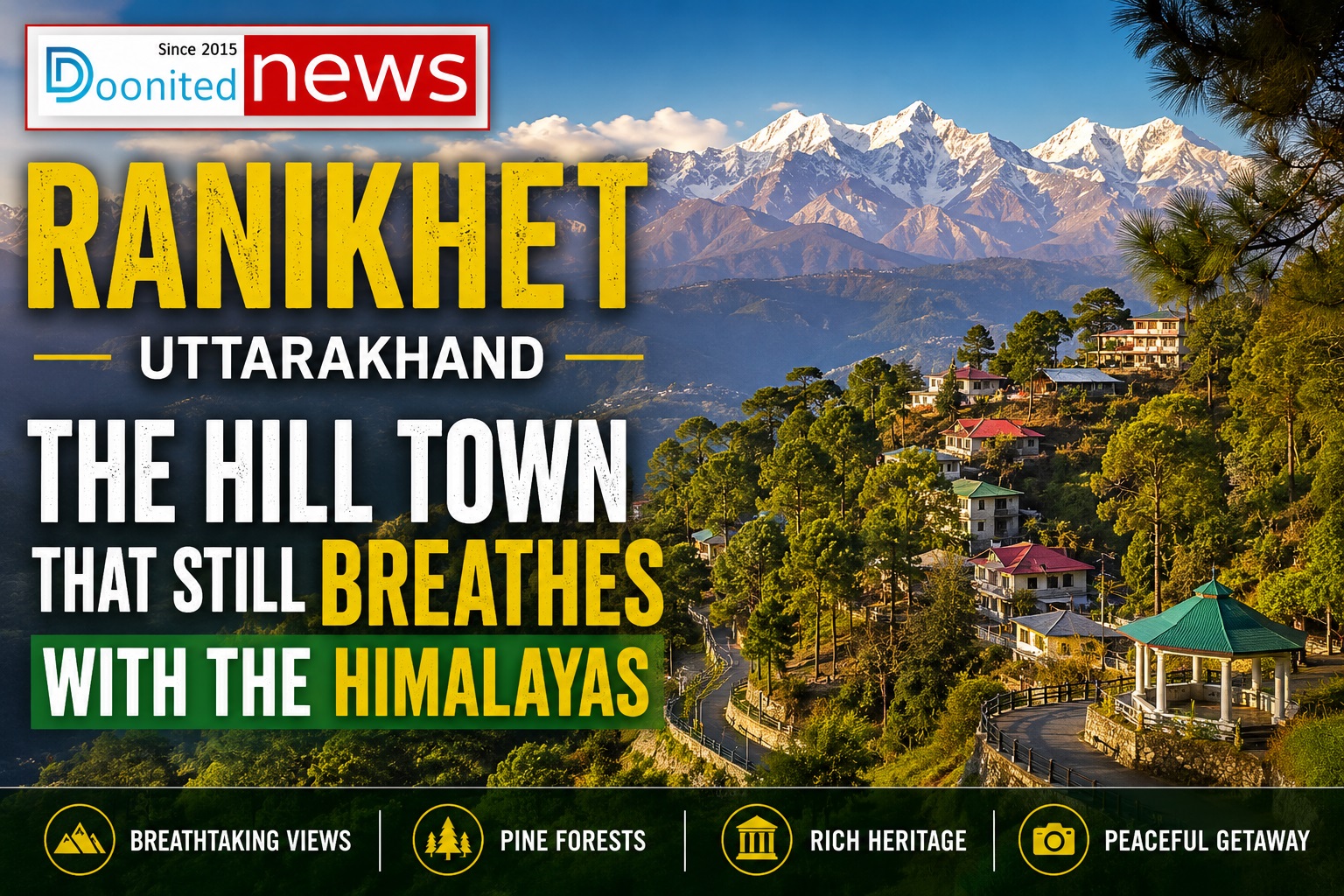
Ranikhet, Uttarakhand: The Hill Town That Still Breathes With the Himalayas
Doonited News | Uttarakhand | Editorial Travel Feature
In an era when many hill stations are struggling under traffic, concrete expansion and uncontrolled tourism, Ranikhet remains one of Uttarakhand’s rare mountain towns that still feels connected to the rhythm of the Himalayas. The name itself means “Queen’s Meadow,” and as the first light touches the pine-covered slopes and distant snow peaks, it becomes easy to understand why generations of travelers have fallen in love with this quiet corner of Kumaon.
Ranikhet is not a destination that overwhelms visitors with noise or spectacle. It wins them slowly—with silence, clean mountain air, forests scented with pine and long views of the central Himalayas that seem to stretch beyond time.
A Hill Station Built Around Landscape, Not Around Crowds

Located in Almora district at an elevation of around 1,800 metres, Ranikhet was developed during the British period as a cantonment town. Unlike many commercial hill stations, large parts of Ranikhet are still protected by military administration, which has unintentionally preserved its green character. Wide roads, orderly settlements and extensive forest cover create a sense of space that is increasingly rare in mountain tourism.
Walking through Ranikhet often feels less like visiting a tourist town and more like entering a carefully guarded landscape where nature remains the principal resident.
The Himalayan View That Stops Conversation

On clear mornings, viewpoints around Ranikhet reveal magnificent panoramas of Nanda Devi, Trishul, Nanda Ghunti and other Himalayan peaks. The mountains appear almost suspended above the forests, glowing pink and gold at sunrise. Visitors often arrive with cameras and leave with something less tangible—a renewed sense of scale and humility.
These views are not merely scenic attractions; they are reminders of the fragile mountain environment that sustains Uttarakhand’s rivers, forests and communities.
Chaubatia: Orchards, Forests and Quiet Walking Trails

One of Ranikhet’s most beloved areas is Chaubatia, known for its orchards, forested slopes and gentle walking paths. Apple, apricot and peach trees add seasonal colour to the landscape, while the surrounding forests provide habitat for birds and other wildlife.
Chaubatia represents a style of tourism that is increasingly valuable: slow travel, walking, observation and immersion rather than hurried sightseeing.
Jhula Devi Temple and the Sound of Bells

Ranikhet’s spiritual character is reflected in the famous Jhula Devi Temple, where thousands of bells hang from the temple complex. Devotees tie bells after their wishes are fulfilled, creating a unique visual and auditory experience as mountain winds move through the shrine.
The temple is not just a religious stop; it is part of the cultural identity of Kumaon and a reminder that Himalayan travel is often a journey through living traditions.
Why Travelers Return to Ranikhet

Ask frequent visitors why they return, and many struggle to give a single reason. Ranikhet offers something that is difficult to market but easy to feel: restfulness. There are no aggressive crowds at every viewpoint, no constant pressure to consume attractions and no need to rush from one selfie spot to another.
People come here to read, walk, watch clouds drift across the mountains and listen to the wind moving through deodar and pine trees.
The Tourism Dilemma: Can Beauty Survive Popularity?

Ranikhet’s growing popularity also raises difficult questions. Better roads and social-media exposure are bringing more visitors each year. Tourism supports local livelihoods, hotels, transport operators and small businesses. Yet the Himalayas have repeatedly shown that unchecked development can damage the very landscape that attracts tourists.
Encroachment on forest land, excessive construction, waste generation and pressure on water resources are emerging concerns across many hill towns. Ranikhet still has an opportunity that several other destinations have already lost: the opportunity to plan before irreversible damage occurs.
What Responsible Tourism Should Look Like in Ranikhet
Carry back plastic and packaged waste
Avoid leaving litter on roadsides, viewpoints and forest trails.
Choose local homestays and businesses
Support Kumaoni families and community-based tourism rather than only large commercial operators.
Use water carefully
Mountain towns face seasonal water stress; simple conservation by visitors matters.
Respect forest areas and silence zones
Avoid loud music, off-trail driving and disturbance to wildlife.
Experience local culture
Taste Kumaoni food, speak with residents and engage with the region beyond photography.
More Than a Tourist Destination

Ranikhet is often described as a hill station, but that phrase is too small for what it represents. It is a meeting point of forest, mountain, culture and memory. Soldiers train here, orchard keepers work here, temple bells ring here and travelers rediscover silence here.
To reduce Ranikhet to a weekend getaway would be to miss its deeper value. It is one of the few places where the Himalayas still feel present in everyday life rather than hidden behind commercial tourism.
An Editorial Reflection

Uttarakhand’s future tourism model will be shaped by places like Ranikhet. The state can choose a path of endless construction and short-term tourist numbers, or it can choose a path that protects forests, water, heritage and mountain character while generating sustainable livelihoods.
Ranikhet offers a living example of what the second path can look like. Its beauty is not dramatic excess; it is balanced beauty. Its tourism appeal is not noise; it is stillness. Its greatest attraction may be that it reminds visitors that travel is not only about reaching a place—it is about learning how to slow down enough to truly see it.
If Uttarakhand wishes to preserve the soul of its mountains, Ranikhet should not merely be promoted. It should be protected.