
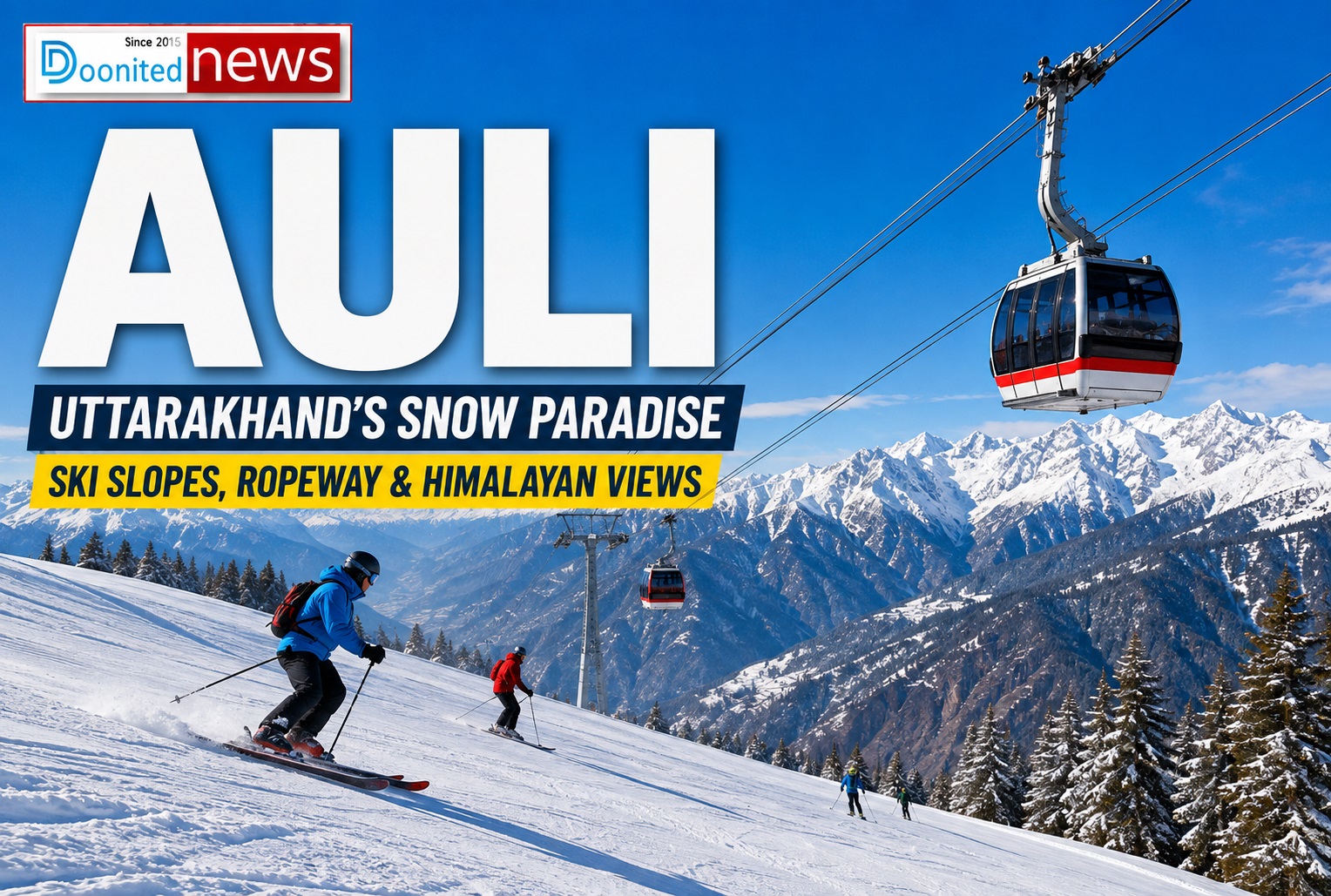
Auli: Uttarakhand’s Snow Paradise Where the Himalayas Become a Skiing Playground
By Doonited News | Travel & Adventure Uttarakhand
High above the Alaknanda valley in Uttarakhand’s Chamoli district lies a destination that looks completely different when winter arrives.
Green alpine slopes disappear beneath snow. Oak and conifer forests turn white. Cable cars move high above the mountainside, and skiers begin carving trails across the Himalayan slopes.
This is Auli — one of India’s best-known skiing destinations and one of the most spectacular winter landscapes in Uttarakhand.
Situated at around 2,800 metres above sea level, Auli offers something relatively unusual in Indian tourism: a combination of high-altitude skiing, Himalayan panoramas, cable-car journeys, trekking and quiet mountain scenery within the same destination. Uttarakhand Tourism describes Auli as India’s premier ski resort destination and recommends January to March particularly for skiing enthusiasts.
But Auli is much more than a place to see snow.
Its story is also connected with the development of adventure tourism in Uttarakhand and the transformation of a Himalayan training landscape into a nationally recognised ski destination.
Why Is Auli Famous for Skiing?
Auli’s greatest natural advantage is its terrain.
The high-altitude slopes receive winter snow and provide long stretches suitable for skiing. According to Uttarakhand Tourism, Auli was originally developed as a paramilitary training base, and its slopes subsequently became popular with both recreational visitors and professional skiers.
The official tourism portal describes snow-covered skiing terrain extending for several kilometres, with facilities for beginners as well as experienced skiers. Ski training and equipment rental are also available seasonally.
For someone who has never skied before, Auli can therefore be more than a sightseeing trip.
It can be an introduction to an entirely different form of Himalayan adventure.
January to March: The Classic Skiing Season
If the purpose of the journey is specifically skiing, timing matters.
Uttarakhand Tourism identifies January to March as the preferred period for skiing enthusiasts, while another official tourism article describes late November through March as the broader winter skiing period. Actual snow conditions can naturally vary from year to year.
That distinction is important for travellers.
Auli is a natural mountain destination, not an indoor ski resort. Snowfall, road conditions, visibility and operational status of lifts or ropeways can change with weather.
Anyone travelling specifically for skiing should therefore check current snow and operational conditions immediately before departure.
The Auli Ropeway: A Journey Above the Himalayas
Even visitors who have no intention of skiing often come to Auli for another famous experience — the ropeway from Joshimath towards Auli.
Uttarakhand Tourism describes it as one of India’s highest and longest ropeways, covering approximately 4 km through spectacular mountain scenery. An official trekking itinerary gives a more precise distance of 3.96 km.

The attraction is not simply transportation.
As the cable car climbs, the landscape opens beneath the passengers. Forests, valleys and mountain slopes gradually fall away while enormous Himalayan peaks appear across the horizon.
On a clear winter day, the journey can become one of the defining experiences of visiting Auli.
Auli ropeway cabin suspended above snowy slopes with Himalayan peaks in the distance.
Standing Before Nanda Devi
Auli’s snow is only part of its appeal.
The destination also offers views towards some of the great peaks of the Garhwal Himalayas.
Most prominent among them is Nanda Devi, rising to 7,816 metres and recognised as India’s second-highest mountain. Uttarakhand Tourism specifically highlights Auli’s panoramic views towards Nanda Devi.
Other Himalayan peaks visible from the broader landscape can include Trishul, Dunagiri and Kamet, depending upon location and weather conditions.
This changes the character of the destination.
You are not simply skiing down a snowy hill.
You are skiing within one of the world’s great mountain systems.
Gorson Bugyal: Beyond the Ski Slopes
Auli is equally interesting when visitors move away from its principal ski area.
Nearby Gorson Bugyal, also written Gurson Bugyal, is a high-altitude meadow surrounded by oak and conifer forest.
Uttarakhand Tourism places it at around 3,056 metres and approximately 3 km from Auli. In summer it becomes a green alpine meadow; in winter snow changes it into an entirely different landscape.
It is also considered an accessible trekking destination, although winter trekking conditions should never be underestimated.
Auli Artificial Lake
Another recognisable feature of Auli is its artificial lake.
The lake forms part of the ski-resort landscape and becomes particularly photogenic when the surrounding terrain is covered with snow.
The official Uttarakhand Tourism destination page describes it as accessible via the cable-car area and highlights its striking appearance against the surrounding slopes.
From Military Training Ground to Adventure Destination
Auli’s development as a skiing centre also has an interesting modern history.
Before becoming a major tourist ski destination, the terrain was used for training by the Indo-Tibetan Border Police, according to Uttarakhand Tourism.
That connection makes geographical sense.
Snow, altitude, cold temperatures and difficult mountain terrain create exactly the sort of conditions in which personnel operating in high Himalayan environments require specialised training.
Over time, the same landscape developed another identity.
Today, instead of being known primarily as a difficult high-altitude training environment, Auli has become one of the places most strongly associated with Indian skiing.

Auli Is Not Only a Winter Destination
Snow dominates photographs of Auli, but the destination does not disappear when winter ends.
When temperatures rise, white slopes become green meadows.
Trekking replaces skiing.
Forests and bugyals become the main attraction, and routes around Auli connect travellers with landscapes such as Gorson Bugyal and the wider Garhwal Himalayan trekking network.
Auli also functions as a gateway towards the broader region associated with the Nanda Devi and Valley of Flowers National Parks, Hemkund Sahib and other important Himalayan destinations.
So there are effectively two very different Aulis.
Winter Auli is snow, skiing and cable cars.
Summer Auli is meadows, forests and trekking.
How to Reach Auli
Most road journeys towards Auli pass through Joshimath, approximately 14–16 km away depending on the route and reference point. Travellers can continue towards Auli by road when conditions permit, while the ropeway provides another connection when operational.
For air travellers, Uttarakhand Tourism lists Jolly Grant Airport near Dehradun as the closest major airport, roughly 286 km away.
The road journey into Chamoli is long, but it is also part of the Himalayan experience.

Joshimath and the surrounding mountain valley photographed from a high viewpoint.
Caption: Joshimath serves as the principal gateway for travellers heading towards Auli.
Before Planning a Winter Trip
Winter in the Himalayas should never be treated casually.
Heavy snowfall can affect roads and local transportation. Ropeway and ski operations can be influenced by weather and technical conditions, and mountain visibility can change quickly.
Travellers should therefore check current road, snow and ropeway information before departure rather than relying solely on an itinerary prepared weeks earlier.
Beginners attempting skiing should use trained instructors and appropriate equipment.
Warm layered clothing, suitable footwear, gloves, eye protection and weather preparation are practical necessities rather than optional extras.
Why Auli Matters to Uttarakhand Tourism
Uttarakhand is internationally recognised for pilgrimage destinations such as Kedarnath and Badrinath, spiritual centres such as Rishikesh and Haridwar, and natural treasures such as the Valley of Flowers.
Auli adds something different to that identity.
Adventure.
It demonstrates that Uttarakhand’s mountains are not only landscapes to admire or sacred places to visit. They can also support carefully managed outdoor experiences such as skiing and trekking.
This diversification matters because it allows travellers to discover different dimensions of the state.
Where Winter Changes the Mountains
Perhaps the best way to understand Auli is to see it before and after snowfall.
Without snow, there are mountains, forests and high-altitude meadows.
Then winter arrives.
The landscape turns white.
Cable cars begin travelling above snow-covered forests.
Skiers appear on the slopes.
Nanda Devi rises beyond them.
And an isolated Himalayan meadow becomes one of India’s most distinctive winter destinations.
For some visitors, Auli means skiing.
For others, it is the ropeway.
For photographers, it may be the mountains.
And for someone experiencing Himalayan snow for the first time, simply standing there may be enough.
That is the attraction of Auli — a place where winter does not merely change the weather. It transforms the entire landscape.