
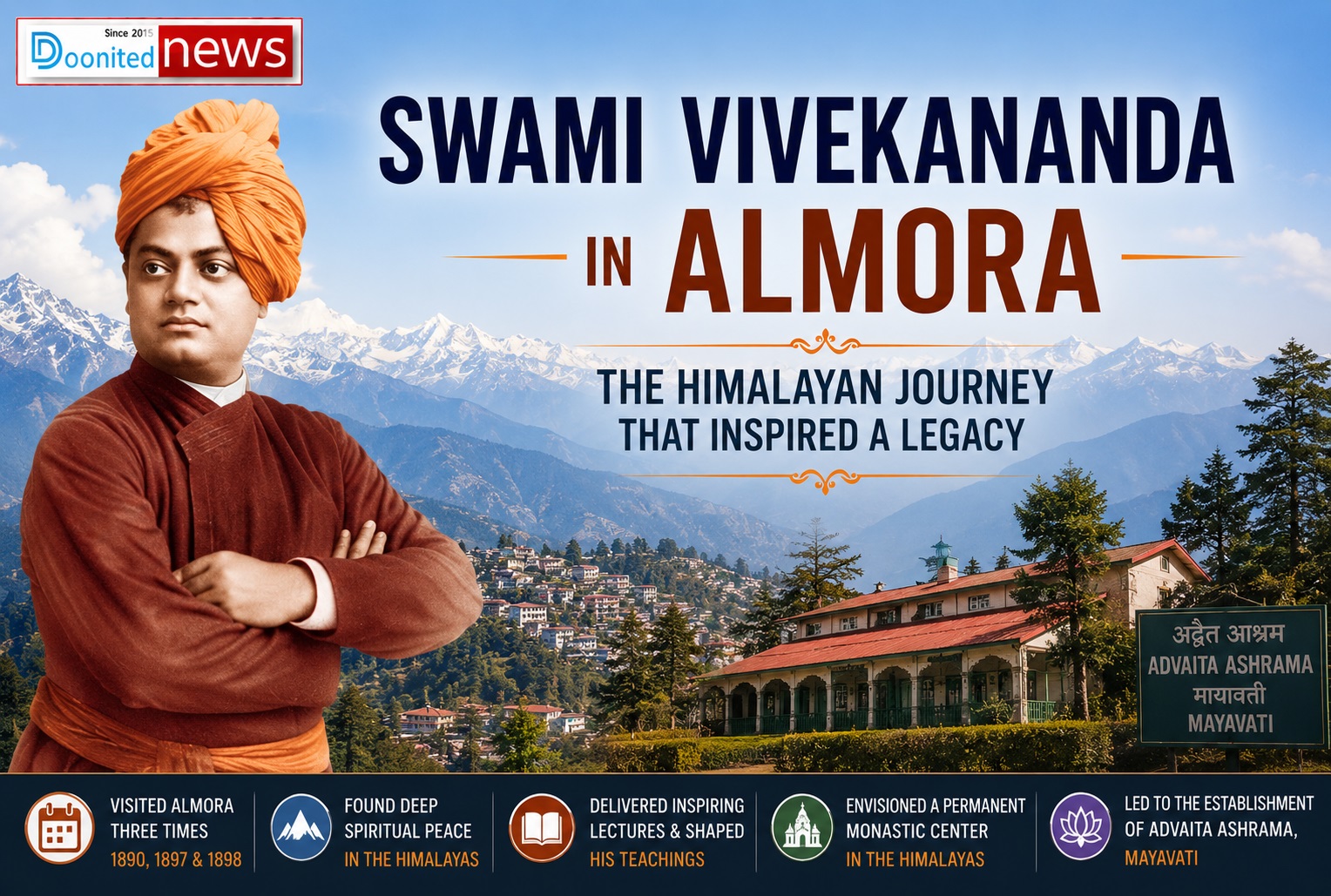
Swami Vivekananda in Almora: The Himalayan Journey That Inspired a Spiritual Legacy
By Doonited News | Spiritual & Heritage Uttarakhand

There are places that become famous because a great personality visited them. And then there are places that seem to become part of that person’s inner journey.
For Swami Vivekananda, Almora and the Kumaon Himalayas belonged to the second category.
Long before Uttarakhand became a separate state, Vivekananda travelled through these Himalayan mountains as a wandering monk. He returned after becoming internationally famous following his 1893 address at the World’s Parliament of Religions in Chicago. The Himalayas remained deeply connected with his vision of renunciation, contemplation and Advaita Vedanta.
Accounts preserved within the Ramakrishna-Vivekananda tradition document three important visits by Vivekananda to Almora. Advaita Ashrama today even publishes a dedicated work, Swami Vivekananda’s Three Visits to Almora, documenting their importance.
But the story goes beyond three visits.
It ultimately leads from Almora to Mayavati in present-day Champawat district, where Vivekananda’s dream of a Himalayan centre devoted to Advaita took institutional form.
The Himalayas Called to Vivekananda
For Vivekananda, the Himalayas were not simply beautiful mountains.
They represented something fundamental to India’s spiritual tradition — tyaga, or renunciation, and yoga.
Official history maintained by Advaita Ashrama records his strong attraction to the Himalayas and describes them as the land of renunciation and yoga.
This helps explain why Kumaon became so significant in his life.
Before he became the celebrated monk recognized around the world, Vivekananda had travelled extensively across India. His Himalayan journeys belonged to this larger period of spiritual exploration and direct engagement with Indian society.
First Almora Journey: 1890
In 1890, the man who would later become internationally known as Swami Vivekananda was still living largely the life of a wandering monk.
The Himalayas offered precisely the environment that generations of Indian seekers had sought: mountains, solitude, austerity and distance from ordinary worldly life.
Almora therefore entered Vivekananda’s story before Chicago made him famous.
This distinction is important.
His relationship with the Himalayas was not created by celebrity. It was rooted in his earlier spiritual life.

He Returned to India as a National Figure
Everything had changed by the time Vivekananda returned to the region in 1897.
His speeches at the World’s Parliament of Religions in Chicago in September 1893 had brought him international recognition. He subsequently spent years teaching Vedanta in the United States and Britain before returning to India in January 1897.
His journey through India after returning became a remarkable public event.
From Colombo northwards, Vivekananda delivered a series of influential addresses concerning Indian civilization, spirituality, national regeneration and the condition of ordinary people.
Those addresses were later collected under the famous title Lectures from Colombo to Almora.
Almora therefore occupies a literal place in one of the best-known collections of Vivekananda’s Indian lectures.
Almora and Vivekananda’s Vision for India
Vivekananda’s message during this period was not simply a call to withdraw from society in search of personal enlightenment.
His interpretation of spirituality increasingly connected religious realization with human welfare.
According to the official biographical account maintained by Advaita Ashrama, his lectures after returning to India sought to awaken pride in India’s cultural heritage, emphasize the underlying unity of Hindu traditions and focus educated Indians’ attention on the condition of disadvantaged people through what he described as Practical Vedanta.
This is an important part of the Almora story.
The mountains represented contemplation and renunciation, but Vivekananda’s mission also demanded action.
His spirituality increasingly connected the monastery with the world outside it.
The Dream of a Himalayan Monastery
One of the most fascinating aspects of this history is that Vivekananda wanted something permanent in the Himalayas.
He did not merely want to visit.
Evidence preserved by Advaita Ashrama shows that as early as 1896, he was actively considering establishing a monastery around Almora.
In a letter dated 5 August 1896, Vivekananda asked his friend Lala Badri Sah about suitable property near Almora where a monastery with a garden might be established.
The dream was remarkably specific.
He wanted a secluded Himalayan environment suitable for spiritual life.
The idea would eventually become reality — although not in Almora town itself.
Captain and Charlotte Sevier Enter the Story
Among the Westerners strongly influenced by Vivekananda were Captain James Henry Sevier and Charlotte Sevier.
The couple had met Vivekananda in England and became devoted followers. Advaita Ashrama records them among the people instrumental in realizing his Himalayan vision.
After Vivekananda’s return to India, the search for an appropriate location intensified.
In Almora, Vivekananda inspired the Seviers and his monastic disciple Swami Swarupananda to search for a place where an ashrama dedicated specifically to Advaita could be created.
Eventually, they found an extraordinary location.
Mayavati.

Mayavati: The Dream Becomes Reality
Mayavati lies near Lohaghat in today’s Champawat district of Uttarakhand.
Advaita Ashrama describes the location as approximately 6,400 feet above sea level, surrounded by mountains on three sides and opening toward magnificent views of the snow-covered Himalayan range.
It was here that Vivekananda’s idea of a Himalayan centre devoted to Advaita finally materialized.
Advaita Ashrama was inaugurated in March 1899 and was recognized as a branch of Belur Math.
Its purpose was distinctive: the study, practice and dissemination of Advaita Vedanta.
Even today, Mayavati maintains that contemplative identity. The Ashrama states explicitly that it has no temple or temple-centred devotional activities because the centre is dedicated particularly to spiritual practice and meditation.
That makes Mayavati quite different from many of Uttarakhand’s better-known religious destinations.
Vivekananda Finally Came to Mayavati
There is an important chronological detail worth clarifying.
Although Vivekananda’s Almora experiences helped inspire the search for the Himalayan centre, Advaita Ashrama was established in 1899, and Vivekananda himself visited Mayavati in January 1901.
He remained there for about a fortnight.
The Main Building in which he stayed has subsequently been preserved as part of Mayavati’s heritage. Advaita Ashrama reported restoration and conservation of the historic structure in 2022.
So a spiritual aspiration that had occupied Vivekananda for years eventually acquired a physical home among Uttarakhand’s mountains.

Almora, 1898 and Prabuddha Bharata
Vivekananda’s later stay in Almora also became connected with another institution that would carry his intellectual legacy around the world: Prabuddha Bharata, meaning Awakened India.
The English-language journal had originally begun publication in Chennai in July 1896.
After its editor B. R. Rajam Iyer died, the journal’s future became uncertain.
Advaita Ashrama’s historical account records that Vivekananda, while resting in Almora following his nation-awakening tour, asked Captain and Mrs. Sevier to revive the journal.
Eventually, Prabuddha Bharata became intimately associated with Mayavati.
This gives the Vivekananda-Almora connection an important intellectual dimension.
The Himalayas were not merely somewhere to retreat from the world.
Ideas were being prepared there to travel back into it.
A Centre Where East and West Could Meet
Mayavati embodied another important feature of Vivekananda’s mission.
His journey to the West had convinced him that Vedanta could speak across national and cultural boundaries.
Advaita Ashrama describes Mayavati as becoming a meeting place for minds from both East and West while producing an extensive body of literature concerning Vedanta, Sri Ramakrishna, Sarada Devi and Vivekananda.
The Ashrama also became historically important for publishing.
Early editions of Vivekananda’s works and literature concerning his life were published from Mayavati, alongside Prabuddha Bharata.
From a quiet corner of the Kumaon Himalayas, books and ideas began travelling far beyond Uttarakhand.

Why the Himalayas Mattered So Much
Perhaps the deeper question is not how many times Vivekananda visited Almora.
It is why he kept returning to the Himalayas in thought and in life.
The answer lies partly in Advaita.
Advaita Vedanta teaches, at its deepest level, the non-dual reality underlying existence. Vivekananda transformed this philosophical tradition into a powerful modern message about the divinity inherent in human beings and the essential spiritual unity underlying apparent differences.
The vast Himalayan landscape provided an extraordinary setting for contemplation of those ideas.
But Vivekananda did not ultimately advocate spirituality divorced from human suffering.
The organization he founded, the Ramakrishna Mission, formally established on 1 May 1897, combined spiritual ideals with education, medical work, relief, rehabilitation and other forms of service.
That combination — contemplation and service — became central to his legacy.
Uttarakhand’s Place in the Vivekananda Story
Uttarakhand is usually introduced through ancient sacred geography.
Kedarnath.
Badrinath.
Gangotri.
Jageshwar.
The Panch Kedar.
But its modern spiritual history is equally fascinating.
Swami Vivekananda’s relationship with Almora and the Kumaon Himalayas demonstrates that Uttarakhand continued to influence major religious thinkers well into the modern era.
The region gave Vivekananda something difficult to measure statistically: a landscape in which his spiritual vision could find both silence and direction.
And from his vision emerged a permanent Himalayan institution.

From Almora to Mayavati — A Living Legacy
Today a traveller can stand in Almora and look across the same Himalayan landscape that fascinated Vivekananda more than a century ago.
Farther east, at Mayavati, his dream of an Advaita monastery continues.
The mountains remain.
The Ashrama remains.
Prabuddha Bharata continues to be published.
And Vivekananda’s writings continue travelling to readers around the world.
That may be the most remarkable part of this Uttarakhand story.
Swami Vivekananda came to the Himalayas searching for spiritual depth. His encounter with the region helped inspire something permanent — a Himalayan centre dedicated not simply to remembering his teachings, but to studying and carrying forward the philosophy that shaped them.
For Almora and Uttarakhand, that connection is an important chapter in India’s modern spiritual heritage.