
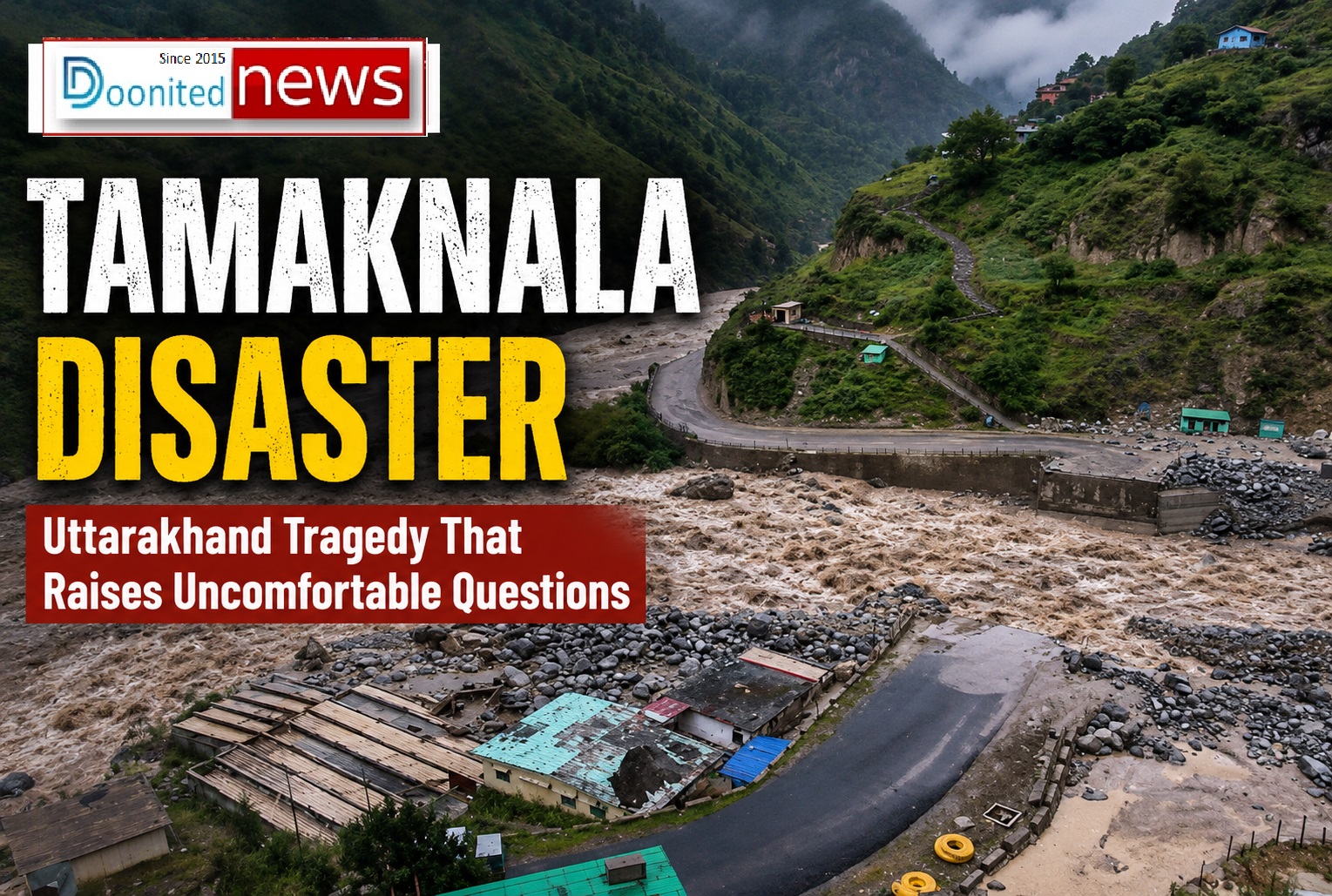
Tamaknala Disaster, Uttarakhand: The Mountain Tragedy That Raises Uncomfortable Questions
Doonited News | Uttarakhand | Editorial Feature
Tamaknala, Uttarakhand: When a mountain stream turns into a raging torrent, it is easy to call it a natural disaster. Yet after every major tragedy in Uttarakhand, one question returns with greater force: was it only nature, or did human negligence deepen the devastation?
The recent disaster in the Tamaknala region has once again exposed the fragile reality of life in the Himalayan hills. Torrential rain, sudden flooding and collapsing slopes transformed a peaceful mountain settlement into a landscape of destruction within hours. Roads were washed away, houses were damaged and families spent the night searching for missing relatives and safe shelter.
A Night of Fear in the Himalayas

Illustrative images not real
Residents describe a terrifying sequence: intense rainfall, the roar of water from the hills, power outages and then the sudden arrival of debris-laden floodwater. In many places, people had only minutes to escape. For mountain communities, disasters do not arrive as distant headlines; they arrive at the doorstep in darkness and rain.
By morning, the valley had changed. Footpaths disappeared, retaining walls collapsed and sections of road were left hanging over eroded slopes.
Why This Disaster Was Not Entirely Unexpected

Illustrative images not real
Officials often describe such events as unprecedented, but local people have repeatedly warned about unstable slopes, blocked drains and construction near seasonal streams. The Himalayas are geologically young and fragile. Heavy rain is a trigger, but vulnerability is frequently created by human decisions.
The critical question is not whether it rained heavily. The critical question is why the landscape was unable to absorb and safely channel that rainfall.
Encroachment Along Natural Water Channels

Illustrative images not real
Many Himalayan streams remain almost dry for much of the year, creating a dangerous illusion of safety. During cloudbursts, however, they become violent torrents carrying water, mud and boulders. Construction near these channels greatly increases the risk to life and property.
Experts have long argued that floodplains and debris-flow paths should remain free from permanent structures, yet pressure for land and development continues to push settlements closer to hazardous zones.
Road Cutting and Slope Instability

Illustrative images not real
One of the most visible contributors to mountain instability is unscientific road construction. Slopes are often cut steeply without adequate retaining walls, rock support or drainage planning. During intense rainfall, these weakened slopes fail, sending soil and rock onto roads and settlements below.
In several Himalayan districts, repeated landslides have occurred on recently cut road sections, raising serious questions about engineering standards and monitoring.
Drainage Failure: The Hidden Disaster

Illustrative images not real
Blocked culverts, undersized drains and poorly maintained storm-water channels can turn heavy rain into a destructive force. When water cannot pass through designed pathways, it seeks new routes—often through roads, fields and homes.
Mountain drainage systems require constant maintenance, especially before the monsoon. Neglecting them can multiply the impact of extreme rainfall.
Climate Change Is Intensifying Extreme Rainfall

Illustrative images not real
Scientists increasingly warn that the Himalayan region is experiencing more frequent extreme rainfall events. Warmer atmospheric conditions allow more moisture to accumulate, which can then be released in short, intense bursts. Infrastructure designed for older rainfall patterns may no longer be adequate.
Climate change does not eliminate the role of poor planning; it magnifies the consequences of that planning.
The Human Cost Beyond the Numbers

Illustrative images not real
Disaster reports count damaged houses and blocked roads, but they rarely capture the deeper losses: children afraid to sleep during rain, farmers who lose an entire season’s income, elderly residents cut off from medical care and families who must rebuild their lives from scratch.
For many mountain households, a single disaster can erase years of savings and hard work.
A Pattern That Keeps Repeating
Uttarakhand has witnessed a troubling cycle:
-
warning signs are ignored,
-
extreme rain arrives,
-
rescue operations begin,
-
compensation is announced,
-
committees are formed,
-
public attention fades,
-
another disaster occurs.
This pattern suggests not merely a natural problem but a governance problem. A mountain state cannot rely primarily on relief after destruction; it must invest in prevention before destruction occurs.
What Must Change Now

Illustrative images not real
Scientific hazard mapping
Every settlement near streams and unstable slopes should be mapped using modern geotechnical and hydrological studies.
Strict construction regulation
No permanent construction should be allowed within scientifically identified flood and debris-flow zones.
Safe road engineering
Slope stabilization, retaining structures and drainage must be treated as essential infrastructure, not optional additions.
Community-based warning systems
Local residents often detect unusual water flow or slope movement before officials do. Their observations should be integrated into formal warning networks.
Transparent technical audits
After major disasters, independent experts should evaluate whether roads, drains and protective structures met approved standards.
Development Must Respect the Mountains

Illustrative images not real
Uttarakhand needs roads, tourism, electricity and connectivity. The real debate is not development versus environment; it is reckless development versus safe development. A road that collapses every monsoon is not development. A hotel built in a flood path is not development. A drainage system that fails during the first extreme storm is not development.
True development in the Himalayas is infrastructure that respects geological limits and protects human life.
The Mountains Are Warning Us

Illustrative images not real
After the floodwaters recede, the mountains fall silent again. But that silence hides fractured slopes, weakened foundations and unresolved risks. The people of Tamaknala do not need sympathy alone; they need assurance that their tragedy will lead to real change.
The Tamaknala disaster should be treated as a warning for all of Uttarakhand. Extreme rainfall may be unavoidable, but large-scale vulnerability is not. If unsafe construction, poor drainage and weak enforcement continue, future tragedies will be consequences, not surprises.
The mountains have spoken repeatedly through floods, landslides and cloudbursts. The real question is whether we are finally prepared to listen.