
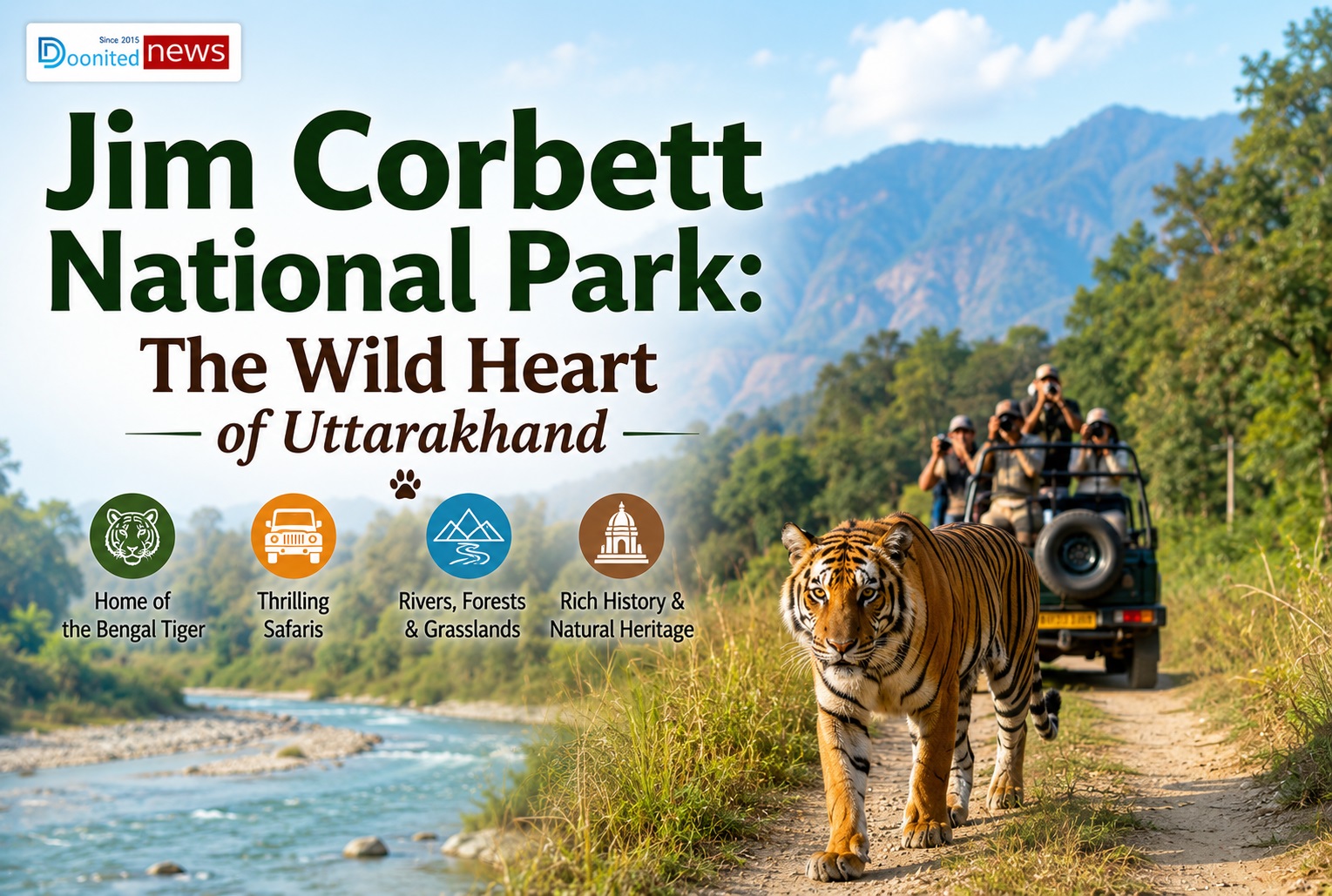
Jim Corbett National Park: The Wild Heart of Uttarakhand Where History, Safari and Adventure Meet
By Doonited News | Travel Uttarakhand
At dawn, the forest is almost silent. Mist rises from the Ramganga River, deer step cautiously into the grasslands, and somewhere deep inside the sal forest a peacock calls. Then the safari jeep stops. Every head turns toward the trees.
This is Jim Corbett National Park, India’s oldest national park and one of the country’s greatest wildlife landscapes.
Established in 1936 as Hailey National Park in the Nainital district of present-day Uttarakhand, Corbett is far more than a tiger reserve. It is a place where wildlife, Himalayan foothills, colonial history, rivers, forests and family adventure come together in a single unforgettable journey.
India’s First National Park
The story of Corbett begins in the British era. In 1936, the area was protected as Hailey National Park, making it the first national park in India. After Independence, it was renamed in honour of Jim Corbett, the famous hunter-turned-conservationist who later became one of the strongest voices for wildlife protection.

Corbett’s transformation from a hunter of man-eating tigers to a passionate conservationist mirrors the larger story of India’s changing relationship with wildlife. His writings introduced millions of readers to the beauty and complexity of the Kumaon forests.
Today, his name remains inseparable from the park.
A Forest That Feels Endless
Corbett spreads across a remarkable variety of habitats: sal forests, riverine belts, grasslands, marshes and foothill valleys. This diversity is the secret behind its extraordinary wildlife.

Driving through the park, the scenery changes constantly. Dense forest suddenly opens into golden grasslands, and a quiet river bend appears where elephants may be drinking.
For photographers, every kilometre offers a new composition.
The Thrill of a Corbett Safari
The most famous experience is the jeep safari. Visitors enter designated tourism zones such as Dhikala, Bijrani, Jhirna and Dhela, accompanied by trained guides.

The excitement is not only about seeing a tiger. Guides teach visitors to read the forest: fresh pugmarks on the road, alarm calls of langurs, disturbed grass, or the sudden silence of birds.
Even without a tiger sighting, the safari feels like an expedition into a living wilderness.
Tigers, Elephants and More
Corbett is internationally famous for the Bengal tiger, but the park supports an entire ecosystem of wildlife.
Commonly Seen Wildlife
-
Bengal tiger
-
Asian elephant
-
Spotted deer (chital)
-
Sambar deer
-
Wild boar
-
Gharial and mugger crocodile
-
Otters
-
Leopard (less frequently seen)
-
More than 500 species of birds

For many visitors, the first sight of a wild elephant emerging from the forest is every bit as thrilling as a tiger encounter.
The Ramganga River: Corbett’s Lifeline
Flowing through the heart of the park, the Ramganga River is the ecological lifeline of Corbett. It sustains fish, crocodiles, birds and mammals throughout the year.

At sunrise, the riverbanks become especially beautiful. Kingfishers flash blue across the water, egrets hunt in the shallows, and mist drifts above the current.
Many photographers consider the Ramganga at dawn the most magical scene in Corbett.
Fun Beyond Wildlife
Corbett is also one of Uttarakhand’s most family-friendly destinations. Around Ramnagar, visitors can enjoy:
-
Riverside resorts
-
Nature walks
-
Birdwatching trails
-
Corbett Museum
-
Village experiences
-
Campfire evenings (outside the core forest area)

Children often enjoy learning animal tracks, spotting birds and listening to forest stories from local guides.
Dhikala: The Legendary Zone
Among all tourism zones, Dhikala holds a special place in the imagination of wildlife lovers. Vast grasslands stretch toward the Ramganga reservoir, creating dramatic open landscapes rarely seen elsewhere in India.

Staying inside the Dhikala forest rest house area is considered one of the classic Indian wildlife experiences.
A Paradise for Birdwatchers
With hundreds of recorded bird species, Corbett is a major birding destination.

Crested serpent eagles soar above the forest, hornbills move through the canopy, and kingfishers patrol the riverbanks. Winter brings additional migratory species, making the park attractive throughout much of the year.
The Corbett Museum
In Kaladhungi, the former home of Jim Corbett has been converted into a museum displaying photographs, personal belongings and historical material related to his life and conservation work.

The museum adds an important historical dimension to a wildlife trip, reminding visitors that conservation is built not only on forests but also on ideas and public awareness.
The Best Time to Visit
Corbett is generally most popular during the cooler and drier months, when wildlife viewing is easier and outdoor activities are more comfortable. Some zones may close during the monsoon season, so visitors should always check current park regulations before planning travel.
Responsible Safari Tourism
Corbett’s popularity also brings responsibility. Forest authorities emphasize:
-
Maintain silence during safaris
-
Do not feed wildlife
-
Avoid littering
-
Stay inside designated tourism areas
-
Follow guide and forest staff instructions
-
Respect animal movement and viewing distances
The future of Corbett depends on visitors treating the forest as a protected home for wildlife rather than an amusement park.
Why Corbett Still Captivates India
Nearly ninety years after its creation, Jim Corbett National Park continues to capture the imagination of travellers because it offers something increasingly rare: a genuine sense of wilderness.
Here, history is not confined to museums, adventure is not manufactured, and nature still determines the rhythm of the day.
As the safari jeep leaves the forest and evening light falls across the Ramganga, visitors often realize that the true magic of Corbett is not only the possibility of seeing a tiger. It is the feeling of having entered a landscape where the wild still has the final word.
Jim Corbett National Park remains the wild heart of Uttarakhand—a place where history, safari, rivers and forests come together to tell the enduring story of India’s wilderness.