
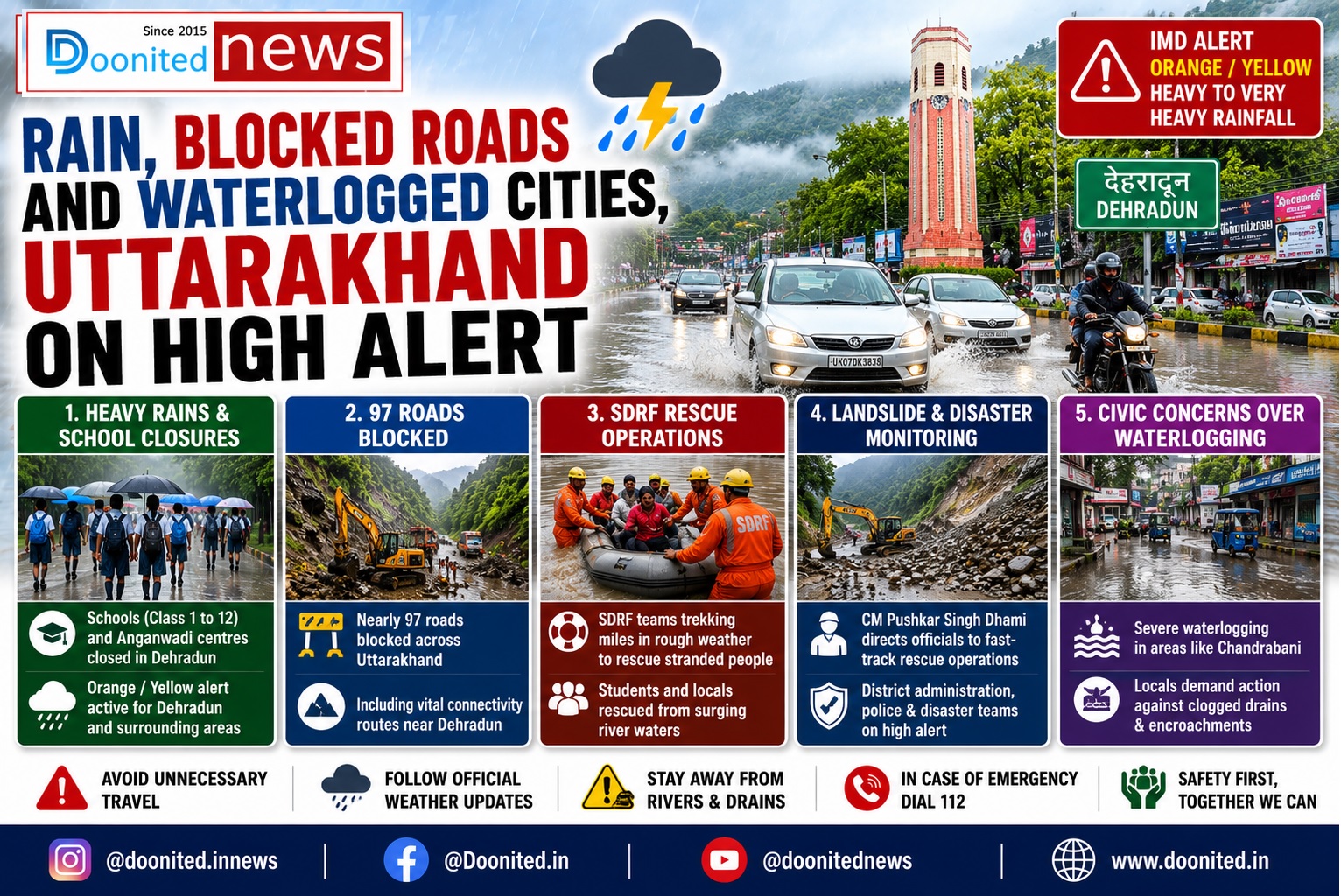

Uttarakhand on High Alert: Rain, Blocked Roads and Waterlogged Cities Test the State’s Disaster Preparedness
Doonited News | Uttarakhand | Editorial | 19 August 2026

Dehradun: Uttarakhand is once again confronting the full force of the monsoon. Heavy rainfall, swollen streams, landslides, blocked roads and waterlogging are disrupting daily life across the state, while disaster-response teams remain on alert.
The India Meteorological Department has forecast continued rainfall activity across Uttarakhand, including isolated heavy rain in several districts and thunderstorms with lightning and intense to very intense spells of rain in other parts of the state. The latest district forecast also warns of the possibility of overflowing rivulets and streams, inundation of low-lying areas and landslides or rockfalls in vulnerable locations.
But this year’s monsoon story is no longer simply about how much rain has fallen.
It is about whether Uttarakhand’s roads, drainage systems, towns and emergency-response mechanisms can withstand what the rain is exposing.
Roads Blocked, Connectivity Under Pressure
Reports of nearly 97 roads being blocked because of rain and landslide debris underline the vulnerability of Uttarakhand’s road network. The figure should be treated as a reported operational count that can change rapidly as roads are opened and new blockages occur.
For a Himalayan state, a blocked road is much more than an inconvenience.
It can delay an ambulance.
It can isolate a village.
It can prevent schoolchildren from reaching home.
It can interrupt food and medicine supplies.
And during a major emergency, it can slow the very rescue teams needed to save lives.

The recurring pattern deserves serious attention: rain triggers a slope failure, debris reaches the road, traffic stops, heavy machinery is mobilised and the road is eventually reopened.
But reopening a road is not the same as making it resilient.
If the same locations repeatedly fail, Uttarakhand needs permanent engineering and geological solutions rather than a system that relies primarily on post-landslide clearance.
Schools Closed: The Right Precaution, But Only the Beginning
During periods of severe weather, district administrations have used school closures as a precautionary measure. Dehradun, for example, has previously ordered one-day closures of Classes 1–12 and Anganwadi centres when heavy rainfall was forecast, while the Chief Minister directed disaster-management agencies to remain on high alert.
The logic is straightforward.
A school bus travelling through a waterlogged road is a risk.
A child walking beside an overflowing drain is a risk.
A vehicle travelling through a landslide-prone mountain stretch is a risk.
Keeping children at home during a dangerous weather window is therefore not a holiday decision. It is risk management.
But the administration should also ensure that such decisions are communicated early enough for parents, schools and transport operators to respond safely.
The objective should always be prevention rather than evacuation after something goes wrong.
Pauri and Other Hill Districts: Weather Does Not Respect Administrative Boundaries
The challenge becomes even greater in hill districts such as Pauri Garhwal, where steep terrain, narrow roads and dispersed settlements make the consequences of heavy rain potentially more severe.
The IMD’s current forecast continues to identify Pauri among the districts where isolated heavy rainfall is possible.
For children and teachers in remote mountain areas, the journey to school can itself become a safety concern.
A short spell of intense rain can change the condition of a road, stream or slope within minutes.
This is why district-level weather alerts need to translate into local, route-specific decisions, rather than simply becoming another warning on a government website.
SDRF: The Men and Women Who Enter When Others Are Told to Stay Away

When roads disappear under debris and rivers rise unexpectedly, the State Disaster Response Force becomes one of the most visible faces of government.
A July rescue near Santla Devi Temple in Dehradun demonstrated the danger. Seven people became stranded on an island-like stretch in a swollen river after the water level rose rapidly during continuous rain. SDRF personnel reached them and brought them to safety.
These operations illustrate a basic truth about Uttarakhand:
Disaster response in the mountains is itself dangerous.
Rescuers may have to travel through difficult terrain, cross unstable ground and work beside rapidly flowing water.
That is why the state’s decision to maintain SDRF and other emergency agencies on high alert during periods of severe weather is essential. The Chief Minister has previously directed SDRF, NDRF and district administrations to maintain maximum vigilance during heavy-rain episodes.
But there is an important distinction:
A strong rescue force is necessary. A society that needs fewer rescues is better.
Chandrabani: When Waterlogging Becomes a Civic Failure

Perhaps nowhere is the difference between a natural hazard and a man-made vulnerability clearer than Chandrabani.
Residents have repeatedly complained about monsoon flooding, blocked drainage and encroachments. Recent reporting from the locality linked recurring flooding to encroachments and blocked drainage systems, with residents also pointing to the overflowing Asan river during heavy rain.
This is not merely a complaint about dirty roads.
It is a question of whether natural water channels are being allowed to perform the function for which the landscape evolved.
Dehradun has historically depended on a network of rivers, streams, seasonal channels and drainage routes. When these pathways are narrowed, covered, blocked or diverted, rainwater has nowhere to go.
It eventually finds its own route.
And that route may be through somebody’s house.
The Drainage Problem Cannot Be Solved With Pumps Alone
Dehradun’s civic authorities have deployed dewatering pumps at several vulnerable locations, including Chandrabani, Rishpana, Sahastradhara Road, ISBT and other areas. Government-backed flood-protection and river-cleaning projects are also under way at locations including the Asan, Song, Suswa and other drainage systems.
These measures matter.
But pumps are essentially a response mechanism.
They do not solve an obstructed natural drainage channel.
They do not eliminate encroachment.
They do not restore a river’s floodplain.
And they cannot substitute for a functioning storm-water network.
A more durable strategy requires mapping natural drainage channels, keeping them clear, preventing illegal obstruction and ensuring that new infrastructure does not redirect water toward residential areas.
Residents of Chandrabani and nearby areas have previously protested over concerns that highway construction and drainage arrangements were altering natural water flow and increasing flood risk.
That allegation deserves technical assessment rather than political dismissal.
Dehradun’s Open Drains: A Hidden Monsoon Hazard
There is another problem that becomes visible only when water rises.
Open drains.
Recent reporting from Dehradun documented concerns over open drains, missing covers and unprotected streams. During heavy rain, flooded roads can make it difficult for pedestrians to distinguish between a normal road surface and an open drainage channel.
This creates a particularly dangerous situation.
A pedestrian may think they are stepping into shallow water.
There may actually be an open drain beneath it.
That is not simply a weather hazard.
That is an infrastructure-safety failure.
The Real Question: Is Uttarakhand Prepared—or Merely Responsive?
The state has disaster-response teams.
It has weather forecasting.
It has district administrations.
It has dewatering pumps.
It has excavators.
It has emergency control rooms.
It has police and SDRF personnel.
Yet every monsoon, the same vulnerabilities return.
That should force a larger policy discussion.
Uttarakhand needs five permanent priorities:
1. Map every major natural drainage channel.
No urban development plan should ignore the historic flow of water.
2. Identify chronic landslide and flood hotspots.
These locations should receive permanent engineering attention rather than repeated emergency clearance.
3. Protect emergency access routes.
Roads used by ambulances, rescue teams and essential supplies should receive special monsoon monitoring.
4. Remove dangerous drain obstructions.
Open and covered drains must be inspected, cleaned and safely barricaded before peak rainfall.
5. Link weather alerts to local action.
An IMD warning should trigger specific decisions for schools, roads, tourism, construction and vulnerable communities.
The Cost of Ignoring the Warning Signs

The danger is that repeated disruption becomes normal.
Residents stop being surprised when roads flood.
Motorists learn which streets to avoid.
Shopkeepers move goods above floor level.
Children learn which drains are dangerous.
And authorities prepare another list of roads that need clearing.
That is not resilience.
That is adaptation to failure.
A city should not have to become accustomed to infrastructure malfunctioning every monsoon.
An Editorial Word
Uttarakhand cannot control the Himalayas.
It cannot prevent every cloudburst, every landslide or every episode of extreme rainfall.
But it can decide how vulnerable its people will be when those events occur.
The state has demonstrated that it can mobilize rescue teams quickly. It has shown that administrators can respond to emergencies and that disaster personnel are willing to work in dangerous conditions.
The next step must be to reduce the number of emergencies requiring rescue in the first place.
The monsoon is not a surprise in Uttarakhand.
It arrives every year.
The real measure of governance is therefore not how dramatically the state responds after the roads are blocked or homes are flooded.
It is whether, before the next downpour, the drains are clear, the slopes are monitored, the roads are prepared, the schools have a clear safety protocol and the natural channels of water are allowed to remain open.
Uttarakhand does not need a stronger emergency culture alone. It needs a stronger prevention culture.
Because when the rain finally arrives, it is already too late to begin preparing.