
Dehradun–Mussoorie Road: The Mountain Has Its Own Limits
Doonited News | Uttarakhand | Editorial Feature

Dehradun: The road from Dehradun to Mussoorie is more than a route to a hill station.
It is a lifeline.
Every day, residents, workers, students, traders, tourists, hotel employees and emergency vehicles use this mountain corridor. But every monsoon, the same road is forced to confront a reality that cannot be negotiated with engineering alone:
The mountain has limits.
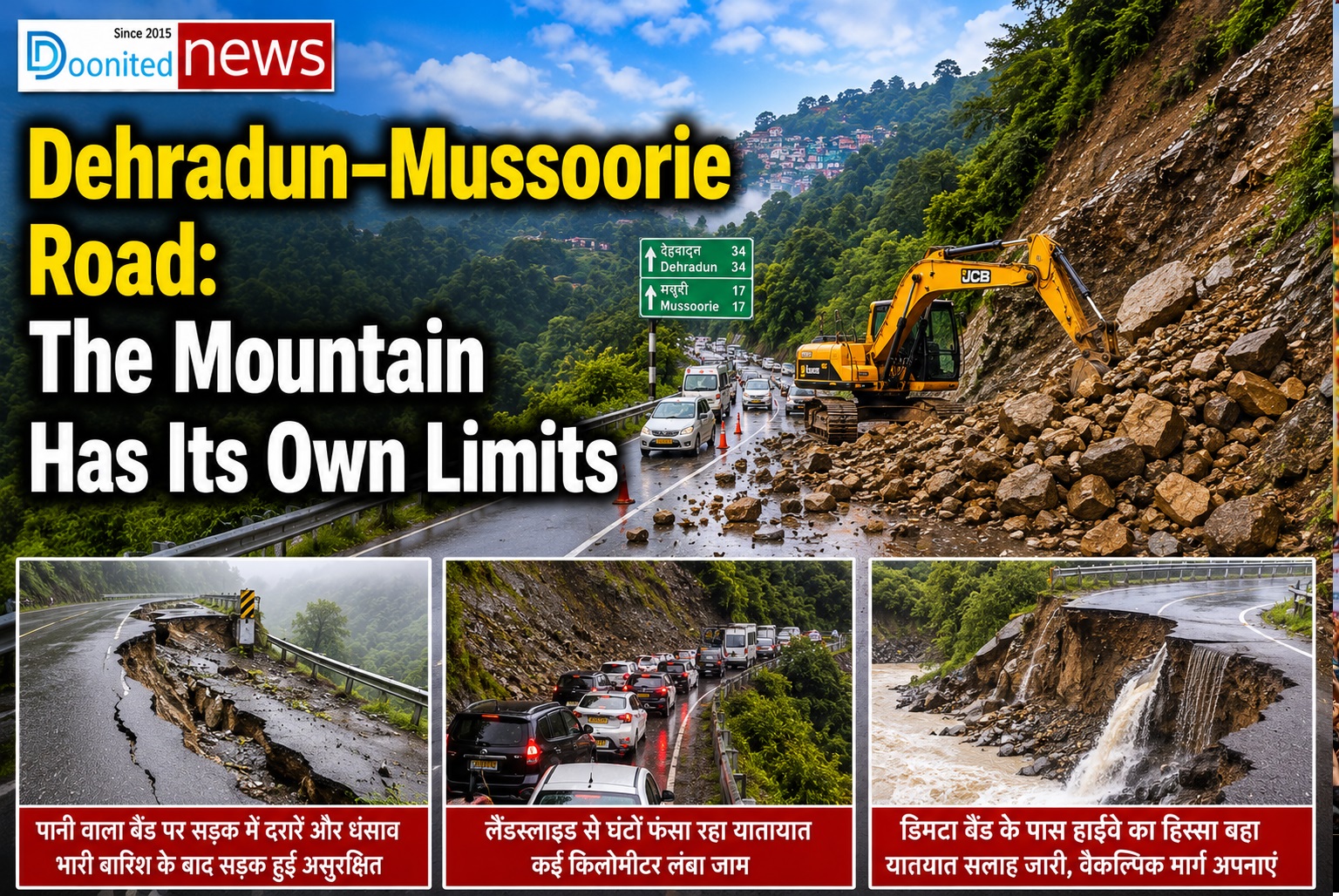
In recent weeks, heavy rain has repeatedly disrupted the Dehradun–Mussoorie corridor. A fresh landslide near Pani Wala Bend recently created a traffic snarl stretching several kilometres, with commuters reportedly trapped for hours. The Public Works Department had already been working to widen the affected passage when fresh rain triggered another slide.
Earlier, heavy rainfall caused large cracks and visible sinking near Pani Wala Bend, prompting authorities to declare the affected stretch unsafe and close it to traffic.
And on August 20, a section of the Mussoorie–Kempty Highway near Dimta Band on NH-707A was washed away after heavy rain, with Uttarakhand Police issuing a traffic advisory and asking travellers to use alternative routes.
These are not isolated inconveniences.
They are warnings.
When a Road Starts Fighting the Mountain

A mountain road is fundamentally different from a highway across a plain.
It cuts through slopes.
It depends on retaining structures, drainage and stable geological conditions.
And when prolonged rainfall saturates a hillside, water can weaken soil and rock, destabilise slopes and undermine road foundations.
That is what makes the latest damage so concerning.
At Pani Wala Bend, the road did not simply become muddy.
It developed large cracks and began sinking after heavy rain weakened the embankment beneath it. Authorities eventually declared the section unsafe.
That should change the way we think about mountain infrastructure.
A crack in a mountain road is not merely a pothole.
It can be a warning that something underneath is moving.
The JCB Can Clear the Road. It Cannot Stabilise the Mountain.
Every time a landslide blocks the road, the familiar response begins.
JCBs arrive.
Workers clear debris.
Traffic is regulated.
The road is reopened.
And everyone moves on.
That response is necessary.
But it is not always sufficient.
A road can be cleared in hours.
A slope may take years to stabilise.
This distinction matters.
If the same stretch repeatedly fails during heavy rain, the question should move beyond:
“How quickly can we clear the debris?”
It should become:
“Why is this slope repeatedly failing?”
That requires geological investigation, drainage assessment and engineering designed specifically for the terrain.
The Mountain Does Not Read the Project Schedule

There is often a tendency to measure infrastructure success by completion.
Road completed.
Bridge inaugurated.
Traffic opened.
Project delivered.
But in the Himalayas, completion is only the beginning.
The real test arrives during:
the first heavy monsoon,
the first major landslide,
the first extreme rainfall event,
and eventually—
the first decade of use.
A road that survives these tests is infrastructure.
A road that repeatedly fails under predictable seasonal conditions requires a harder examination.
Mussoorie’s Beauty Is Also Its Vulnerability
Mussoorie sits on a mountain ridge and its slopes are naturally vulnerable to landslides, rockfall and erosion during intense rainfall. Recent reporting has again highlighted the fragile nature of the terrain around the hill station.
This creates a contradiction.
The very landscape that makes Mussoorie beautiful also makes road construction difficult.
Visitors want wider roads.
Residents want better connectivity.
Businesses want uninterrupted tourist traffic.
Authorities want faster transportation.
But the mountain has its own geological limits.
You cannot negotiate with gravity.
Tourism Cannot Be Allowed to Dictate Safety

Mussoorie is one of Uttarakhand’s major tourism destinations.
During weekends and holidays, the Dehradun–Mussoorie road can carry enormous traffic.
When rain damages the road, the pressure becomes even greater.
Tourists wait.
Local residents wait.
Hotels worry about cancellations.
Commercial vehicles slow down.
Emergency vehicles face delays.
The temptation is then to reopen the road as quickly as possible.
But fast reopening must never become more important than safe reopening.
A road should reopen when engineers determine it is safe—not simply because hundreds of vehicles are waiting.

The Cost of a Road Closure Is Real
For a tourist, a two-hour delay may mean missing lunch or checking into a hotel late.
For a resident, it may mean missing work.
For a business, it can mean cancelled bookings.
For an ambulance, it can mean something far more serious.
This is why reliable mountain connectivity is not a luxury.
It is essential infrastructure.
But reliability does not mean keeping a road open at any cost.
It means creating a system in which:
- Dangerous stretches are identified early.
- Traffic is restricted before failure.
- Alternative routes are communicated.
- Emergency corridors are protected.
- Repairs are technically sound.
- Long-term slope stabilisation is prioritised.
The Recent Washout Near Dimta Band Is Another Warning
The Mussoorie–Kempty Highway incident provides another example.
On August 20, a section near Dimta Band on NH-707A was washed out following heavy rainfall. Uttarakhand Police advised travellers to use alternative routes and warned that clearance could take time.
This is precisely why monsoon travel in Uttarakhand requires a different mindset.
A journey that normally takes an hour may take several hours.
A route that was open in the morning may become unsafe in the afternoon.
A road shown as open on a map does not necessarily mean every section is safe after intense rainfall.
Weather and road conditions have to be checked together.
The Problem Is Bigger Than One Road

The Dehradun–Mussoorie corridor is only one example.
Across Uttarakhand, heavy rainfall has recently caused landslides and road blockages on several important routes. In one recent spell, heavy rain pushed rivers above danger levels while landslides disrupted key highways connecting hill districts.
The pattern is clear:
The state’s transportation network remains highly exposed to extreme weather.
This is particularly important as Uttarakhand continues to expand tourism and pilgrimage infrastructure.
More visitors mean more vehicles.
More vehicles mean greater dependence on roads.
Greater dependence on roads means greater consequences when those roads fail.

Are We Building Roads—or Building Against the Mountain?
This is where the development debate becomes uncomfortable.
Uttarakhand needs roads.
There is no question about that.
Remote communities need connectivity.
Hospitals need access.
Tourism needs transportation.
Businesses need logistics.
But the answer cannot simply be:
Cut the hill. Widen the road. Build again. Repair again.
Mountain infrastructure requires a different philosophy.
Before widening or strengthening a road, authorities need to understand:
- Slope stability
- Drainage patterns
- Rock structure
- Groundwater movement
- Landslide history
- Rainfall intensity
- Traffic load
- Debris-flow risk
The objective should not be to defeat the mountain.
The objective should be to work with it.
Drainage May Be More Important Than Asphalt
One of the least glamorous parts of road construction is often one of the most important:
drainage.
Rainwater needs somewhere to go.
If water is allowed to accumulate behind a retaining structure or beneath a road embankment, it can weaken the foundation and contribute to instability.
That is why repairing the visible road surface without addressing the water beneath it can become an expensive cycle.
Fresh asphalt may make a road look new.
It does not necessarily make the slope stable.
A Warning for Tourists

Anyone travelling from Dehradun to Mussoorie during periods of heavy rain should treat weather warnings seriously.
Before travelling:
- Check the latest weather alert.
- Check current road conditions.
- Follow Uttarakhand Police traffic advisories.
- Avoid unnecessary travel during severe rainfall.
- Do not stop near active landslide zones.
- Never park beneath visibly unstable slopes.
- Do not approach swollen streams for photographs.
- Allow extra travel time.
- Follow instructions from police and road authorities.
A holiday can be postponed.
A road accident cannot be undone.

The Mountain’s Message to Planners
The repeated failures on the Dehradun–Mussoorie route should not be treated only as temporary monsoon problems.
They should be used as data.
Every crack.
Every landslide.
Every washout.
Every rockfall.
Every road closure.
Every drainage failure.
Every emergency repair.
Together they create a map of vulnerability.
That map should guide future engineering decisions.
Instead of asking:
“Where did the road fail?”
officials should ask:
“Where is the road likely to fail next?”
That is the difference between reactive disaster management and preventive infrastructure planning.
A Road for the Next 50 Years, Not the Next Monsoon
The Dehradun–Mussoorie road is too important to be treated as a recurring emergency-repair project.
It needs a long-term resilience strategy.
That could include:
Geological monitoring
Slope stabilisation
Improved drainage
Early-warning sensors at vulnerable locations
Retaining and protection structures based on site-specific engineering
Strict debris-management practices
Traffic management during extreme weather
Alternative connectivity planning
Regular independent safety audits
The objective should be simple:
Make the road safer before the next monsoon—not merely repair it after the next landslide.

There is an uncomfortable truth at the heart of Uttarakhand’s infrastructure story.
We often speak of the mountains as if they are obstacles standing in the way of development.
They are not.
They are the environment within which development has to happen.
The Dehradun–Mussoorie road cannot be treated like an ordinary urban highway.
Its slopes move.
Its rocks weather.
Its drainage changes.
Its rainfall can be intense.
Its traffic is increasing.
And its consequences are enormous when something goes wrong.
The recent landslides, road cracks and washouts are therefore more than traffic stories.
They are messages.
The mountain is telling us that there are limits.
We can build roads.
We can widen roads.
We can strengthen roads.
We can build bridges.
We can deploy JCBs.
But we cannot repeal geology.
The smarter approach is not to fight the mountain harder. It is to understand the mountain better.
Because the real measure of development in Uttarakhand will not be how quickly a road is built.
It will be whether that road remains safe when the rain comes.
The mountain has its own limits. Good engineering begins by respecting them.