
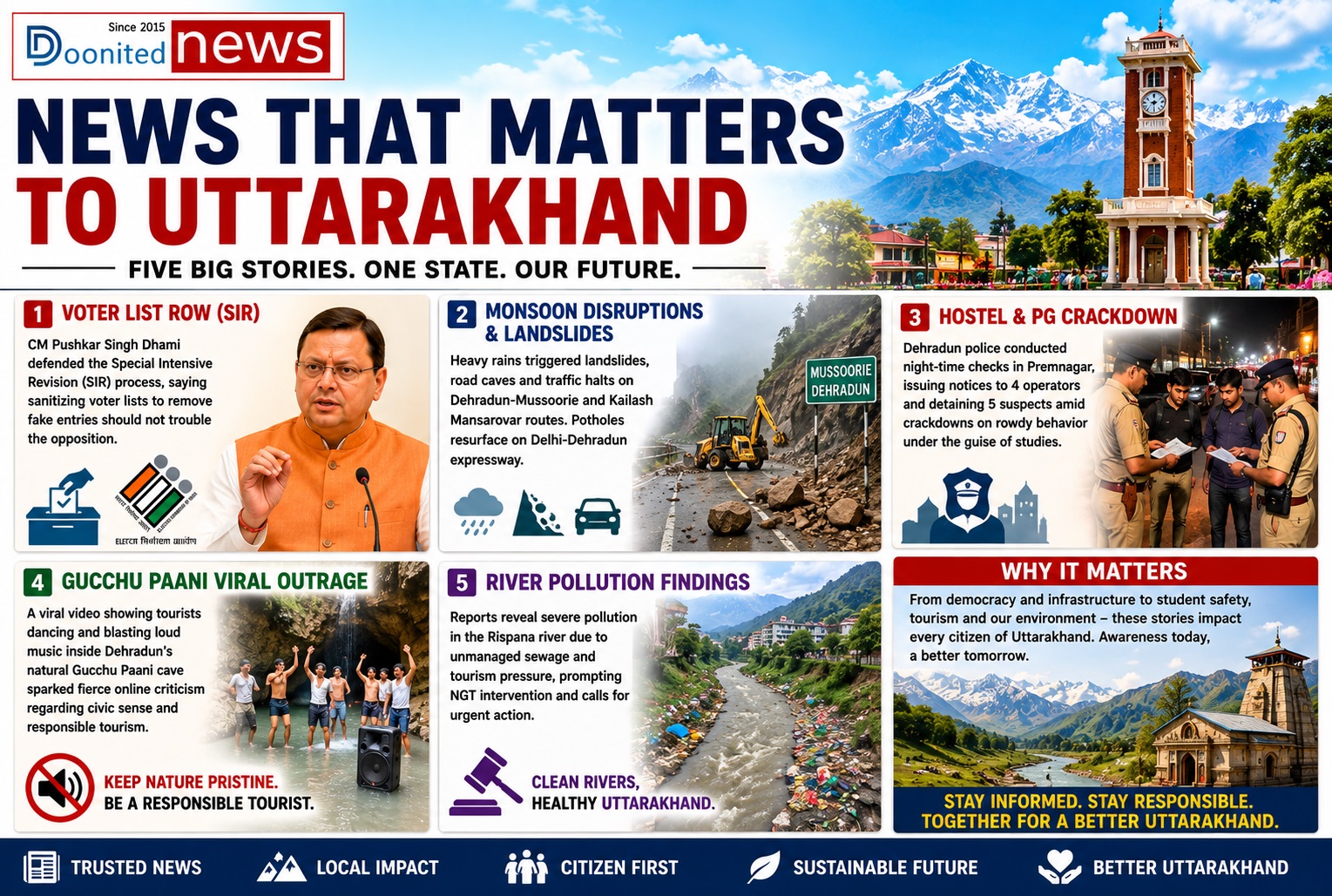

Uttarakhand at a Crossroads: Voter Lists, Monsoon Chaos, Student Safety and a Tourism Crisis
Doonited News | Uttarakhand | Editorial

A political fight over voter-list revision.
Mountain roads collapsing under monsoon pressure.
Police scrutiny of hostels and paying-guest accommodation.
Tourists turning a natural cave into a party venue.
And a river system struggling under sewage, encroachment and uncontrolled urban pressure.
At first glance, these are unrelated stories.
They are not.
Together they expose a larger question about Uttarakhand in 2026:
Can a state that is expanding rapidly still protect the integrity of its democracy, the safety of its residents, its fragile mountain infrastructure and the natural environment that attracts millions of visitors?
1. Voter Lists: Verification Is Necessary—But So Is Public Trust

The Special Intensive Revision (SIR) of electoral rolls has become a political flashpoint in Uttarakhand.
Chief Minister Pushkar Singh Dhami has defended the exercise, arguing that cleaning electoral rolls of ineligible or duplicate entries should not concern genuine voters. At the same time, Congress has raised objections about alleged irregularities in the ongoing revision process and has approached election authorities. Recent reporting has also highlighted a controversy involving an objection reportedly filed against the name of Congress MLA Furkan Ahmad.
The underlying principle is difficult to dispute:
An electoral roll should be accurate.
Duplicate, deceased, shifted or otherwise ineligible entries should not remain indefinitely on voter lists.
But there is an equally important principle:
No genuine voter should lose their democratic right because of an administrative error.
That is why electoral-roll revision must be transparent, documented and subject to effective correction and appeal.
The real issue is not political victory
The government may believe the exercise is necessary.
The opposition may believe the process is being misused.
Both positions need to be tested against evidence.
The Election Commission’s procedures provide mechanisms for claims, objections and verification. The credibility of the process will ultimately depend on whether ordinary voters can understand why their names are retained, questioned or removed—and whether they have a meaningful opportunity to challenge an incorrect decision.
A clean voter list is essential.
But public confidence in the cleaning process is equally essential.
2. Uttarakhand’s Roads Are Paying the Price of the Monsoon

Heavy rainfall has repeatedly disrupted roads around Dehradun and Mussoorie, while landslides and damaged infrastructure have affected the Kailash Mansarovar route.
On the Kailash Mansarovar route, a boulder damaged a Bailey bridge at Kulagad and a landslide occurred at Malgad, leaving 47 pilgrims stranded at Gunji according to a recent report.
The Mussoorie region has faced its own recurring connectivity crisis. Repeated landslides and road damage have disrupted traffic on the Mussoorie-Dehradun corridor, including a section near Pani Wala Bend that developed major cracks before part of the road caved in.
And more recently, heavy rain caused a significant road washout on the Mussoorie-Kempty Highway near Dimta Band, severely disrupting traffic.
These are not merely tourist inconveniences.
Mountain roads are lifelines.
They carry:
- Ambulances
- School buses
- Food supplies
- Construction material
- Local residents
- Tourists
- Pilgrims
- Emergency-response teams
When they fail, an entire local economy can become vulnerable.
The Delhi-Dehradun Expressway Question
The appearance of potholes or surface damage on a relatively new major road should not automatically be interpreted as proof of construction failure. Weather, drainage, traffic loading and maintenance can all affect road surfaces.
But the public is entitled to ask a simple question:
How resilient is the infrastructure that is being built for Uttarakhand’s future?
New roads must be judged not only by how impressive they look on inauguration day.
They must be judged by how they perform after years of rain, traffic and extreme weather.
Infrastructure in Uttarakhand cannot be designed as if the Himalayas were a flat plain.
3. Premnagar’s Hostel and PG Crackdown: Education or an Excuse for Disorder?

Premnagar has grown into one of Dehradun’s major student zones.
Universities, coaching centres, private hostels, PG accommodations, cafés and rental properties have transformed the area into a busy educational neighbourhood.
But with that growth comes a governance challenge.
Police have been conducting night-time checking drives in Premnagar amid concerns over disorderly behaviour and activities around hostels and PG accommodation. Earlier police action in the area has included checks of hostels, PGs, restaurants and other establishments following complaints of suspicious activity.
The exact latest claim that four operators were issued notices and five suspects detained should be independently confirmed from the police’s official release before being presented as a definitive figure.
But the larger issue is well established:
Student accommodation requires supervision and accountability without turning the entire student population into suspects.
The problem is bigger than “rowdy students”
A good student accommodation system needs:
- Proper tenant verification
- Fire-safety compliance
- Clear hostel rules
- Responsible operators
- Adequate security
- Complaint mechanisms
- Respect for neighbourhood residents
- Police verification where legally required
At the same time, students deserve privacy and safety.
The answer is not indiscriminate policing.
It is accountable accommodation management.
A hostel operator who ignores dangerous or illegal activity should face action.
A student who simply comes home late from the library should not automatically be treated as a troublemaker.
4. Gucchu Paani: When Tourism Becomes a Question of Civic Sense

Few places represent Dehradun’s natural character as strongly as Gucchu Paani, popularly known as Robber’s Cave.
Water flows through rock.
Visitors walk through the narrow natural formation.
The surrounding landscape provides a very different experience from the city’s traffic and concrete.
But a recent viral video has sparked criticism after tourists were seen dancing and playing loud music inside the cave with a large portable speaker. The video has generated widespread online condemnation and renewed debate about responsible tourism.
The criticism is not about whether tourists should enjoy themselves.
They should.
It is about whether enjoyment has to destroy the experience for everyone else.
A Natural Cave Is Not a Nightclub
A visitor carrying a large speaker into a natural cave is not merely making noise.
The noise changes the character of the place.
It disturbs other visitors.
It can affect wildlife and the local environment.
And it sends the wrong message about what tourism means.
Tourism should leave a place richer in experience—not poorer in character.
There is also a responsibility on authorities.
Rules are useful only when they are communicated and enforced.
If loudspeakers are prohibited, the restriction should be clearly displayed.
If littering or inappropriate behaviour attracts penalties, visitors should know the rules before entering.
And if rules are repeatedly ignored, enforcement must follow.
5. Rispana: The River That Dehradun Cannot Afford to Lose

Perhaps the most serious story in this collection is the one that receives the least dramatic headlines.
The condition of Dehradun’s rivers.
The Rispana is not merely a watercourse.
It is part of the city’s ecological and drainage system.
Yet official environmental documentation has recorded severe pollution pressures. The Uttarakhand Pollution Control Board’s district environmental plan noted that wastewater from numerous drains and households enters the Rispana system, contributing to pollution downstream in the Suswa river.
The National Green Tribunal has also become involved in the issue of encroachments along the Rispana. A recent report said the tribunal sought the state’s response regarding 324 structures identified as illegal within the active floodplain.
That is not a small civic issue.
It is a warning about how a city treats its natural drainage system.
When a River Becomes a Drain
The transformation is gradual.
First, a small drain is ignored.
Then sewage enters it.
Plastic accumulates.
Construction reaches its banks.
The channel becomes narrower.
People begin building closer to the water.
Eventually, the river is blamed when heavy rain causes flooding.
But the river did not create the problem.
The city changed the river.
The official pollution documentation provides an uncomfortable picture: the Rispana system receives wastewater from a large network of drains and households, while pollution in connected waterways has been significant enough to require restoration planning.
Development Cannot Mean Ignoring the Limits of the Landscape
Uttarakhand is growing.
Dehradun is growing.
Tourism is growing.
Student populations are growing.
Road networks are expanding.
Housing is expanding.
Commercial activity is expanding.
But the mountains, rivers and natural drainage systems have not expanded with them.
That creates a fundamental planning problem.
A city can build another road.
It cannot manufacture another Rispana.
It can construct another hostel.
It cannot recreate a natural cave once its ecological character has been destroyed.
It can repair a road.
It cannot instantly restore a destabilised mountain slope.
It can revise voter lists.
But it cannot restore public confidence once people believe the electoral process is unfair.
Uttarakhand sells itself to the world through its mountains.
Its rivers.
Its forests.
Its spiritual destinations.
Its quiet valleys.
Its clean air.
Its educational institutions.
Its natural beauty.
But the state is slowly confronting a contradiction.
The very things that attract people are being placed under pressure by the way people use the state.
We want better roads—but mountain slopes are cut repeatedly.
We want tourism—but some visitors treat natural sites as private party venues.
We want urban development—but rivers are squeezed and polluted.
We want a clean electoral system—but political arguments can undermine confidence in the process.
We want educational cities—but student accommodation can grow faster than regulation.
None of these problems will be solved by one government department.
They require a change in the idea of development itself.
Uttarakhand cannot afford development that consumes the very assets on which its future depends.
The mountains are not merely scenery.
The rivers are not drains.
Tourist destinations are not party venues.
Student neighbourhoods are not lawless zones.
And voter lists are not political weapons.
They are all part of the same social contract.
If Uttarakhand wants to remain a place people want to visit, live, study and build their future in, growth must finally learn to respect limits.
That is not anti-development.
That is sustainable development.