
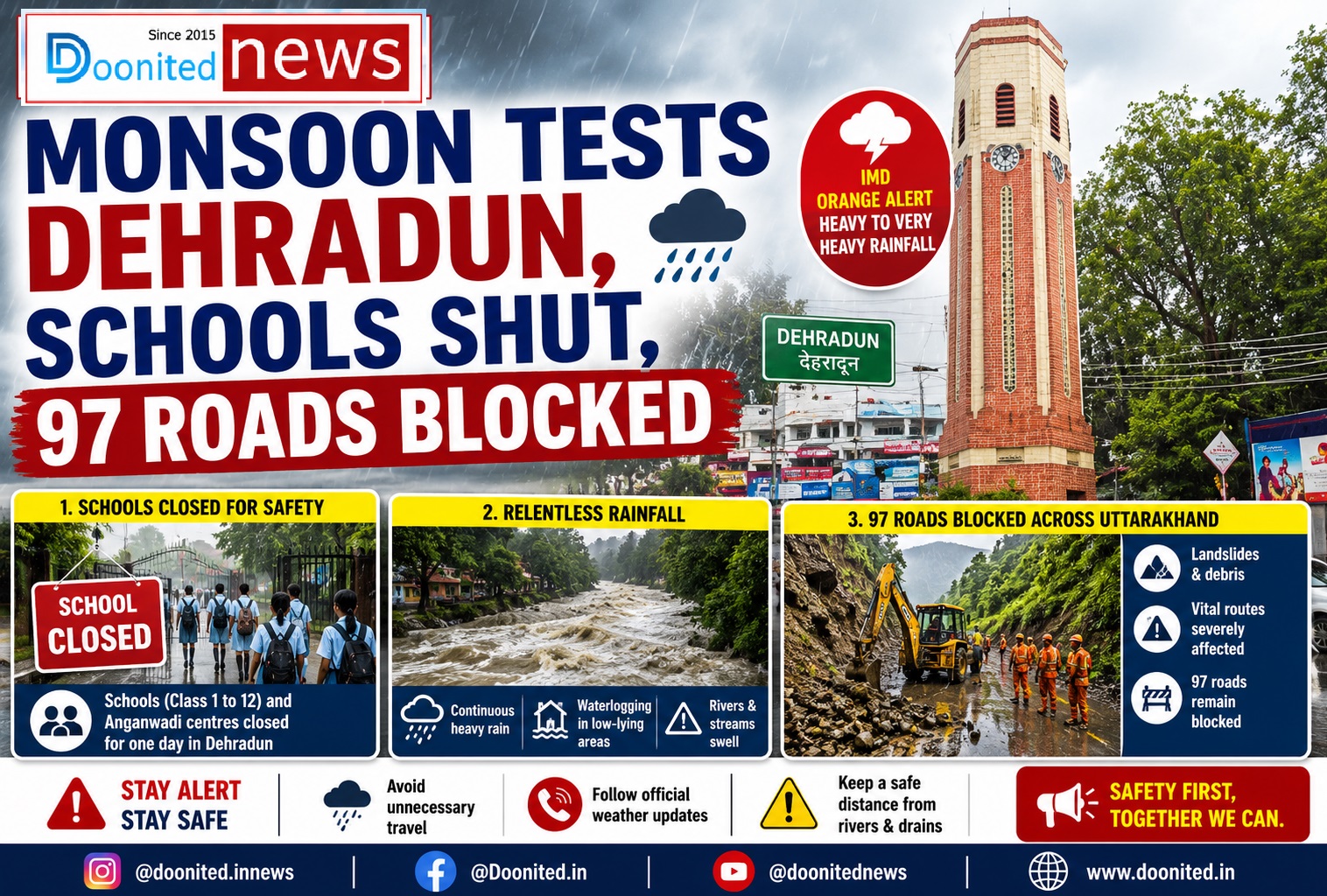

Uttarakhand Under Siege: Schools Shut, 97 Roads Blocked as Monsoon Tests Dehradun
Doonited News | Uttarakhand | Editorial
The immediate response is understandable: keep children at home, warn residents, clear roads and monitor vulnerable areas.
But the recurring question is becoming harder to avoid:
How many times can Uttarakhand call the same monsoon disruption an emergency before it becomes a question of preparedness?
Schools Closed—A Safety Decision, Not a Holiday
With heavy rainfall continuing in Dehradun, authorities declared a one-day closure for schools from Classes 1 to 12 and Anganwadi centres as a precautionary measure. The decision reflects the risks created not only by rain itself but also by waterlogging, poor visibility, traffic disruption and the possibility of landslides in vulnerable areas.
The India Meteorological Department’s latest Uttarakhand forecast has warned of heavy to very heavy rainfall at isolated places, with thunderstorms, lightning and intense to extremely intense spells of rain possible. For Dehradun, the forecast also identifies the possibility of overflowing rivulets and streams, inundation of low-lying areas and landslides or rockfalls in vulnerable locations.
Closing schools in such circumstances is therefore not an overreaction.
It is a recognition that a child’s journey to school can itself become hazardous when roads are flooded, drainage channels overflow or hill roads become unstable.
But a school closure is only the first line of protection
The real responsibility begins outside the school gates.
Are the routes children use safe?
Are drains functioning?
Are low-lying neighbourhoods being monitored?
Are parents receiving timely warnings?
And are emergency teams prepared for the possibility that heavy rainfall may continue beyond a single day?
These are the questions that determine whether precaution actually becomes preparedness.
97 Roads Blocked: Uttarakhand’s Connectivity Under Pressure
The scale of disruption is perhaps most clearly visible on the state’s roads.
Nearly 97 roads were reported blocked across Uttarakhand, with rainfall and landslide debris affecting connectivity.
For a Himalayan state, this is far more serious than a traffic inconvenience.
A blocked road can mean an ambulance cannot reach a patient.
A village can become temporarily isolated.
Essential supplies can be delayed.
Tourists can become stranded.
And disaster-response teams can themselves struggle to reach affected locations.
Recent landslides on the Mussoorie–Dehradun road have already produced severe traffic disruption, demonstrating how quickly a strategically important route can become vulnerable during intense rainfall.
The question is therefore not simply how quickly can the road be cleared?
It should be:
Why does the same infrastructure repeatedly become so vulnerable every monsoon?
The Himalaya Is Not a Flatland Highway
There is an uncomfortable reality that policymakers and citizens alike must accept.
Uttarakhand’s geography is unforgiving.
Mountain roads are constructed across steep slopes and complex geological formations. Rainwater can saturate soil, weaken slopes and trigger rockfalls or landslides. Streams that appear harmless during dry weather can become powerful channels during intense rainfall.
The IMD itself has warned of overflowing rivulets and streams, low-lying inundation and landslide risks during continuous or heavy rain.
That means road engineering in Uttarakhand cannot be treated simply as a matter of laying asphalt and widening carriageways.
Drainage, slope stability, geological assessment and emergency access are equally important parts of road infrastructure.
The Bigger Problem: Emergency Clearance Has Become a Routine
There is a familiar monsoon cycle in Uttarakhand:
Heavy rain → landslide → road blocked → machinery deployed → debris removed → traffic restored.
Then the next major rainfall arrives.
And the cycle begins again.
Clearing a landslide is essential emergency work. But if the same location repeatedly fails, merely removing the debris is not a permanent solution.
The state needs to identify chronic failure points and ask whether they require better drainage, slope stabilization, retaining structures, protective engineering, altered road design or other site-specific measures.
The answer will not be identical everywhere.
But the question must be asked.
Dehradun’s Urban Rain Problem
The situation also exposes a growing challenge inside Dehradun itself.
As the city expands, natural drainage systems face increasing pressure from roads, buildings, paved surfaces and construction. When intense rainfall arrives in a short period, storm-water systems can quickly become overwhelmed.
The result is familiar to residents:
Waterlogged roads.
Traffic jams.
Blocked footpaths.
Overflowing drains.
Stranded vehicles.
The city’s recent monsoon experience has already highlighted concerns about broken and waterlogged footpaths, with pedestrians being forced onto busy roads.
This is where rain stops being merely a weather event and becomes an urban planning issue.
What Should Uttarakhand Be Doing Differently?
1. Identify Permanent Disaster Hotspots
Locations that repeatedly experience landslides, flooding or road failure should be mapped and monitored throughout the year—not only after an accident.
2. Build Drainage Into Every Mountain Road Project
A road without effective water management is particularly vulnerable during intense rainfall.
3. Strengthen Early-Warning Communication
Weather warnings must reach residents, schools, tourists, transport operators and communities in vulnerable areas quickly and in simple language.
4. Use Weather Forecasts to Guide Movement
When authorities issue serious warnings, unnecessary travel—especially into landslide-prone mountain areas—should be avoided.
5. Stop Measuring Success Only by Road Clearance
Opening a blocked road is an immediate achievement. Making that road less vulnerable to the next rainfall is the real measure of resilience.
And What About Tourism?
Uttarakhand’s tourism economy depends heavily on road connectivity.
Dehradun is the gateway to Mussoorie and several major destinations. Mountain roads also serve pilgrims, tourists, local residents, traders and emergency services.
When heavy rainfall blocks roads, the economic consequences spread quickly.
Hotels lose bookings.
Taxi operators lose trips.
Restaurants see fewer customers.
Tourists become stranded.
Local residents struggle to reach markets and hospitals.
This is why responsible weather communication must be treated as part of tourism management as well.
A visitor who receives an honest warning and postpones a journey is safer than a visitor who receives incomplete information and becomes trapped on a mountain road.
The Editorial Question
The closure of schools is a precaution.
The clearing of 97 blocked roads is an emergency response.
The weather warnings are an early-warning mechanism.
But none of these alone constitutes disaster preparedness.
Preparedness means designing cities and infrastructure around the risks the state already knows exist.
Uttarakhand does not need to be reminded every year that the monsoon brings landslides.
It already knows.
The real test is whether that knowledge is being converted into better drainage, safer roads, stronger slopes, faster warnings and smarter urban planning.
There is no argument against the reality of extreme weather.
Heavy rain can overwhelm even well-designed systems. Landslides cannot always be predicted precisely. Mountain terrain will always carry inherent risks.
But Uttarakhand must distinguish between unavoidable natural hazards and avoidable human vulnerability.
A child staying home because the road is unsafe is a necessary precaution.
A road being temporarily blocked by an unavoidable landslide may be inevitable.
But repeatedly sending people through known danger zones, allowing chronic drainage failures to continue and treating every monsoon disruption as a surprise is not resilience.
Uttarakhand cannot stop the rain.
But it can become better prepared for what the rain brings.
And that is the real lesson from today’s 97 blocked roads and closed schools.
The monsoon is not an unexpected visitor to the Himalayas.
It comes every year. Our preparedness should too.