

Three Warnings From Uttarakhand: A Teacher’s Death, Relentless Rain and Elephants on the Highway
Doonited News | Uttarakhand | Editorial Feature
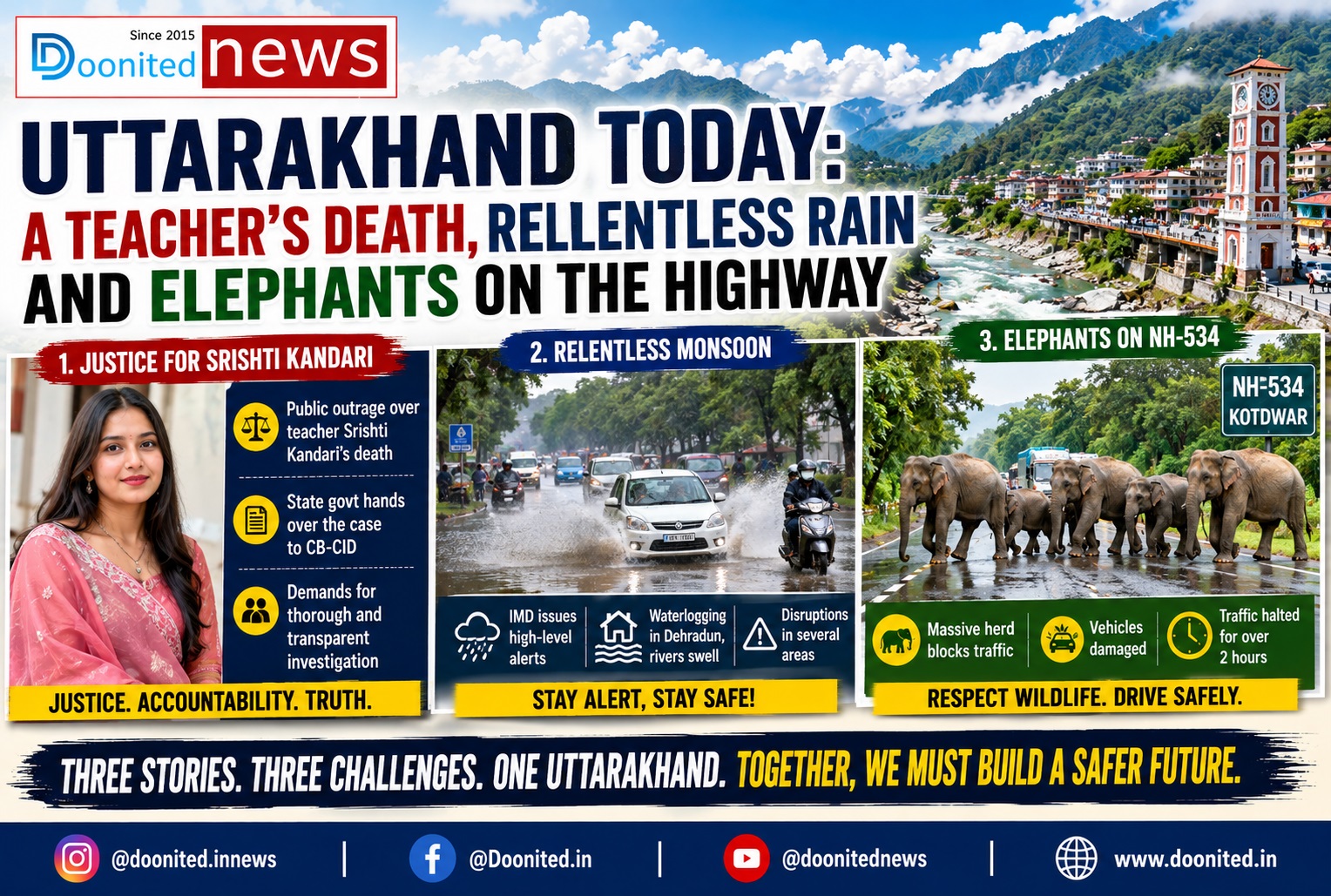
Uttarakhand is confronting three very different stories at the same time—one about justice, one about nature and one about the uneasy coexistence between wildlife and expanding human movement.
In Dehradun, public anger following the death of government school teacher Srishti Kandari has pushed the case into a higher-level investigation by the CB-CID. In the meantime, relentless monsoon activity is again testing Dehradun and other parts of the state with waterlogging, swollen rivers and the threat of landslides. And on the roads of the Lansdowne forest landscape, a herd of elephants has once again reminded motorists that in Uttarakhand, highways can cut through the territory of wildlife just as easily as they connect human settlements.
Three stories. Three different crises.
But together they reveal something larger about the state: Uttarakhand is being forced to confront questions of accountability, preparedness and coexistence.
1. Srishti Kandari Case: When Public Anger Demands Answers
The death of government school teacher Srishti Kandari in Dehradun has moved beyond a local police investigation after the Uttarakhand government ordered a CB-CID probe following public and political demands for a thorough investigation. Reports said Kandari’s family alleged harassment and dowry-related abuse, and an FIR was registered against her husband and in-laws.
The case became particularly disturbing after a purported video recorded before her death circulated on social media, in which she allegedly described the distress she said she had been experiencing at her matrimonial home. Those allegations remain allegations and must be tested against evidence through the investigation.
The CB-CID investigation therefore carries a responsibility much greater than simply closing a file.
It must establish what happened, examine the evidence independently, verify the allegations and determine whether any criminal wrongdoing occurred.
That is what an investigation is supposed to do.
Why the CB-CID investigation matters
Public outrage can draw attention to a case. It cannot establish guilt.
That distinction is essential.
The accused are entitled to due process, while the deceased and her family are entitled to a fair and credible investigation. The credibility of the final outcome will depend on evidence, forensic findings, witness statements, digital records and other legally admissible material—not on social-media narratives.
The larger social question, however, cannot be ignored.
If the allegations of dowry harassment and sustained domestic abuse are substantiated, the case would again expose how dangerous the gap can be between the formal protection available to women and the reality inside some households.
Justice must not be determined by outrage—but neither should outrage be dismissed when it reflects a genuine demand for accountability.
2. Dehradun Under Rain: When the City’s Drainage System Meets the Himalaya
While the investigation unfolds in Dehradun, the city is facing another recurring crisis: heavy monsoon rain.
The India Meteorological Department’s Uttarakhand forecast issued on August 18, 2026, warned of heavy rainfall, thunderstorms and lightning, with the possibility of intense to very intense rainfall in parts of the state. The IMD’s district forecast also warned of inundation of low-lying areas, overflowing streams and isolated landslides and rockfalls during periods of continuous or heavy rain.
Recent heavy rainfall has already pushed rivers and streams higher in parts of Uttarakhand. In Bageshwar, the Saryu rose close to dangerous levels following heavy overnight rain, prompting authorities to clear vulnerable riverbank areas and deploy response teams.
Dehradun’s problem is particularly revealing.
The city has expanded dramatically. Roads, colonies, commercial areas and construction have spread across a landscape that still depends on natural drainage channels and seasonal streams.
When rainfall arrives in intense bursts, the question becomes unavoidable:
Can the city’s drainage infrastructure handle the rainfall that the changing monsoon is delivering?
Waterlogging is not simply a rain problem
Every year, the same scenes appear.
Roads become rivers.
Vehicles crawl through water.
Low-lying neighbourhoods flood.
Traffic collapses.
Streams swell.
And residents begin asking why the same locations repeatedly become vulnerable.
It is tempting to blame everything on exceptional rainfall. But a serious urban policy must examine the entire chain—drainage capacity, encroachment, construction patterns, storm-water channels, maintenance and the ability of local authorities to respond before water enters homes and roads.
The IMD’s warnings are increasingly specific about the consequences: overflowing rivulets and streams, inundation of low-lying areas and landslides in vulnerable locations.
The warning system can tell us when danger is coming.
The harder question is whether our infrastructure is prepared for it.
3. Elephants on NH-534: When the Highway Runs Through the Forest
Then there is the extraordinary sight that periodically stops traffic on the Kotdwar–Dugadda stretch of NH-534: a herd of elephants moving onto the highway.
The specific latest claim that a massive herd blocked traffic for more than two hours and damaged vehicles could not be independently confirmed from the current sources I found. However, elephant movement onto NH-534 in the Kotdwar–Dugadda area is well documented. In one reported incident, a herd appeared near Lalpul, causing traffic disruption; in another earlier incident, elephants surrounded a vehicle carrying grain, while the forest department intervened.
This distinction matters.
Wild elephants are not “traffic offenders.”
They are moving through a landscape that humans have increasingly divided with roads, settlements and infrastructure.
The Lansdowne Forest Division is an important elephant habitat, and official records also show continuing infrastructure work along the Kotdwar–Dugadda section of NH-534, including treatment of multiple landslide-prone locations.
The real danger begins when humans panic
An elephant herd on a highway is spectacular to watch—but it is also potentially dangerous.
Motorists should never approach the animals, sound horns repeatedly, attempt to overtake the herd or stop at dangerously close distances for photographs.
The correct response is patience.
Allow the animals to move.
Let forest officials manage the situation.
Keep a safe distance.
And remember that the road is passing through elephant habitat.
The long-term answer cannot be to push wildlife farther away every time an animal crosses a road.
It has to involve better wildlife corridors, appropriate warning systems, speed management, habitat protection and scientifically designed road infrastructure.
An Editorial Word
Uttarakhand’s greatest strength is also its greatest challenge.
Its mountains, forests, rivers and wildlife attract people from across India and the world. But those same mountains make infrastructure fragile, those rivers can rise rapidly, and those forests are home to animals whose territory does not recognize administrative boundaries.
The answer cannot be to fight nature.
Nor can it be to accept every tragedy as inevitable.
The state must learn to live intelligently with its geography.
The Srishti Kandari case reminds us that justice must be transparent and evidence-driven.
The monsoon reminds us that warnings mean little if infrastructure remains vulnerable.
The elephants remind us that development cannot erase wildlife corridors.
These are not three unrelated headlines.
They are three warnings.
And Uttarakhand should listen before the next headline becomes another tragedy.