

Chamoli Tunnel Tragedy: Eight Dead, Two Still Missing as Uttarakhand Battles Relentless Monsoon
Doonited News | Uttarakhand | Disaster & Environment
Chamoli, Uttarakhand: The monsoon has once again exposed the extraordinary vulnerability of Uttarakhand’s mountains—but this time, the disaster has unfolded deep inside a tunnel.
At the Vishnugad-Pipalkoti hydroelectric project near Mayapur in Chamoli, a sudden surge of water, mud and debris entered an under-construction tunnel on August 13, trapping workers inside. What began as a rescue operation for 22 workers has now become a major tragedy: eight workers have died and two remain missing, according to the latest reports available on August 16.
The disaster has also raised a much larger question for Uttarakhand: how safe is infrastructure development in a Himalayan landscape where heavy rainfall, landslides, unstable geology and underground water can combine with devastating speed?
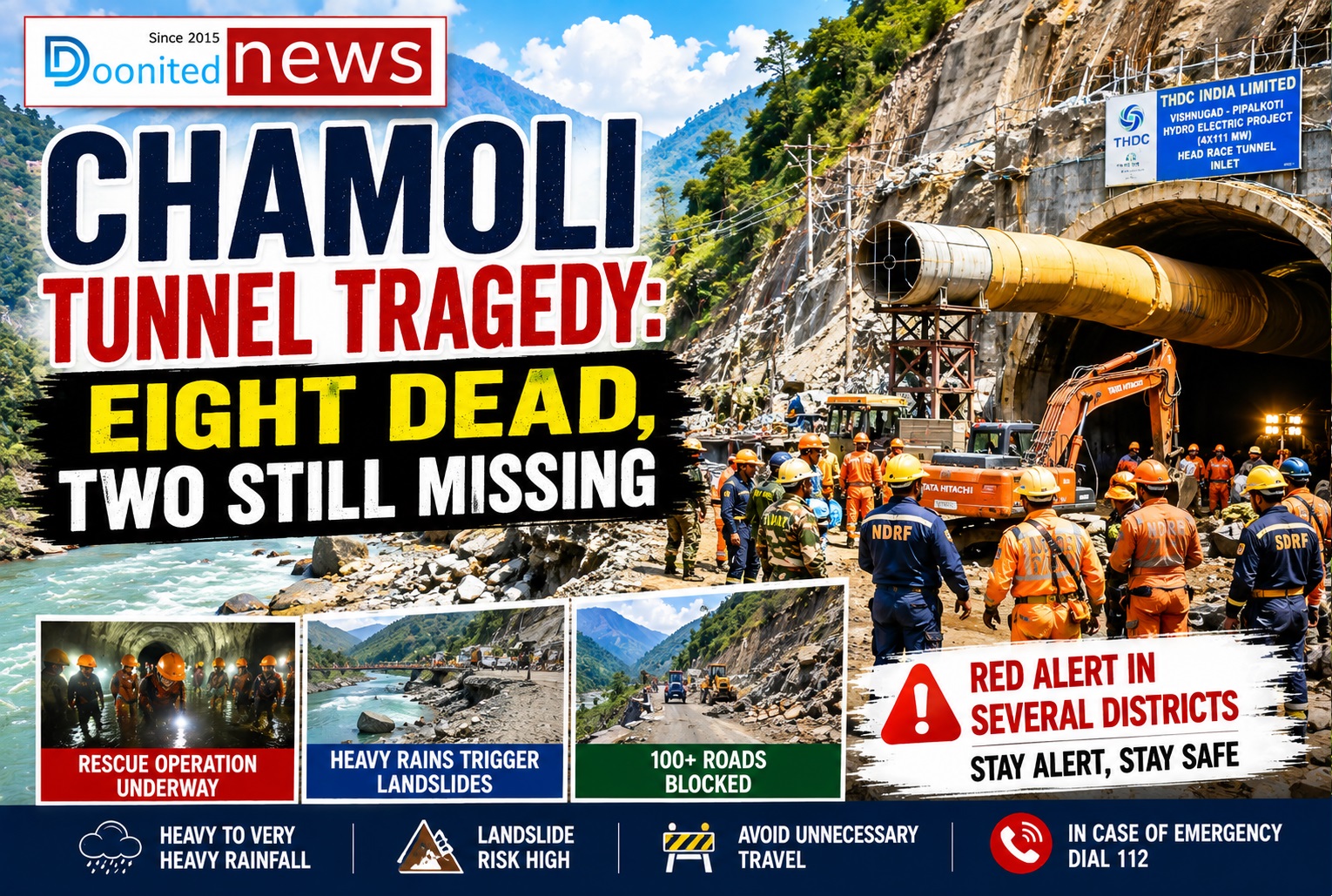
Photographs of the current 2026 incident should be used only with verified news-agency, government or on-ground photographer attribution. The images shown above may include representative or archival tunnel-rescue imagery and should not be presented as photographs of the current incident unless independently verified.
A Tunnel Turned Into a Death Trap
The incident occurred while workers were inside an under-construction tunnel at the Vishnugad-Pipalkoti project. Reports indicate that a sudden landslide or ground failure created an opening through which water and debris rushed into the tunnel.
Of the workers initially trapped, many were brought out alive, but several were seriously injured and others could not be reached immediately. Rescue teams from the NDRF, SDRF, ITBP, police and other agencies were deployed as water, slush and unstable conditions complicated access.
The scale of the operation illustrates the difficulty of rescue work underground during an active monsoon event. A tunnel that is normally a controlled construction environment can become extraordinarily dangerous when water pressure, loose rock and debris suddenly change the conditions inside.
The Human Tragedy Behind the Numbers
Eight deaths are not simply a statistic in a disaster report.
Behind every number is a worker who left home to earn a living, a family waiting for a phone call and a community that may now face years of financial and emotional consequences.
The names of workers reported missing earlier in the operation included workers from Jharkhand and Chhattisgarh, highlighting another uncomfortable reality of India’s major infrastructure projects: the people building strategic infrastructure in difficult terrain are often migrant workers far from their homes and families.
Their safety cannot be treated as a secondary consideration simply because the work happens out of public view.
Why Is the Himalaya So Difficult to Build In?
The answer begins with geology.
The Himalayas are young, tectonically active mountains with fractured rock, steep slopes and complex groundwater systems. Construction tunnels through such terrain can encounter geological conditions that are difficult to predict completely.
Add intense monsoon rainfall and the risk increases.
Water can enter fractures, saturate slopes and increase pressure along weak geological planes. A landslide above or beside a tunnel can then create a pathway for water, mud and rock to move rapidly into an excavation.
That does not automatically establish negligence in this particular accident. The exact technical cause of the Pipalkoti incident must be established through a proper investigation.
But the tragedy does demand a serious examination of how geological risk and worker safety are assessed before and during underground construction.
Uttarakhand’s Monsoon Crisis Is Bigger Than One Tunnel
The tunnel tragedy has occurred against a wider backdrop of severe monsoon disruption.
Heavy rainfall has repeatedly triggered landslides, swollen rivers and road blockages across the state. During earlier intense spells this monsoon, more than 100 roads were reported blocked, including important national and state routes.
In Bageshwar, the Saryu River rose sharply following heavy rainfall, prompting authorities to clear vulnerable areas along the riverbank and place disaster-response teams on alert.
The pattern is unmistakable: when extreme rainfall strikes the mountains, one hazard quickly becomes several.
Rain produces slope failure.
Slope failure blocks roads.
Blocked roads slow rescue.
Rivers rise.
Infrastructure becomes isolated.
And emergency teams themselves have to operate in dangerous conditions.
The Question of Infrastructure Safety
Uttarakhand needs hydropower, roads, bridges and tunnels. Connectivity is essential for residents, pilgrims, tourism and the state’s economy.
The question is therefore not whether infrastructure should be built.
The question is how it should be built in a Himalayan environment.
Every tunnel project should be designed around the possibility that geological conditions may differ from initial assumptions. Continuous geological monitoring, water-pressure monitoring, emergency escape systems, worker communication, evacuation drills and robust contingency plans are not luxuries.
They are life-saving infrastructure.
Rescue Must Not Become the Safety Plan
India has demonstrated impressive disaster-response capabilities. The coordinated deployment of specialist agencies in Chamoli shows the importance of having trained rescue teams available when something goes wrong.
But a rescue operation begins after the safety system has already failed.
The deeper objective must be to prevent workers from becoming trapped in the first place.
That means asking difficult questions before excavation begins and repeatedly during construction:
- Was the geological mapping sufficiently detailed?
- Were underground water pathways properly identified?
- Were rainfall and slope conditions incorporated into daily work decisions?
- Were evacuation routes continuously accessible?
- Could workers communicate immediately with the surface?
- Were emergency shelters and alternative escape routes available?
- Were construction activities modified when extreme weather increased risk?
These questions should be answered by an independent technical investigation—not by assumptions.
The Cost of Treating Himalayan Disasters as “Natural”
There is a dangerous habit in public discourse: when a landslide or flood kills people, the event is quickly described as a natural disaster.
Nature certainly creates the hazard.
But risk is shaped by human decisions.
Where we build.
How we cut slopes.
How we design tunnels.
How we manage drainage.
When we stop construction.
How quickly we evacuate.
And whether worker safety takes precedence over construction schedules.
Calling everything “natural” can prevent society from examining the human factors that determine how many people are ultimately harmed.
The Road Network Is Sending Its Own Warning
The hundreds of kilometres of mountain roads connecting Uttarakhand’s settlements and pilgrimage centres provide another lesson.
When roads repeatedly close after heavy rainfall, the problem is not merely inconvenience. It affects ambulances, food supplies, schoolchildren, tourists, workers and emergency response.
Earlier this monsoon, reports documented more than 100 road closures during intense rainfall, with landslides affecting important Char Dham routes.
A state dependent on mountain roads needs to think beyond debris removal.
Resilient infrastructure must be designed to fail less often—and recover faster when it does fail.
What Uttarakhand Needs Now
Independent Safety Audits
Major underground and mountain infrastructure projects should undergo independent safety reviews, particularly after extreme weather events.
Better Geological Monitoring
Real-time monitoring of slope movement, groundwater pressure and tunnel conditions should become an integral part of high-risk projects.
Weather-Based Work Protocols
Construction schedules should incorporate rainfall forecasts and site-specific geological warnings rather than treating weather as a separate issue.
Multiple Escape Options
Workers underground should have clearly defined emergency escape routes and reliable communication with the surface.
Transparent Accident Investigations
When workers die, the public deserves to know what happened, why it happened and what will change afterward.
The Larger Warning From Chamoli
The tragedy at Pipalkoti should not become another headline that disappears once the rescue operation ends.
Uttarakhand has experienced tunnel accidents, landslides, flash floods and infrastructure failures before. The state cannot afford to learn the same lessons repeatedly through human casualties.
The Himalayas are not an ordinary construction environment.
They demand a different standard of planning, engineering and accountability.
An Editorial Word
Development is necessary. Uttarakhand cannot remain disconnected from the rest of the country, nor can its people be denied modern infrastructure.
But development that places workers at unacceptable risk is not progress.
A tunnel may be an engineering achievement. A hydropower project may strengthen the state’s energy infrastructure. A highway may open a remote valley to the outside world.
Yet behind every project are people.
Their lives must never become the hidden cost of development.
The eight workers who have lost their lives at Pipalkoti—and the families still waiting for news of the two missing workers—deserve more than rescue headlines and compensation announcements.
They deserve answers.
And Uttarakhand deserves an infrastructure policy that understands one fundamental truth:
In the Himalayas, engineering must respect the mountain—or the mountain will eventually test the engineering.
SEO Title
Chamoli Tunnel Tragedy: 8 Dead, 2 Missing as Uttarakhand Battles Monsoon Fury
Meta Description
Chamoli tunnel tragedy at the Vishnugad-Pipalkoti hydro project leaves eight workers dead and two missing as Uttarakhand battles heavy rain, landslides and road blockages.
Focus Keyword
Chamoli Tunnel Tragedy
Secondary Keywords
Chamoli tunnel collapse 2026, Pipalkoti tunnel accident, Uttarakhand tunnel disaster, Vishnugad Pipalkoti project, THDC tunnel accident, Uttarakhand monsoon, Uttarakhand landslides, hydro project safety, Himalayan infrastructure, worker safety
WordPress Tags
Chamoli, Pipalkoti, Tunnel Collapse, THDC, Vishnugad Pipalkoti, Uttarakhand, Monsoon, Landslide, Hydropower, Disaster Management, Worker Safety, Himalayan Infrastructure, Editorial
Suggested WordPress Category
Editorial