
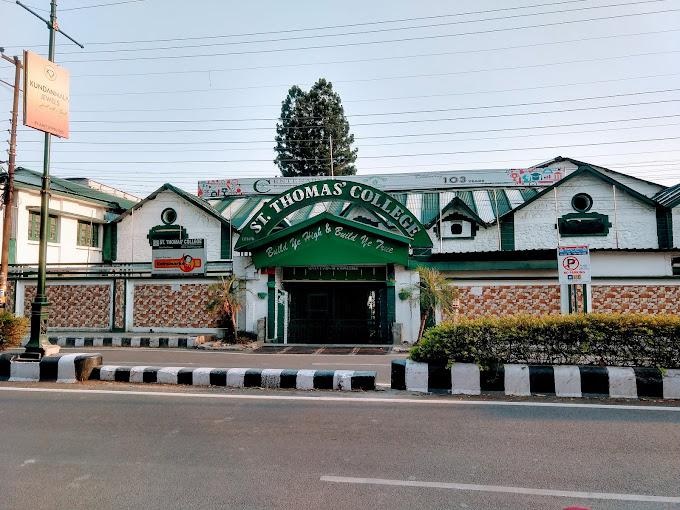

St. Thomas’ College Dehradun: A Century of Memories, Friendships and a Legacy That Lives Beyond the School Gates
Doonited News | Uttarakhand | Education & Heritage

Dehradun: In the heart of Dehradun, on Cross Road, stands an institution whose story is inseparable from the educational history of the city.
St. Thomas’ College.
Founded in 1916, the co-educational school crossed its first century in 2016. But a century-old school is not simply a collection of buildings, classrooms and examination results. It is a repository of memories—of morning assemblies, friendships, teachers, school houses, sports fields, competitions, celebrations and the unmistakable feeling of returning to a place where a part of one’s childhood still seems to exist.
The school’s own centenary website records its address as 2 Cross Road, Dehradun, while its official history traces the institution’s beginnings to 1916.
For generations of Dehradun families, St. Thomas’ has represented something larger than schooling.
It has represented continuity.
1916: A School Begins With 34 Children
The story began in January 1916, when St. Thomas’ Day School opened with 34 children.
The first headmistress was Miss Priscilla C. Wells, supported by two teachers, Miss Hannah and Miss Moses. The school initially operated from a rented house known as Cold Harbour on Eastern Canal Road.
It was a very different Dehradun.
The city had not yet become the sprawling urban centre it is today. The educational landscape was also considerably smaller.
As enrolment increased, the institution sought a permanent site and eventually established itself at the location that became its long-term home on Cross Road.
The first purpose-built structure was modest—a central hall, four classrooms and a verandah.
From those beginnings, the institution would eventually grow into one of Dehradun’s best-known schools.
From a Small Day School to a Century-Old Institution
The transformation was gradual.
As student numbers increased, additional classrooms became necessary. The school eventually formed a registered society in 1924, an important step in giving the institution a more formal organisational foundation.
For many years, the school offered education only up to the middle-school level.
Then came another important transition.
In 1948, the institution received high-school status from the Uttar Pradesh Government, according to historical accounts of the school.
The journey from a small school with 34 children to a major senior-secondary institution reflects not one dramatic transformation but decades of gradual expansion.
That is often how educational institutions become part of a city’s identity.
Not overnight.
Generation by generation.
A School That Remained Co-Educational
One feature of St. Thomas’ history deserves particular attention.
The institution has remained co-educational throughout its history, according to available historical accounts.
That means generations of boys and girls have shared classrooms, activities, competitions and friendships within the same school environment.
Over a century, that creates a remarkable social record.
Different generations may have grown up in completely different India—but the school remained a common thread.
A parent may remember the same corridors that a child walks through decades later.
A former student may return to the campus and immediately recognise the atmosphere even though the city outside has changed dramatically.
The Memory of School Is Often Stronger Than the Memory of Lessons

Ask former students what they remember about school and the answers are rarely limited to textbooks.
They remember:
The first day.
The first close friend.
The teacher who frightened them.
The teacher who encouraged them.
The school captain.
The house competition.
The annual day.
The sports field.
The canteen.
The school song.
The last day before leaving school.
And years later, those apparently ordinary moments become some of the most valuable memories of youth.
That is the intangible heritage of a school.
It cannot be measured in examination percentages.
The House System: Competition With a Sense of Belonging
St. Thomas’ maintains a house system that forms an important part of student life. The school’s official website lists four houses:
Burn House
Cole House
Degruyther House
Fraser House
For generations of students, house competitions have meant much more than points on a noticeboard.
They create identity.
A student may compete fiercely for a house in sport, academics or cultural activities and, years later, still remember the colour, name and people associated with it.
That is how school traditions survive.
Sports: Where School Memories Become Stories

Sports have also played an important role in the culture of the institution.
The school’s current programme includes activities such as cricket, football, basketball, badminton and athletics, alongside other sporting pursuits.
For students, sport provides lessons that classrooms cannot completely reproduce.
How to win.
How to lose.
How to work with teammates.
How to accept discipline.
How to keep trying after failure.
And perhaps most importantly, how to understand that success is rarely achieved alone.
For many former students, the sports ground is therefore not simply a physical space.
It is part of their personal history.
Centenary Year: When Alumni Came Home

The school’s centenary in 2016 became an especially important moment because it brought the institution’s past and present together.
The official centenary programme included a Centenary Alumni Meet, centenary sports and gymnastics displays, a marathon and other commemorative events.
Contemporary reporting described the centenary as a celebration of a school that had grown from a small three-room institution into an institution of national recognition.
But perhaps the most meaningful part of a centenary is not the ceremony.
It is the return of people.
People who may have left Dehradun decades earlier.
People who had not seen their classmates for years.
People who remembered teachers who had long since retired.
People who could walk through the school gates and suddenly find themselves teenagers again.
That is the emotional power of an old school.
Alumni: The Real Measure of a School’s Reach
A school’s legacy ultimately travels with its students.
They become doctors.
Engineers.
Business leaders.
Teachers.
Artists.
Administrators.
Entrepreneurs.
Members of the armed forces.
Professionals in India and abroad.
But alumni should not be measured only by famous names.
The real alumni story is much broader.
It is the thousands of ordinary former students who quietly built careers, raised families, served communities and carried lessons from school into adult life.
A school does not educate only the people whose names later appear in newspapers.
It educates generations of citizens.
When Alumni Return, They Bring More Than Nostalgia
St. Thomas’ maintains an alumni section and registration system through its official website, reflecting the continuing relationship between former students and the institution.
That relationship matters.
A former student returning to school can provide something no textbook can:
experience.
Alumni can speak to students about careers, mistakes, opportunities and the realities of life after school.
They can become mentors.
They can support programmes.
They can help preserve institutional history.
And they can remind current students that the school is part of a much larger community.
The Teachers Who Remain in Memory

Every old school has another group of people who rarely receive enough attention:
the teachers.
Students remember teachers differently.
One is remembered for discipline.
Another for humour.
Another for mathematics.
Another for music.
Another because they noticed a student’s talent when nobody else did.
A teacher may teach hundreds or even thousands of children over a career.
But sometimes one sentence from that teacher stays with a student for decades.
That is an influence impossible to quantify.
A School Embedded in Dehradun’s Urban History
St. Thomas’ location on Cross Road is itself significant.
The school stands in the heart of a city that has transformed around it.
Dehradun has grown from a relatively quiet valley town into a busy urban centre with expanding residential areas, traffic, commercial activity and a rapidly changing skyline.
Yet some institutions remain physical markers of the older city.
St. Thomas’ is one of them.
Its continued presence provides a direct connection between the Dehradun of 1916 and the Dehradun of 2026.
That makes the campus more than educational infrastructure.
It is part of the city’s living heritage.

A Century Later, the Challenge Is Different
The school that opened in 1916 could never have imagined today’s educational environment.
Students now live in a world of:
Artificial intelligence.
Social media.
Digital classrooms.
Global careers.
Online information.
Constant connectivity.
The challenge for a century-old institution is therefore not simply to preserve tradition.
It is to decide which traditions deserve to survive while ensuring students are prepared for a future that is radically different from the past.
That balance is difficult.
But it is also what makes an old institution interesting.
What Should a School Legacy Mean?
An old building is not a legacy.
A large alumni list is not a legacy.
A century of photographs is not a legacy.
A legacy exists when an institution continues to influence people long after they have left its gates.
That influence can be academic.
It can be cultural.
It can be emotional.
It can be ethical.
It can be as simple as teaching a child to stand confidently in front of a crowd—or as profound as inspiring a student to dedicate a life to public service.
The Emotional Geography of St. Thomas’
There are places in every school that become part of its mythology.
The gate.
The assembly ground.
The classroom where a student sat for years.
The sports field.
The stage.
The corridors.
The staff room that students were sometimes afraid to approach.
The noticeboard where examination results appeared.
Years later, those places may look smaller.
The building may appear different.
The trees may have grown.
But memory has a strange quality.
It preserves places at the size they occupied in childhood.
That is why alumni reunions can be unexpectedly emotional.
People are not simply returning to a building.
They are returning to an earlier version of themselves.
St. Thomas’ at 110
In 2026, St. Thomas’ College is 110 years old.
Its centenary is already a decade behind it.
The students who celebrated the 100th year are now older.
The children who entered the school after the centenary are themselves growing into young adults.
And a new generation is now creating memories that will eventually become the school’s future history.
That is the remarkable thing about institutions like St. Thomas’.
The story never really ends.
Every graduating class adds another chapter.
Every teacher leaves a mark.
Every reunion brings back another memory.
Every new student walks through the same gates with an entirely new future ahead.
Dehradun has many schools.
But only a handful have existed long enough to become part of the collective memory of the city.
St. Thomas’ College is one of them.
Founded with just 34 children in 1916, it has witnessed wars, independence, the transformation of Indian society, the expansion of Dehradun and the enormous changes in education and technology.
Its greatest achievement, however, cannot be reduced to its age.
It is the human history accumulated over those 110 years.
The generations of children who entered as students and left as adults.
The teachers who shaped them.
The friendships that survived decades.
The alumni who returned.
The traditions that remained.
And the memories that refuse to disappear.
A school can teach mathematics, science, languages and history.
But sometimes its most enduring lesson is simply this:
Wherever life takes you, there is a place you once called home.
For thousands of former students, St. Thomas’ College, Dehradun remains that place.



What Our Readers Say
Real opinions from the Doonited community.