
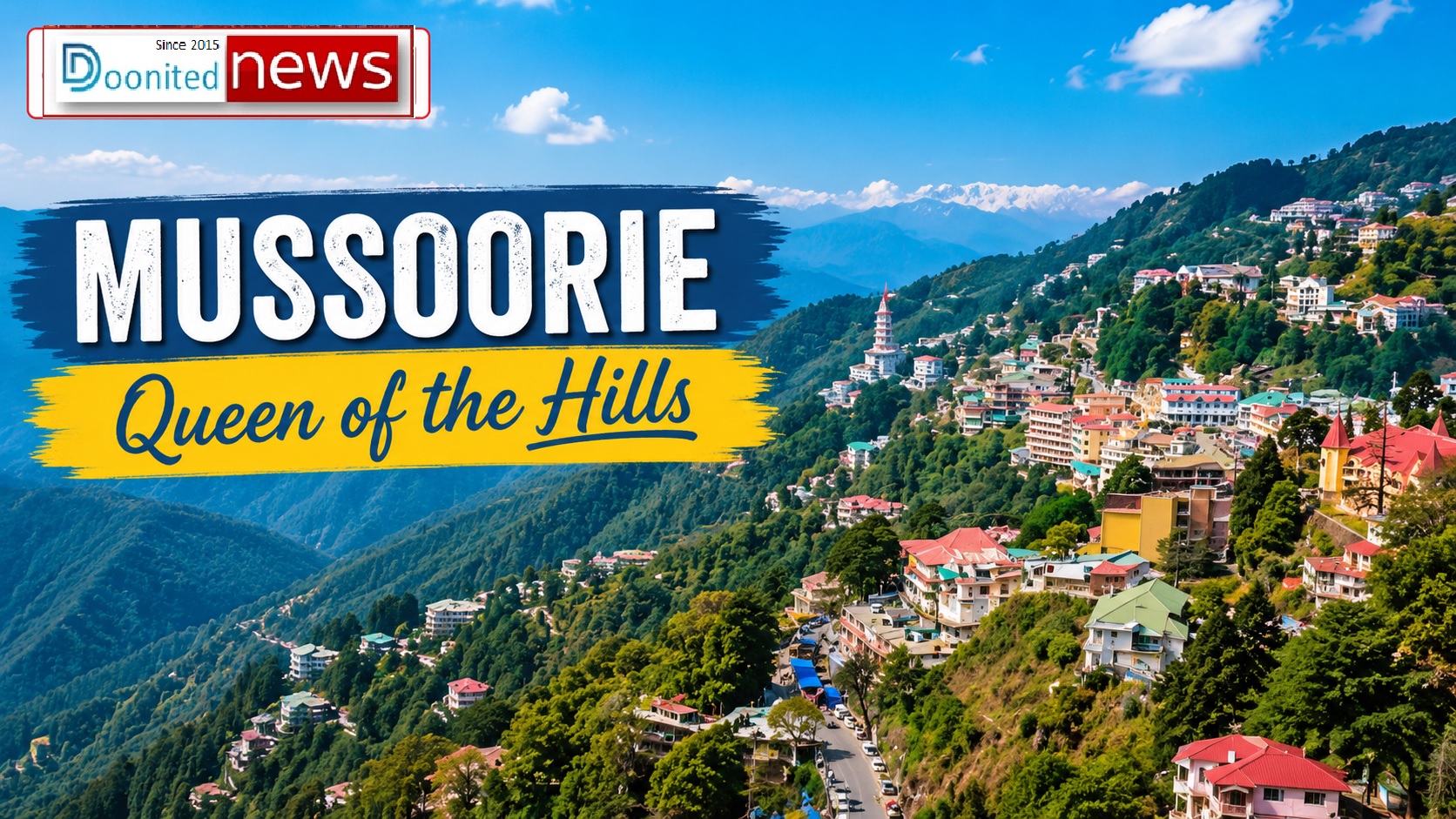
Mussoorie: Discover the Queen of the Hills and Its Timeless Uttarakhand Charm
By Doonited News | Travel Uttarakhand
There are hill stations, and then there is Mussoorie.
Perched in the foothills of the Garhwal Himalayas above the Doon Valley, Mussoorie has attracted travellers for generations with its mountain views, colonial-era character, walking roads, waterfalls and cool Himalayan atmosphere.
Located in Dehradun district, Mussoorie is among Uttarakhand’s best-known tourist destinations and is popularly called the “Queen of the Hills.”
But Mussoorie is more than Mall Road and a weekend escape.
Step away from the busiest streets and the destination reveals forests, heritage buildings, mountain trails, waterfalls, viewpoints and quieter corners that tell a much richer story.
Why Is Mussoorie Called the Queen of the Hills?
Mussoorie’s location is central to its appeal.
The town stretches along a Himalayan ridge at an elevation of roughly 2,000 metres, offering views across the surrounding hills and, in suitable weather, towards the higher Himalayan ranges.
Look in another direction and the Doon Valley spreads below.
This combination of accessibility and mountain scenery helped Mussoorie develop into an important hill station during the British colonial period.
Today, its landscape remains the primary reason millions associate Mussoorie with a classic Uttarakhand hill holiday.
The Story of Mussoorie
Modern Mussoorie developed during the 19th century under British influence.
As happened with several Himalayan hill stations, its relatively cooler climate attracted colonial officials and residents seeking relief from the summer heat of the plains.
Over time, roads, residences, churches, schools and commercial establishments developed across the hills.
The town expanded considerably after Indian independence and is now a major tourism centre.
Yet traces of its earlier architectural character remain visible.
Old buildings, churches and hillside structures make Mussoorie interesting not only as a travel destination but also as part of Uttarakhand’s colonial-era urban heritage.
Mall Road: The Heart of Mussoorie
For many first-time visitors, Mall Road becomes the centre of the Mussoorie experience.
Shops, cafés, restaurants, hotels and viewpoints line the area, while the surrounding mountains create a distinctly hill-station atmosphere.
An evening walk here remains a popular activity.
However, travellers should not make the mistake of seeing Mall Road as the whole of Mussoorie.
Some of the destination’s most rewarding experiences are found away from its busiest commercial stretch.
Lal Tibba: Among Mussoorie’s Famous Viewpoints
Located around the Landour area, Lal Tibba is one of the best-known viewpoints associated with Mussoorie.
On clear days, the surrounding Himalayan landscape can provide impressive long-distance mountain views.
Landour itself has a noticeably different atmosphere from central Mussoorie.
Its winding roads, old buildings, trees and relatively quieter environment make it particularly attractive to travellers interested in walking and experiencing the older character of the hill station.
Rather than rushing through Landour simply for photographs, spend time walking through the area.
Mussoorie is often best experienced slowly.
Landour: Mussoorie’s Quieter Neighbour
If central Mussoorie represents the energy of a popular tourist destination, Landour offers a quieter contrast.
Its narrow mountain roads, forested surroundings and historic character have made it one of the most appealing parts of the greater Mussoorie area.
The famous Landour Bakehouse area and old cantonment surroundings have become popular with visitors, but the real attraction is the ambience itself.
Walking through Landour in suitable weather can reveal a side of Mussoorie that traffic-heavy tourist itineraries often miss.
Kempty Falls
Kempty Falls is one of the most recognizable tourist attractions near Mussoorie.
Water descending through the mountain landscape has made the falls a popular excursion for generations of visitors.
Its popularity, however, also means it can become crowded during peak tourism periods.
Travellers looking for a quieter experience should consider visiting outside the busiest hours where practical.
Visitors should also respect safety restrictions around waterfalls, particularly during periods of heavy rainfall when water levels and currents can change rapidly.
Gun Hill
Gun Hill is another well-known Mussoorie viewpoint.
The elevated location provides broad views of the surrounding hills and town.
The area has long been associated with Mussoorie tourism and remains popular with families and first-time visitors.
Like several central attractions, it can become busy during weekends and holiday periods.
Company Garden
For families and travellers looking for a relaxed outing, Company Garden is another established Mussoorie attraction.
Landscaped gardens, flowers and recreational facilities make it quite different from the wild mountain landscapes found elsewhere around Uttarakhand.
It can be incorporated into a broader Mussoorie itinerary rather than treated as the primary reason to visit the hill station.
George Everest
One of the more interesting destinations around Mussoorie is associated with Sir George Everest, the Surveyor General of India after whom Mount Everest was later named.
The historic George Everest estate and surrounding landscape have become popular with travellers for their combination of heritage and panoramic scenery.
This location adds another dimension to Mussoorie.
A trip here is not simply about taking photographs of mountains. It connects the region with the history of surveying and geographical exploration in the Indian subcontinent.
Cloud’s End and Mussoorie’s Natural Side
Mussoorie’s forests are often overshadowed by its hotels and shopping streets.
Yet the surrounding Himalayan vegetation is an essential part of the destination.
Areas such as Cloud’s End provide visitors with opportunities to experience quieter forested landscapes away from central Mussoorie.
Walking through these environments demonstrates why responsible tourism matters.
Plastic waste, excessive construction and unmanaged traffic do not simply make a destination unattractive. They can gradually damage the ecological qualities that made tourists visit in the first place.
When Is the Best Time to Visit Mussoorie?
Mussoorie offers different experiences across different seasons.
Spring and early summer generally provide pleasant weather and are among the most popular periods for visitors.
The monsoon transforms the surrounding hills into intense shades of green, but rainfall can also bring fog, slippery roads and the possibility of landslides in Himalayan areas.
Autumn can provide clearer weather and beautiful mountain conditions.
Winter offers cold weather, and snowfall may occur depending on prevailing conditions.
Snowfall should never be guaranteed for a particular travel date. It depends on weather systems and varies from year to year.
Visitors should check current forecasts and road conditions before travelling.
How to Reach Mussoorie
Mussoorie’s accessibility is one of its major advantages.
Dehradun is the principal gateway.
Road connections link Dehradun and Mussoorie, with taxis, buses and private vehicles commonly used for the journey.
For rail travellers, Dehradun Railway Station is the nearest major railhead.
For air travellers, Jolly Grant Airport near Dehradun serves the region.
Actual travel time can vary considerably depending on traffic, weather and road conditions, particularly during weekends and peak holiday seasons.
The Problem of Overtourism
Mussoorie’s popularity creates challenges.
Heavy traffic, parking pressure, construction, water demand and waste generation can place significant stress on a Himalayan town with limited geographical space.
This is not simply an inconvenience for tourists.
It is a long-term sustainability issue.
Visitors can help by avoiding litter, reducing disposable plastic use, respecting local regulations and considering travel outside extreme peak periods when possible.
Tourism should strengthen mountain communities rather than gradually undermine the environment in which they live.
Mussoorie Beyond Instagram
Modern travel often reduces destinations to photographs.
Mussoorie deserves more time.
Walk through Landour.
Watch the Doon Valley from the hills.
Explore the older parts of town.
Experience the forests.
Try local and regional food rather than eating exclusively at familiar chain restaurants.
Talk to people who live and work there.
When travellers engage with the destination rather than simply collecting photographs, Mussoorie becomes much more interesting.
Why Mussoorie Still Matters
India now has countless mountain resorts, hotels and tourism destinations.
Yet Mussoorie continues to hold a special place in the story of Uttarakhand tourism.
Part of that attraction is nostalgia.
Part is accessibility.
But the strongest reason is geographical.
The town occupies an extraordinary position between the Doon Valley and the Garhwal Himalayas, close enough to the plains for a relatively convenient journey yet high enough to offer a distinctly Himalayan environment.
That combination is difficult to replicate.
The Queen of the Hills
Mussoorie has changed enormously since its development as a hill station in the nineteenth century.
Hotels have multiplied.
Traffic has increased.
Tourism has transformed the local economy.
Yet on a clear morning, when sunlight reaches the mountain ridges and the Himalayan landscape appears beyond the town, it becomes easy to understand why generations of travellers have returned.
The real Mussoorie is not contained in one waterfall, one viewpoint or one market.
It is found in the combination of mountains, forests, heritage, weather and Himalayan life.
That is the Mussoorie worth discovering.
And it remains one of the defining travel experiences of Uttarakhand.