
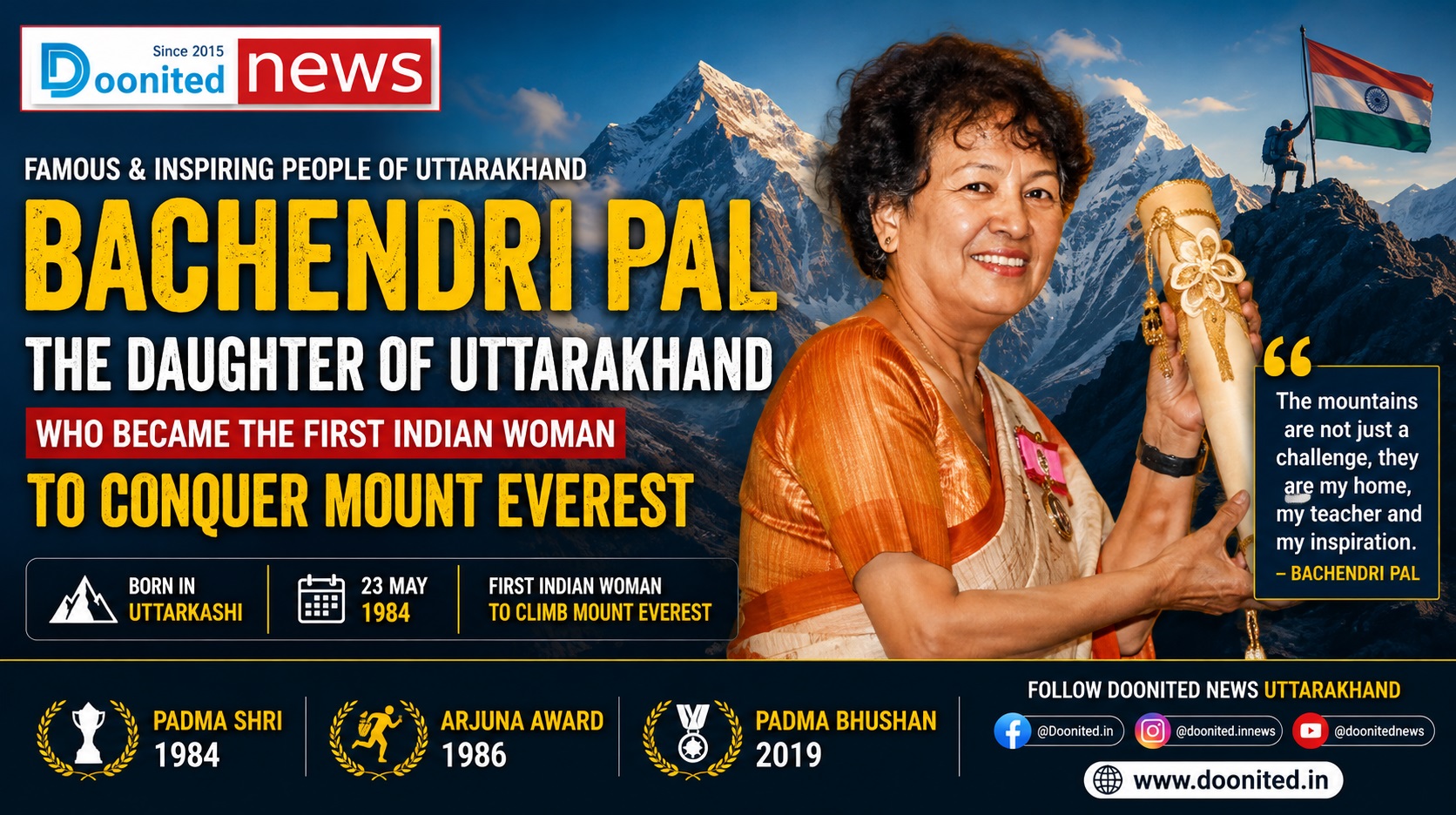
Bachendri Pal: The Daughter of Uttarakhand Who Became the First Indian Woman to Conquer Mount Everest
By Doonited News | Inspiring People of Uttarakhand
The mountains of Uttarakhand have produced generations of people accustomed to difficult terrain, resilience and life in the Himalayas. But on 23 May 1984, one woman from Uttarkashi took that Himalayan spirit to the highest point on Earth.
Bachendri Pal became the first Indian woman to reach the summit of Mount Everest, creating a landmark in Indian mountaineering and women’s sporting history. Tata Steel records her Everest summit date as 23 May 1984, while Government of India records confirm the national honours that followed her achievement.
Her story, however, is much bigger than one successful climb.
From Uttarkashi to the Top of the World
Bachendri Pal was born on 24 May 1954 in Uttarkashi, in present-day Uttarakhand. Growing up in the Himalayan region brought the mountains into her life from an early age, but becoming a professional mountaineer—particularly as a woman in that period—was far from a conventional career choice.
Education remained an important part of her journey. According to Tata Steel’s biographical account, Pal completed her bachelor’s degree in 1978 and master’s degree in 1979 from Garhwal University. She subsequently pursued professional outdoor and leadership training, including an Outdoor Educators’ Course at the Sir Edmund Hillary Outdoor Pursuit Centre in New Zealand.
The young woman from Uttarkashi was gradually preparing for something that would change the history of Indian mountaineering.
The Historic Everest Expedition of 1984
In 1984, Bachendri Pal became a member of the Indian Everest Expedition.
Mount Everest represents one of the most demanding challenges in mountaineering. Extreme altitude, unpredictable weather, freezing temperatures and reduced oxygen make every expedition potentially dangerous.
On 23 May 1984, Pal successfully reached the summit.
She had become the first Indian woman to climb Mount Everest.
It was not simply an individual sporting achievement. At a time when far fewer Indian women were represented in high-altitude adventure sports, her success demonstrated what women could achieve in one of the world’s most physically and psychologically demanding disciplines.
For Uttarakhand, it also gave the Himalayan state another enduring connection with the history of Indian mountaineering.
Recognition from the Government of India
The significance of her achievement was recognized nationally.
The official Gazette of India records Bachendri Pal among the recipients of the Padma Shri following the 1984 Everest expedition.
She later received the Arjuna Award in 1986. Tata Steel also records her as a recipient of the Tenzing Norgay National Adventure Award.
Decades later, another major national honour followed.
In 2019, the Government of India awarded Bachendri Pal the Padma Bhushan in the field of Sports. The official Padma Awards record lists her with Uttarakhand.
From Padma Shri to Padma Bhushan, her recognition reflected not only the Everest achievement but a much longer contribution to adventure and mountaineering.
Her Journey Did Not End at Everest
This is perhaps the most important part of Bachendri Pal’s story.
For some athletes, a historic achievement becomes the defining conclusion of their career. Pal instead used her experience to help create opportunities for others.
She became closely associated with Tata Steel Adventure Foundation (TSAF) and spent decades promoting adventure sports, leadership development and mountaineering, particularly among young people and women.
Tata Steel says she joined the company in December 1983 and subsequently played a pioneering role in developing adventure programmes. By the time of her retirement in May 2019, her association with Tata Steel had lasted more than three and a half decades.
Her influence can also be measured through the mountaineers she helped develop.
Tata Steel identifies Everest summiteers associated with her mentorship and TSAF, including Premlata Agarwal, Arunima Sinha, Binita Soren, Hemant Gupta, Swarnalata Dalai and others.
In this sense, Bachendri Pal’s legacy multiplied.
She did not simply climb a mountain herself. She helped others believe they could climb theirs.
Leading Women Beyond Everest
Pal also continued organizing and leading ambitious expeditions.
One particularly significant chapter came with the 1993 Indian Women’s Everest Expedition, which she led. Tata Steel records that 18 members of the expedition reached the summit and that the expedition created multiple records.
Her work increasingly connected adventure with leadership, confidence and women’s empowerment.
Even decades after her own Everest summit, she remained involved in ambitious outdoor initiatives. TSAF’s later programmes included expeditions specifically designed to demonstrate that age need not become an automatic barrier to physical challenge and adventure.
Why Bachendri Pal Matters to Uttarakhand
Bachendri Pal’s story has special significance for Uttarakhand.
The state is home to some of India’s greatest Himalayan landscapes and has a deep connection with mountaineering, trekking and adventure. But mountains alone do not create mountaineers.
People do.
Bachendri Pal transformed her Himalayan beginnings into an achievement recognized across India and internationally.
Her journey connects several aspects of modern Uttarakhand’s identity — the Himalayas, adventure, women’s achievement, education, perseverance and leadership.
She also represents something particularly important for younger generations: success need not end with personal recognition. Achievement can become more meaningful when experience is passed on to others.
A Legacy Higher Than One Summit
More than four decades have passed since Bachendri Pal stood on the summit of Everest.
The date 23 May 1984 remains permanently associated with a historic first for Indian women. But measuring her career only by that moment would overlook much of what followed.
She became an instructor, expedition leader and mentor. She helped promote adventure as a means of developing confidence and leadership. And she helped create pathways for subsequent generations of mountaineers.
Everest made Bachendri Pal a national name.
What she did after Everest helped turn that achievement into a legacy.
For Uttarakhand, the girl born among the Himalayas who eventually stood on top of the world remains one of the state’s most inspiring personalities.