
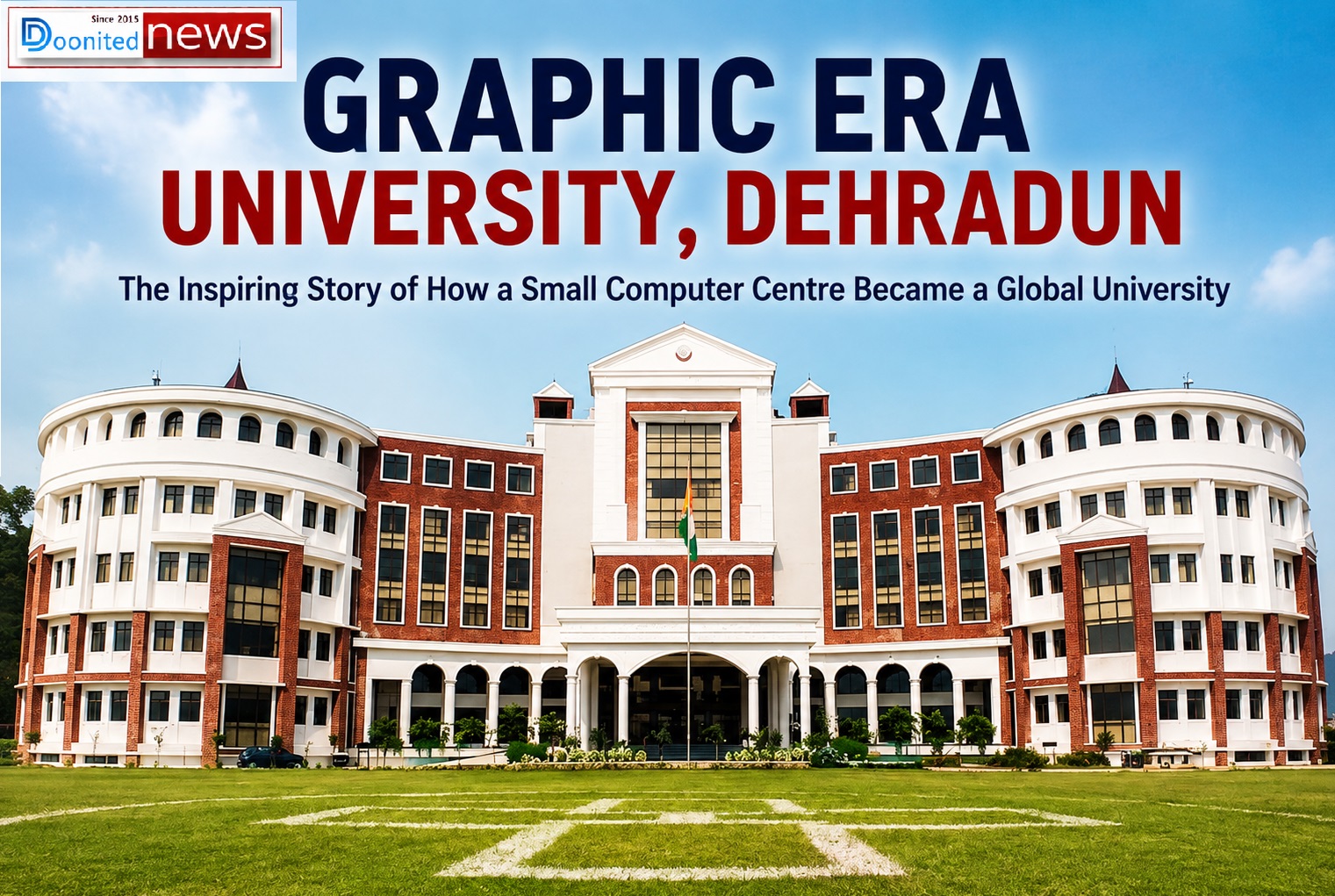
Graphic Era University Dehradun : The Inspiring Story of How a Small Computer Centre Became a Global University
By Doonited News | Education Uttarakhand
Graphic Era began in 1993 as a small computer centre in Dehradun. At that time, computer education was still emerging in many parts of India, and access to professional technical training was limited.
The institution was founded by Prof. (Dr.) Kamal Ghanshala, an educationist who believed that students from Uttarakhand and nearby regions should have access to modern technical education without having to leave their home state.
What started with a handful of students and limited resources gradually developed into a respected educational institution through academic discipline, industry-oriented teaching and continuous expansion.

From Institute to University
The institution expanded steadily during the 1990s and early 2000s. As student numbers increased and new programmes were introduced, Graphic Era evolved from a training centre into a full-fledged higher-education institution.
A major milestone came when it was granted university status and became Graphic Era University (now commonly known as Graphic Era Deemed to be University).
This transition allowed the institution to broaden its academic offerings, strengthen research activities and develop into a multidisciplinary university.

The Legacy of an Educational Dream
Graphic Era University’s history demonstrates how educational institutions can emerge from modest beginnings when driven by a clear purpose.
For many families in Uttarakhand, the university symbolizes opportunity — the possibility that students from mountain towns and smaller cities can access modern education and compete at national and global levels.
As Graphic Era moves further into its fourth decade, its journey continues to reflect the educational aspirations of Dehradun and the wider state of Uttarakhand.
What began as a small computer-training initiative has become one of the most influential educational stories of the Doon Valley.
When people talk about Dehradun as an education city, names like Doon School, Forest Research Institute and Indian Military Academy often come to mind. Yet one of the most remarkable modern educational stories of Uttarakhand belongs to Graphic Era University.
Today it is known as a major centre for engineering, management, computer science, research and innovation. But its journey began not with a grand campus or a wealthy trust. It began with a small computer training centre, a handful of students and the vision of one educationist who believed technology could change the future of Uttarakhand’s youth.
This is the story of how a modest classroom in Dehradun grew into a university with national and international recognition.
The Beginning: A Dream in 1993

The story starts in 1993, when Prof. (Dr.) Kamal Ghanshala founded a small computer institute in Dehradun. At that time, computer education was still emerging in many parts of India, and students from the Himalayan region often had limited access to modern technical training.
Dr. Ghanshala believed that talented students from Uttarakhand should not have to leave their state to pursue quality technical education. With limited resources but strong determination, he began teaching computer science and information technology courses.
Dr. Kamal Ghanshala is widely recognized as the driving force behind the Graphic Era movement. His vision was not simply to open another college; he wanted to create an institution that combined:
- strong technical education,
- practical skills,
- research culture,
- innovation,
- entrepreneurship, and
- opportunities for students from diverse backgrounds.
Former students often describe him as a founder who remained deeply involved in academic development rather than functioning only as an administrator.
Former students often recall that the early institution was known for:
personal attention,
practical learning,
discipline, and
a strong teacher-student connection.
That modest beginning became the foundation of what would later become Graphic Era University.
Why the Name “Graphic Era”?
The name reflected the founder’s vision of a new era driven by technology, graphics, computing and innovation. During the 1990s, computers were transforming business, communication and education across the world.
Graphic Era was created to prepare students for that technological future. It was never intended to be merely a coaching centre; it was conceived as an institution that would build a generation comfortable with emerging technologies.
From Computer Institute to Engineering College

As demand for technical education increased, the institute expanded into an engineering and professional education institution. New laboratories, classrooms and faculty members were added, and engineering programs became a major focus.
The growth coincided with the rapid expansion of India’s IT industry in the late 1990s and early 2000s. Many students saw engineering and computer science as pathways to new careers, and Graphic Era emerged as one of Uttarakhand’s prominent technical institutions.
From a Small Room to a Global Presence
Perhaps the most inspiring aspect of the Graphic Era story is the scale of its transformation.
1993: A small computer centre in Dehradun.
Today: A large university with national and international academic connections, thousands of students and a significant presence in higher education.
Such growth was neither automatic nor easy. It required sustained investment, academic planning, faculty development and institutional vision over several decades.
The Turning Point: Becoming a University
A major milestone came in 2008, when the institution received recognition as a Deemed to be University under the UGC framework.
This changed its role dramatically. Instead of functioning primarily as an affiliated college, it gained greater academic autonomy in designing programs, introducing new courses, promoting research and developing its own educational system.
The institution subsequently became known as Graphic Era Deemed to be University and expanded into management, commerce, sciences, humanities, law, media studies, hospitality, agriculture and several other disciplines.
The Campus That Grew with Uttarakhand

The university experience is not limited to academics. Cultural festivals, technical events, sports competitions, clubs, entrepreneurship cells and social-service activities form an important part of student life.
This broader campus culture aims to develop communication skills, teamwork, leadership and creativity alongside academic learning.

National Recognition
Graphic Era has received recognition from national higher-education bodies and has appeared in various university rankings in India. Such rankings change from year to year, so students should always consult the latest official data for current positions and accreditation details.
Nevertheless, the university is widely regarded as one of the prominent private higher-education institutions in Uttarakhand.
Contribution to Uttarakhand
One of Graphic Era’s most significant achievements is its contribution to the educational landscape of Uttarakhand. Before the rapid expansion of higher education in the state, many students had to move to metropolitan cities for technical and professional education.
Graphic Era helped create opportunities within Uttarakhand itself by:
- offering professional courses locally,
- generating academic and non-academic employment,
- attracting students from across India,
- supporting research activity in the state, and
- strengthening Dehradun’s reputation as an education hub.
Located in Clement Town, Dehradun, the campus today bears little resemblance to the small institute of 1993. Modern academic blocks, research laboratories, libraries, auditoriums, sports facilities, hostels and green spaces now form a large university environment at the foothills of the Himalayas.
Visitors are often surprised that an institution that began with a handful of students has grown into a substantial university township within just three decades.
Education Beyond Engineering
While Graphic Era is especially known for engineering and technology, its academic portfolio has expanded considerably.
Academic Area | Examples |
|---|---|
Engineering & Technology | CSE, AI, Data Science, Electronics, Civil, Mechanical |
Management & Commerce | MBA, BBA, Finance, Marketing |
Computer Applications | BCA, MCA, Software Development |
Sciences | Physics, Chemistry, Mathematics, Biotechnology |
Humanities & Social Sciences | Psychology, English, Media Studies |
Health & Allied Sciences | Pharmacy, Nursing, Allied Health programmes |
Law & Professional Studies | Integrated law and professional programmes |
This multidisciplinary expansion reflects the university’s transition from a technical institute to a comprehensive university.
“Graphic Era University Dehradun central lawn library students Uttarakhand campus photography daylight”,
“Graphic Era University Dehradun modern lecture hall innovation center engineering campus Uttarakhand”
Located in Dehradun, the university benefits from the educational environment of the Doon Valley. Over the years, the campus has developed into a large academic and residential complex with classrooms, laboratories, libraries, research facilities, hostels, sports infrastructure and innovation spaces.
The Himalayan surroundings give the campus a distinctive character that many students and visitors immediately notice.
Research, Innovation and Start-ups

In recent years, Graphic Era has increasingly emphasized research, innovation and entrepreneurship. The university has established laboratories, research centres and incubation initiatives intended to encourage students and faculty to work on technology, entrepreneurship and applied research projects.
Hackathons, innovation competitions, startup mentoring and industry collaboration have become important parts of campus life.
How Graphic Era Changed Dehradun’s Educational Identity
Dehradun has historically been famous for schools and research institutions, but Graphic Era contributed significantly to strengthening the city’s identity as a higher-education and technology hub.
Students from many Indian states now come to Dehradun specifically for professional and technical education. This has influenced the city’s economy, housing, transport, employment and educational ecosystem.
In many ways, Graphic Era helped demonstrate that Uttarakhand could become a destination for higher education rather than merely a place from which students migrate elsewhere.
Student Life Beyond Classrooms

In recent years, Graphic Era has increasingly emphasized research and innovation. The university has established laboratories, research centres and incubation initiatives intended to encourage students and faculty to work on technology, entrepreneurship and applied research projects.
Hackathons, innovation competitions, start-up mentoring and industry collaboration have become important parts of campus life.

The university experience is not limited to academics. Cultural festivals, technical events, sports competitions, clubs, entrepreneurship cells and social-service activities form an important part of student life.
This broader campus culture aims to develop communication skills, teamwork, leadership and creativity alongside academic learning.
From a Small Room to a Global Presence
Perhaps the most inspiring aspect of the Graphic Era story is the scale of its transformation.
1993
A small computer centre in Dehradun
Today
A large university with national and international academic connections, thousands of students and a significant presence in higher education
Such growth was neither automatic nor easy. It required sustained investment, academic planning, faculty development and institutional vision over several decades.

The Legacy of an Educational Dream
Graphic Era University’s history demonstrates how educational institutions can emerge from modest beginnings when driven by a clear purpose.
For many families in Uttarakhand, the university symbolizes opportunity — the possibility that students from mountain towns and smaller cities can access modern education and compete at national and global levels.
As Graphic Era moves further into its fourth decade, its journey continues to reflect the educational aspirations of Dehradun and the wider state of Uttarakhand.
What began as a small computer-training initiative has become one of the most influential educational stories of the Doon Valley.