
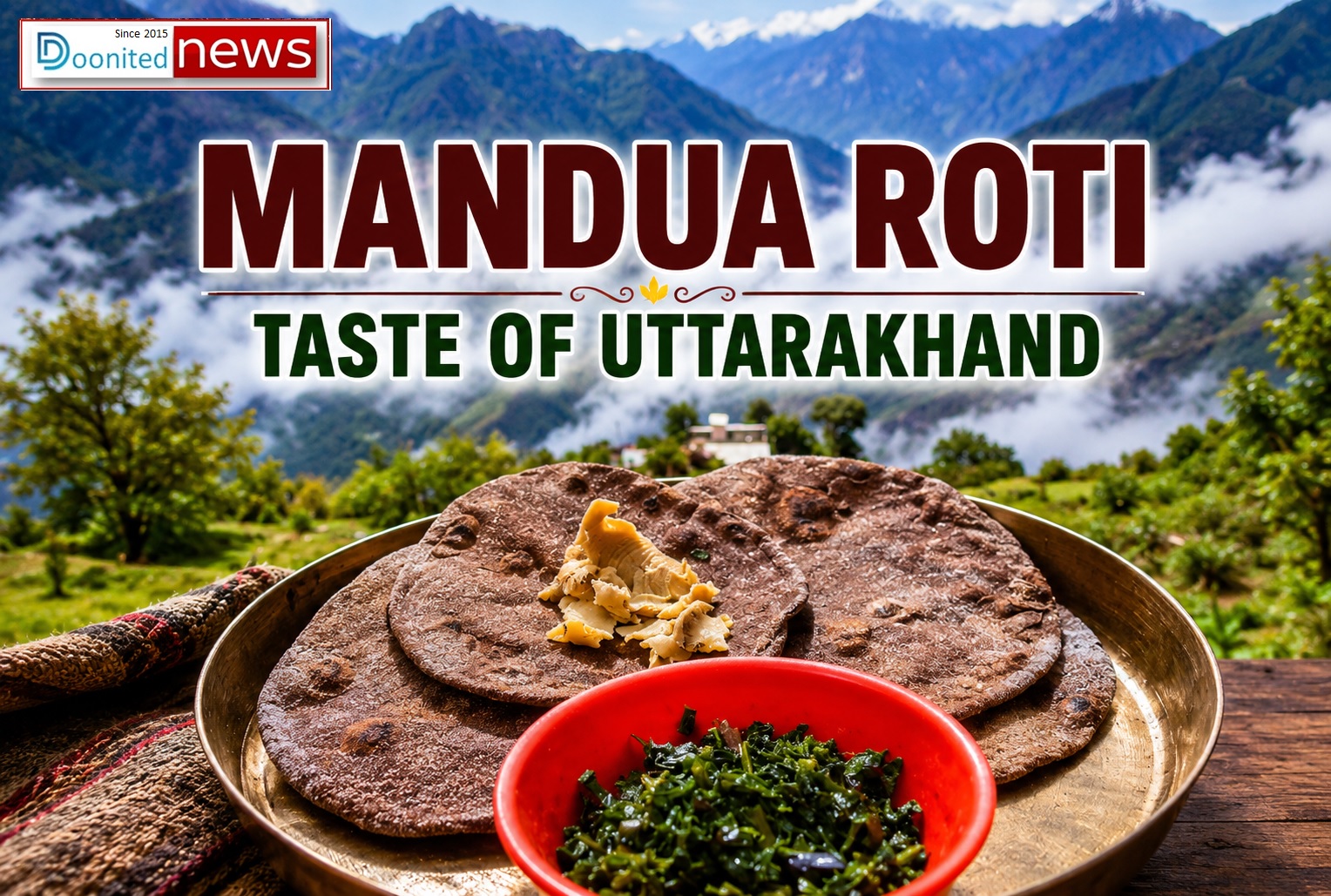
Mandua Roti: Uttarakhand’s Ancient Himalayan Grain Returning to the Modern Plate
By Doonited News | Food Uttarakhand

Long before millets became fashionable in urban supermarkets and health-food menus, families in the hills of Uttarakhand were already growing and eating mandua.
Known elsewhere in India as ragi or finger millet (Eleusine coracana), mandua has been part of the agricultural landscape and food culture of the Himalayan region for generations. Finger millet remains one of Uttarakhand’s important crops, particularly relevant to its rain-fed hill agriculture.
And perhaps no food represents this relationship between the mountain, farmer and kitchen more simply than a warm Mandua Ki Roti.
Mandua: A Grain Born for Mountain Life
Agriculture in Uttarakhand’s hills has never been easy. Terraced fields, steep slopes, variable rainfall and limited cultivable land shaped what generations of mountain communities could grow.
Finger millet became important partly because it is well adapted to rain-fed conditions. ICAR describes finger millet as a crop suited to varied environments and notes its importance as both a food and fodder crop.
In Uttarakhand, this is not merely agricultural history. Traditional varieties are still culturally significant: in 2025, ICAR reported the national registration of the traditional Uttarakhand farmer variety “Jhumkiya Mandua,” describing the state’s mountain crop diversity as connected with cultural identity, livelihoods, nutrition and adaptation.
So when we talk about mandua, we are also talking about Uttarakhand’s farming heritage.
From the Terraced Field to the Pahadi Kitchen

For generations, harvested mandua grain has been processed into a dark, earthy flour and transformed into rotis and other preparations.
Even the official Uttarakhand Tourism itinerary for Pauri and Khirsu highlights hand-rolled rotis prepared from locally grown ragi or mandua, traditionally cooked over a wood fire and served as part of a pahadi meal.
That small detail tells an important story.
Mandua roti was not invented as a modern “superfood recipe.”
It was everyday mountain food.
Why Has Mandua Suddenly Become Popular Again?
Modern interest in millets has brought renewed attention to foods that Himalayan communities have known for generations.
Finger millet is nutritionally interesting in its own right. ICAR research describes it as a source of dietary fibre and notes its particularly high calcium content relative to other cereals and millets.
Its renewed popularity therefore represents an interesting reversal: a grain once regarded primarily as traditional rural food is increasingly appearing in contemporary discussions about nutrition, climate-resilient agriculture and millet-based diets.
But its importance to Uttarakhand goes deeper than nutritional statistics.
Mandua represents continuity.
Traditional Uttarakhand Mandua Roti Recipe

Mandua flour contains no gluten, so making a pliable roti from it requires more care than making an ordinary wheat chapati. Household recipes vary considerably, and some cooks mix mandua with wheat flour to make handling easier.
Ingredients
For approximately 4–5 rotis:
- 1 cup mandua (finger millet/ragi) flour
- About ½–¾ cup warm water, added gradually
- A small pinch of salt — optional
- Ghee for serving — optional
How to Make Mandua Roti
1. Prepare the dough
Place the mandua flour in a bowl. Add warm water gradually while mixing.
Bring it together into a soft dough. Do not pour all the water at once because the quantity required can vary according to the flour.
2. Shape carefully
Take a small portion and form it into a ball.
Because pure mandua dough can crack more easily than wheat dough, flatten it gently between your palms or press/roll it carefully between sheets of food-safe material.
For beginners, mixing a little wheat flour with mandua makes the dough easier to handle, although the result is no longer a pure mandua roti.
3. Heat the tawa
Place the shaped roti onto a hot tawa.
Cook until the lower surface begins to set, then turn it over.
4. Cook both sides
Continue cooking, turning as necessary, until both sides develop cooked brown patches. Traditionally, methods vary from household to household, including finishing the roti over direct heat or a wood fire.
5. Serve immediately
Mandua roti is at its best when served hot.
A little ghee can be spread over the top if desired.

What Goes Well With Mandua Roti?
Its earthy flavour works particularly well with simple pahadi accompaniments rather than elaborate restaurant gravies.
Try it with a local dal, seasonal vegetables, leafy-green preparations, curd, chutney or other traditional Garhwali/Kumaoni dishes.
The result is the sort of uncomplicated meal that explains Uttarakhand cuisine better than an elaborate restaurant platter ever could.
More Than a Roti
There is an important cultural story hidden inside this humble brown flatbread.
For an urban consumer, mandua may be something purchased because the packet says “millet.”
For an Uttarakhand farmer, it can represent something very different: land, harvest, family food and generations of agricultural knowledge.
ICAR’s work on finger millet continues even today, including development and promotion of hill-suitable mandua varieties and processing technologies. Its Almora institute has, for example, developed finger-millet varieties for Himalayan conditions.
That gives Uttarakhand an opportunity.
Traditional mountain foods need not remain confined to nostalgia.
They can become part of the state’s modern culinary identity.
Mandua and the Future of Uttarakhand Food Tourism
Imagine visitors arriving in a Garhwal or Kumaon homestay and being served locally grown mandua roti rather than the same generic restaurant menu available everywhere else.
The visitor gets an authentic experience.
The farmer gains a market for a traditional crop.
The cook preserves regional knowledge.
And the village retains another connection with its culinary heritage.
That is where food tourism can become meaningful.
It is not merely about eating.
It is about understanding why a particular food belongs to a particular landscape.

A Taste of the Himalayas
Mandua roti may look modest beside elaborate restaurant dishes.
But that simplicity is precisely what makes its story worth telling.
It comes from a grain suited to the hills, from agricultural traditions maintained over generations, and from kitchens where food historically had to respond to the realities of mountain life.
Today, the world calls millets climate-resilient and nutritionally valuable crops.
Uttarakhand’s hills have known their value for a very long time.
And every warm mandua roti placed on a traditional pahadi plate carries a small part of that history.
This is not simply millet bread.
It is a taste of Uttarakhand’s Himalayan heritage.
Discover the Traditional Flavours of Garhwal and Kumaon