

Show Quick Read
Key points generated by AI, verified by newsroom

- US missile strikes killed three Indian seafarers in Gulf.
- Deaths overshadow G7 summit talks, impacting bilateral trade.
- India demands accountability while progressing trade agreement talks.
- Trust remains crucial for future of strategic partnership.
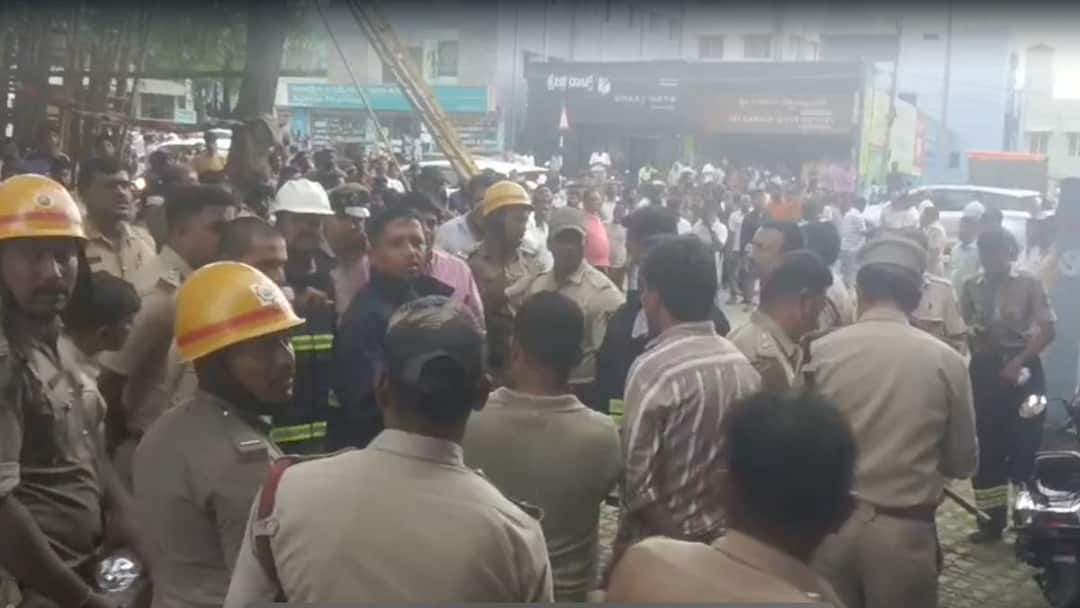
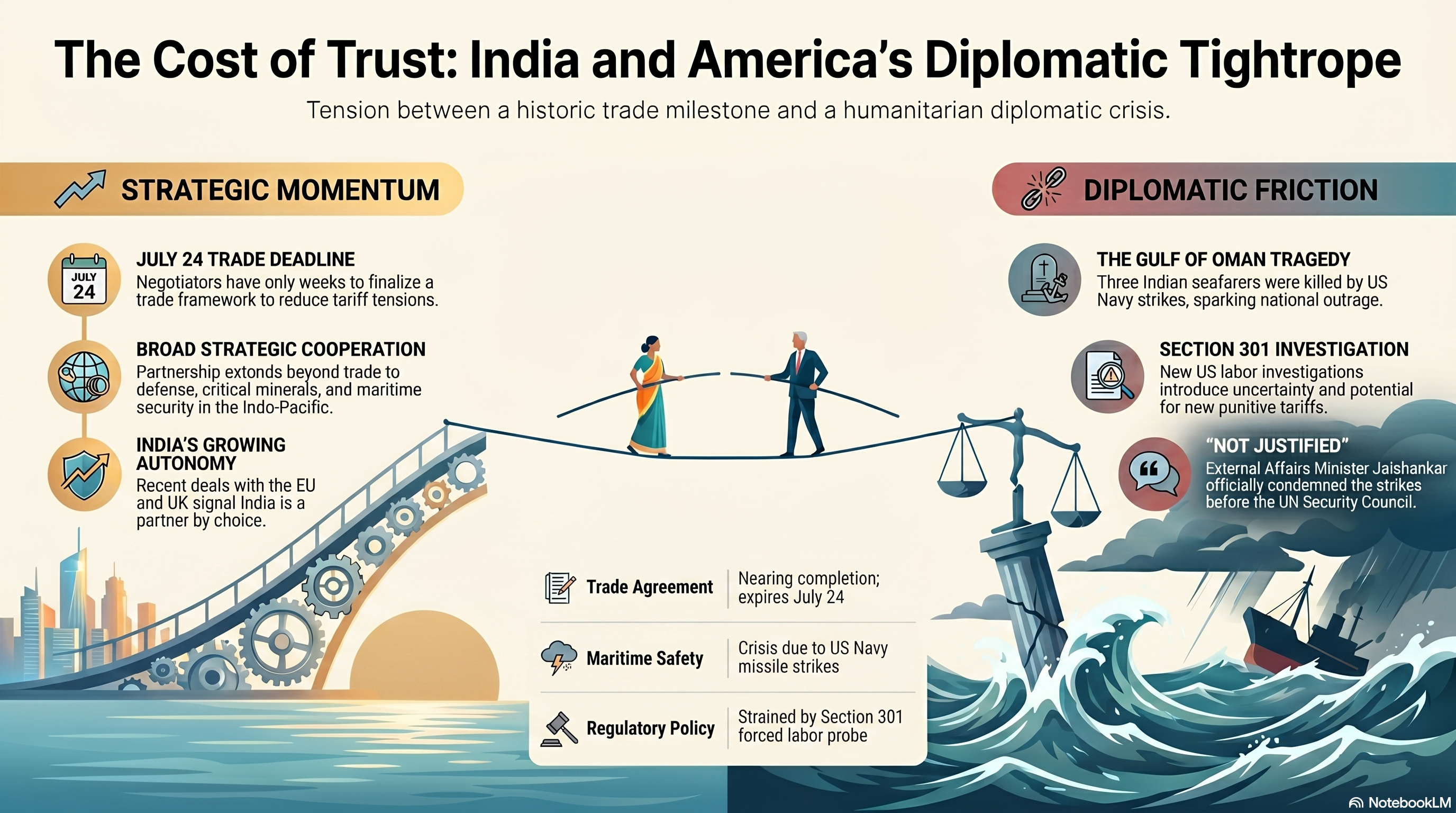
Diplomacy often asks nations to hold contradictory truths at the same time. Few moments illustrate this better than the one confronting India and the United States today. On one hand, the two countries are closer than ever to concluding a major trade agreement that could reshape economic relations for years to come. On the other hand, three Indian seafarers are dead, killed in missile strikes carried out by the United States Navy in the Gulf of Oman. Twenty-one others survived only after being pulled from the water.
The timing could hardly be worse. Prime Minister Narendra Modi is heading to France for the G7 summit, where discussions with US President Donald Trump are expected to focus heavily on trade, strategic cooperation, and the future of the bilateral relationship. Yet the deaths of Indian citizens at the hands of American forces now hang over every conversation.
India has responded with unusual clarity. External Affairs Minister S. Jaishankar reportedly conveyed to his American counterpart that the strikes were “not justified.” The US Charge d’Affaires was summoned twice within three days. New Delhi raised the matter before the United Nations Security Council. These are not the actions of a government willing to quietly absorb a diplomatic embarrassment. They signal genuine anger and a determination to establish accountability.
A Crisis That Tests a Strategic Partnership
At the same time, India has been careful not to allow outrage to become rupture. That restraint reflects a larger reality: the India-US relationship has become too important to either side to be sacrificed on the altar of a single crisis, however tragic.
This is what makes the present moment so politically and morally complex.
The deaths of the seafarers occurred against the backdrop of a carefully managed diplomatic recovery. For much of the past year, relations between Washington and New Delhi had been strained by tariff disputes, disagreements over trade access, and concerns in India about the Trump administration’s outreach to Pakistan and engagement with China. When Secretary of State Marco Rubio visited India in late May, the trip was widely interpreted as an effort to repair those strains.
Trade Talks Gain Momentum Despite Tensions
The optics were positive. Meetings were cordial. The Quad framework was reaffirmed. Discussions on trade advanced significantly. By early June, negotiators on both sides appeared close to finalising an interim trade arrangement that would reduce tariff tensions and establish a roadmap for deeper economic integration.
The proposed agreement is significant. It follows nearly a year of tariff escalation that pushed duties on some Indian exports to punitive levels. The framework reached in February lowered reciprocal tariff rates and created a pathway for expanded trade in energy, technology, aviation, and industrial goods. Both governments portrayed the arrangement as a foundation for a more stable economic partnership.
Yet even before the Gulf of Oman strikes, obstacles remained.
ALSO READ: OPINION | The Quad Cannot Afford Silence As China Seeks To Redraw Asia’s Balance Of Power
Section 301 Probe Adds New Uncertainty
The United States Trade Representative’s decision to launch a broad Section 301 investigation into imports connected to forced labour introduced fresh uncertainty. India now faces the possibility of additional tariffs unless it secures satisfactory assurances from Washington. Unsurprisingly, New Delhi has linked progress on the Bilateral Trade Agreement to a favourable outcome in the investigation.
The deadline is looming. The current tariff framework expires on July 24. Negotiators have only a few weeks to bridge remaining differences and transform political intent into legally binding commitments.
That urgency explains why Modi’s meeting with Trump matters so much.
Why Modi and Trump Hold the Key
The challenge before both leaders is not simply economic. It is political. Trade negotiators can settle technical questions regarding customs procedures, market access, and tariff schedules. What they cannot provide is the political authority required to make the final compromises that every major agreement demands. Only national leaders can do that.
But politics cannot erase morality.
The deaths of the three Indian seafarers are not a footnote in a trade discussion. They are not an unfortunate complication to be managed or a diplomatic inconvenience to be postponed. They represent a fundamental test of how the United States treats a strategic partner and how India defends the interests of its citizens abroad.
Accountability Cannot Be an Afterthought
If Washington expects the incident to fade into the background while negotiations proceed, it misunderstands the mood in India. Public opinion is unlikely to accept a purely procedural response. There must be transparency regarding the circumstances of the strikes, accountability where appropriate, and recognition of the human cost involved.
At the same time, there is a danger in allowing legitimate anger to obscure larger strategic realities.
The India-US relationship today extends far beyond trade. It encompasses defence cooperation, technology transfers, critical minerals, maritime security, supply chain resilience, and the broader balance of power in the Indo-Pacific. Both countries view each other as essential partners in navigating an increasingly fragmented international order.
ALSO READ: OPINION | BJP’s Growing Attraction For Political Heavyweights: A Boon Or A Challenge?
India’s Growing Strategic and Economic Options
India also has options that it did not possess a decade ago. Recent trade agreements with the United Kingdom, the European Union, Oman, and New Zealand demonstrate a growing confidence in New Delhi’s ability to diversify its economic relationships. The message to Washington is unmistakable: India is a partner by choice, not necessity.
That reality should encourage humility on both sides.
For the United States, it means recognising that strategic partnerships require respect as well as shared interests. For India, it means understanding that even serious crises need not derail relationships that serve long-term national objectives.
Lessons From a History of Managed Differences
History suggests that resilient partnerships are not those that avoid conflict but those that manage it effectively. India and the United States have weathered disagreements over nuclear policy, sanctions, trade barriers, defence procurement, and geopolitical priorities. Each time, both governments eventually concluded that the benefits of cooperation outweighed the costs of confrontation.
The question now is whether that logic still holds under the weight of three coffins.
As Modi and Trump meet at Évian, they face a narrow but important opportunity. The immediate task is straightforward: reaffirm commitment to concluding the trade agreement before July 24 and prevent the Section 301 process from becoming another source of mistrust. Simultaneously, Washington must address India’s concerns regarding the Gulf of Oman strikes with seriousness and credibility.
Trust Remains the Deciding Factor
Neither objective excludes the other. In fact, they are interconnected. Trust is the invisible currency that sustains strategic partnerships. Without it, trade deals become fragile, defence cooperation becomes transactional, and diplomatic rhetoric loses meaning.
The deaths of the three seafarers have exposed a painful fault line in the India–US relationship. Whether that fault line widens into a fracture or becomes the catalyst for a more mature partnership depends on what happens next.
The deal can still be done. The strategic logic remains compelling. But before the signatures, the tariff schedules, and the press conferences, there are three Indian families mourning loved ones who will never come home.
No successful partnership can afford to forget that.
The writer is a technocrat, political analyst, and author.
[Disclaimer: The opinions, beliefs, and views expressed by the various authors and forum participants on this website are personal and do not reflect the opinions, beliefs, and views of ABP News Network Pvt Ltd.]
POLITICS: Lok Sabha Speaker to Hear Both TMC Factions Before Decision
Doonited Affiliated: Syndicate News Hunt
This report has been published as part of an auto-generated syndicated wire feed. Except for the headline, the content has not been modified or edited by Doonited