
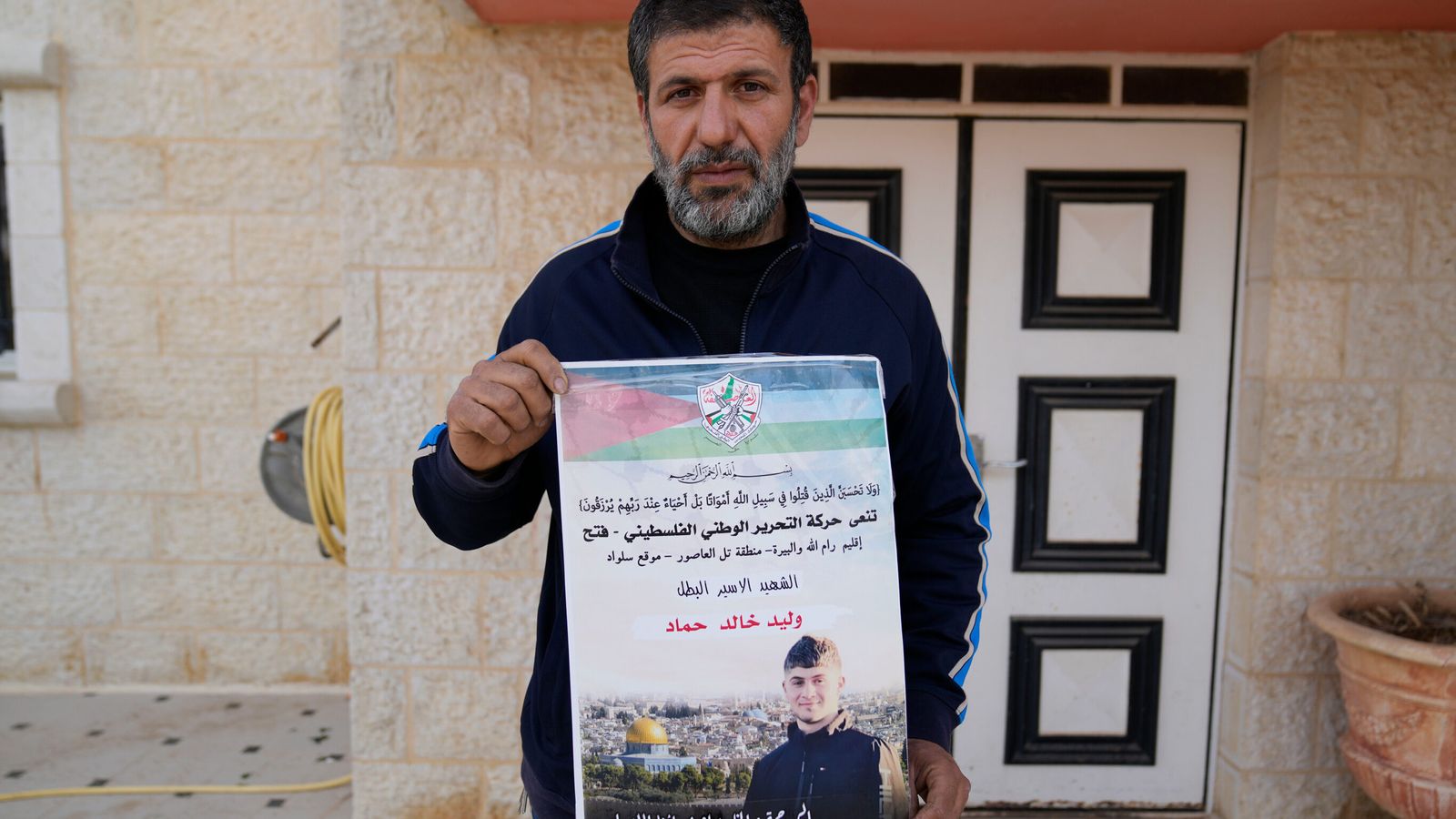
A Palestinian teenager was starved in an Israeli prison before his death, a judge ruled before closing the case.
According to a newly-unsealed court decision, the judge said it was clear 17-year-old Walid Ahmad was starved, but the cause of death was undeterminable.
The case drew attention as he was the first Palestinian under 18 to die in Israeli detention, Palestinian officials said.
Ahmad, described by his family as a healthy teenager, spent six months in Israel’s Megiddo prison before collapsing in March 2025.

His family say he was arrested at his home in the occupied West Bank town of Silwad, during a pre-dawn raid in September 2024, for allegedly throwing stones at soldiers.
An autopsy did not establish a single, definitive cause of death but starvation was likely to be the leading cause, according to the report of an Israeli doctor who observed the procedure.
Dr Daniel Solomon also noted that the teen was suffering from extreme malnutrition and showed signs of scabies.
In the now-unsealed ruling, first published by Israeli daily newspaper Haaretz, the Israeli judge supervising the investigation ordered that the probe be halted in December.
The judge said evidence of Ahmad’s starvation did not prove the cause of death.
Read more:
Woman pleads not guilty to attempted murder of Rihanna
Social media giants found liable for social media addiction
Judge Ehud Kaplan, according to the ruling shared with The Associated Press by Haaretz, wrote: “The fact that he was apparently starved cannot be hidden and should not be hidden.
“But I cannot determine based on the findings of the expert report that there is a causal connection between his poor physical condition and his death, and therefore I cannot determine that the death was caused by a crime.”
He added: “Given this state of affairs, the investigation into his death is exhausted.”
In Israel, judges can be requested to oversee an investigation into deaths of detainees in custody.
They are able to seek and review evidence to determine the cause of death, and establish if it resulted from wrongdoing by any party.
If evidence of wrongdoing is established, the judge can move toward criminal indictments. Or, as was done in Ahmad’s case, they can order an investigation be stopped.
Haaretz published the ruling after successfully filing for a gag order on the case to be lifted.
Doonited Affiliated: Syndicate News Hunt
This report has been published as part of an auto-generated syndicated wire feed. Except for the headline, the content has not been modified or edited by Doonited