
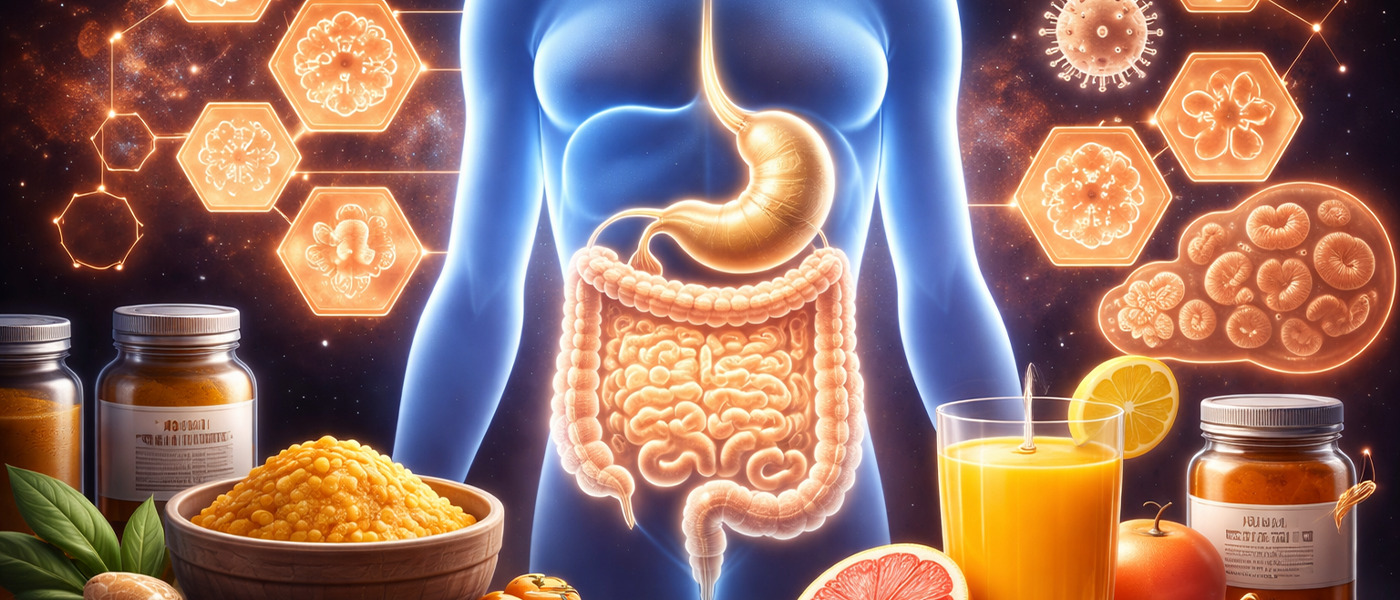
The Ayurvedic View of Gut Health
In Ayurveda, gut health is the foundation of overall well-being, governing digestion, nourishment, and immunity. Central to this is agni (digestive fire), which controls food breakdown, nutrient absorption, and formation of dhatus (body tissues).
Balanced agni (digestive fire) supports health, while weak agni leads to ama (toxin build up/metabolic waste), formed from improper digestion. Ama (toxin buildup) blocks srotas (body channels), hampering nutrient flow and causing inflammation.
Gut health is also affected by dosha imbalance, or disturbance in the internal bio-energies – Vata (governs movement), Pitta (linked to metabolism), and Kapha (associated with structure).

Why Gut Health Is Especially Important for Women
Certain gut bacteria, known as the estrobolome, help metabolise estrogen (the main female hormone). Imbalance in the gut may disrupt this process, affecting menstrual cycle health, fertility, and overall hormonal balance.
Since women routinely experience hormonal fluctuations during menstruation, pregnancy, and menopause, maintaining gut health becomes especially important. An imbalanced gut would, otherwise, aggravate hormonal balance.
Women experience higher hormonal sensitivity due to fluctuations in estrogen and progesterone across life stages. These changes affect:
• Mood, sleep, and energy
• Appetite and metabolism
• Digestive function
Monthly Cycle and Digestion
Menstrual cycle health is affected by digestion, and, in turn, impacts digestion through changes in estrogen and progesterone hormones. These changes influence gut motility (movement of food through the digestive system), appetite, and sensitivity.
Here’s how the monthly cycle impacts digestion:
• Follicular phase (menstruation to ovulation): rising estrogen supports better gastrointestinal motility (movement of food), smoother digestion, and stable appetite
• Ovulation: peak estrogen maintains efficient digestion and supports microbiome balance
• Luteal phase (post-ovulation): higher progesterone slows motility, which may cause bloating, constipation, heaviness, and increased cravings

Stress and Gut Balance
Stress directly affects digestion through the gut–brain axis (gut–brain communication system) and:
How Gut Imbalance Can Affect Hormones
In Ayurveda, hormones are not described directly but are understood through agni (metabolic fire), dhatu poshana (tissue nourishment), and dosha balance – or the balance of internal bio-energies – Vata Dosha (governs movement), Pitta Dosha (linked to metabolism), and Kapha Dosha (associated with structure).
The 2nd -century Ayurvedic treatise, ‘Charaka Samhita’, highlights the central role of gut health by stating, ‘rogah sarve api mande agnau’, meaning ‘all diseases arise from weak digestion’.
Nutrient Deficiency
Weak digestion impairs the formation of dhatus (body tissues), leading to dhatu kshaya (tissue depletion). As stated in the ‘Charaka Samhita’, ‘rasa dhatu kshaye sarve dhatavah kshiyante’, which translates to ‘when the primary nutrient essence is depleted, all tissues weaken’.
When the tissues – primarily Rakta (blood tissue), Meda (fat tissue), and Shukra/Artava (reproductive tissue) – are undernourished, hormonal functions are disturbed, leading to irregular menstrual cycles and reduced vitality and poor reproductive health.
Inflammation
Incomplete digestion forms ama (toxin buildup), which blocks srotas (body channels). These blockages disrupt nutrient absorption, creating a state of chronic inflammation. When ama (toxins) combines with doshas, it further aggravates imbalance and inflammation.
This is why poor gut health can lead to inflammatory issues such as irregular cycles, skin concerns, and metabolic disturbances – making inflammation a key link between the gut and hormonal health.
Metabolic Sluggishness
The classical text ‘Ashtanga Hridaya’, states: ‘agnimandya … vyadhinam ashrayah’ or ‘low agni (digestive fire) is the root of many diseases)’. Weak agni, it is believed, leads to agnimandya (low metabolic activity), slowing all body processes.
This impacts hormonal regulation, leading to:
• Weight gain or difficulty losing weight
• Lethargy and low energy
• Hormonal irregularities
Disturbances in the doshas (internal bioenergies) are also an important factor impacting the gut and hormonal balance.
• Vata Dosha imbalance (energy of movement) leads to irregular cycles and variable digestion
• Pitta imbalance (impacts metabolism directly) triggers inflammation, heat, and irritability
• Kapha imbalance (associated with structure) causes sluggish metabolism and weight gain
Signs of Poor Gut Health in Women
Below are the signs of poor gut health in women.
Bloating, gas and bowel movement irregularities: These are linked to aggravated Vata (internal bio-energy) and Vishama Agni (irregular digestion).
Fatigue: Weak digestion affects Rasa Dhatu (primary nutrient fluid), leading to dhatu kshaya (tissue depletion). This causes fatigue, which may also show up as low vitality, weak immunity and mental dullness.
Skin issues: These reflect Rakta Dhatu (blood tissue) and Pitta (bio-energy) balance. Poor gut health and ama (toxin buildup), combined with Pitta aggravation, lead to inflammation and trigger problems like acne, breakouts, rashes and sensitivity.
Mood changes: Gut imbalance affects manas (mind) through the gut-brain connection and may show up as irritability, anxiety, mood changes and brain fog.

How to Improve Gut Health Naturally
As per the ‘Charaka Samhita’, proper food sustains the body and is the key to health, including hormonal balance. Here are Ayurvedic factors connected with improving gut health naturally.

Doonited Affiliated: Syndicate News Hunt
This report has been published as part of an auto-generated syndicated wire feed. Except for the headline, the content has not been modified or edited by Doonited