
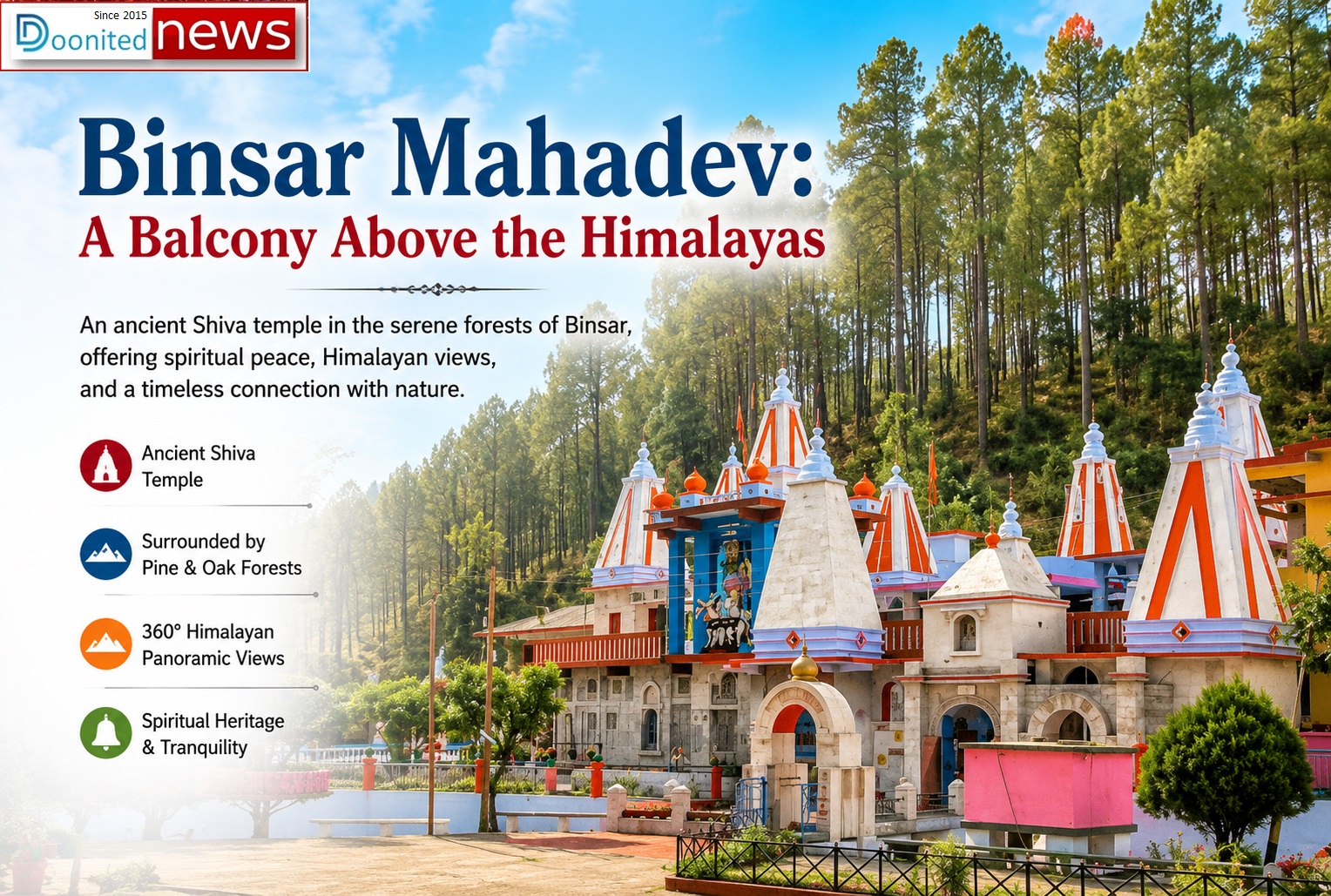
Binsar: The Himalayan Silence That Still Watches Over Kumaon
By Doonited News | Heritage Uttarakhand
In an age when most hill stations announce themselves with traffic, hotels and crowded viewpoints, Binsar does the opposite. It whispers.
Perched on a forested ridge in Almora district of Uttarakhand, Binsar is one of those rare Himalayan destinations where the loudest sound is often birdsong and the clearest view is not of a marketplace but of snow peaks stretching across the horizon.
Famous for its wildlife sanctuary, ancient forests, Zero Point panorama and royal Kumaoni history, Binsar feels less like a tourist stop and more like a forgotten Himalayan kingdom still guarded by trees.
The Road Into the Forest
The final stretch to Binsar passes through thick oak and pine woods. Sunlight filters through the leaves, langurs leap across branches, and the air grows noticeably cooler with every turn.

Zero Point: A Balcony Above the Himalayas
The most celebrated place in Binsar is Zero Point, a viewpoint that offers one of the finest mountain panoramas in Kumaon.
On a clear morning, the Himalayan skyline appears almost impossibly close: Nanda Devi, Trishul, Nanda Kot, Panchachuli and other snow-clad peaks rise above layers of blue ridges.

Travelers often arrive before sunrise and wait in silence as the first light turns the peaks from silver to gold. The spectacle lasts only a few minutes, but many visitors remember it for years.
A local forest guard smiled and said, “In Binsar, the mountains wake you up before the alarm does.”
A Sanctuary of Birds and Wild Forests
Binsar is not only a viewpoint; it is a protected ecological treasure. The Binsar Wildlife Sanctuary shelters dense Himalayan broadleaf forests and a remarkable variety of birdlife.

Birdwatchers come searching for woodpeckers, laughingthrushes, flycatchers and other Himalayan species. Leopards, barking deer, goral and Himalayan black bears inhabit the sanctuary, though sightings require patience and luck.
Walking through these forests is less about spotting wildlife immediately and more about feeling the living rhythm of the Himalayan ecosystem.
When Binsar Was a Royal Summer Capital
Long before it became a nature retreat, Binsar was associated with the Chand dynasty, the rulers who once governed much of Kumaon. Historical records indicate that the region served as a summer retreat for the Chand kings, who valued its cool climate and commanding mountain views.

Standing on the ridge today, it is easy to understand why royalty chose this place. The forests provide natural shelter, the air remains fresh even in summer, and the Himalayan horizon creates a sense of grandeur that no palace wall could rival.
Binsar Mahadev: The Sacred Heart of the Forest
No story of Binsar is complete without Binsar Mahadev, the ancient Shiva shrine that gives the region much of its spiritual identity.

The better-known temple lies near Ranikhet in Almora district, surrounded by deodar and oak forests. Another historically significant Binsar Mahadev site exists in the Chauthan region of Pauri Garhwal, reflecting the wider spread of Shiva worship across Uttarakhand’s mountain communities.
Pilgrims visit the temple not only for ritual worship but also for the extraordinary serenity of the forest setting. The fragrance of deodar, the sound of bells and the mountain breeze create an atmosphere that feels distinctly Himalayan.
A Temple Hidden Among Cedars
Unlike many large pilgrimage centres, Binsar Mahadev remains modest in scale. Its stone structure blends naturally with the surrounding forest.

5
Local devotees often describe the shrine as a place where Shiva is worshipped in silence rather than spectacle. During festivals such as Mahashivaratri, the temple becomes lively with prayers and traditional Kumaoni devotional music, yet it quickly returns to its tranquil forest rhythm.
The Binsar Morning
One of the greatest luxuries in Binsar costs nothing: morning.
Mist drifts through the trees, distant peaks emerge slowly from the clouds, and the forest seems to breathe with the rising sun.

Visitors who stay overnight often find themselves waking early without effort. The combination of cool air, silence and mountain light creates a rare sense of calm that many urban travelers have forgotten.
More Than a Hill Station
Binsar refuses to fit neatly into a single category.
|
What it is |
Why it matters |
|---|---|
|
Wildlife sanctuary |
Protects rich Himalayan biodiversity |
|
Viewpoint |
Offers one of Kumaon’s finest Himalayan panoramas |
|
Historic landscape |
Linked with the Chand dynasty’s summer retreat |
|
Spiritual destination |
Home to the ancient Binsar Mahadev temple tradition |
|
Nature retreat |
Provides silence, forest walks and mountain solitude |
This layered identity is what makes Binsar unusual. It satisfies birdwatchers, photographers, pilgrims, historians and quiet seekers all at once.
The Evening That Stays With You
As sunset approaches, the forests darken gently while the snow peaks catch the final light. Smoke rises from distant village houses, birds settle into the trees, and the ridge grows quiet.

Unlike crowded tourist towns where evenings are filled with noise, Binsar ends the day with stillness. Many visitors discover that this stillness becomes the memory they carry home.
Why Binsar Matters Today
In a rapidly commercializing Himalaya, Binsar offers an important reminder: mountain tourism does not always need amusement parks, traffic and loud entertainment.
Its greatest attractions are forest, sky, wildlife, history and silence.
That simplicity is precisely its strength.
The Himalayan Kingdom of Quiet
From the royal legacy of the Chand dynasty to the sacred presence of Binsar Mahadev, from the dense sanctuary forests to the vast panorama of Zero Point, Binsar tells a story that is both historical and deeply personal.
It is a place where the Himalayas are not merely seen—they are felt.
Binsar remains one of Uttarakhand’s rarest treasures: a quiet Himalayan kingdom where forests guard history, temples preserve faith, and the mountains still speak in silence.