Woodstock School, Mussoorie: 170+ Years of International Education in the Himalayas
By Doonited News | Education Uttarakhand

High above the Doon Valley, amid the forests and mountain slopes of Landour near Mussoorie, stands an educational institution whose history began long before India’s independence.
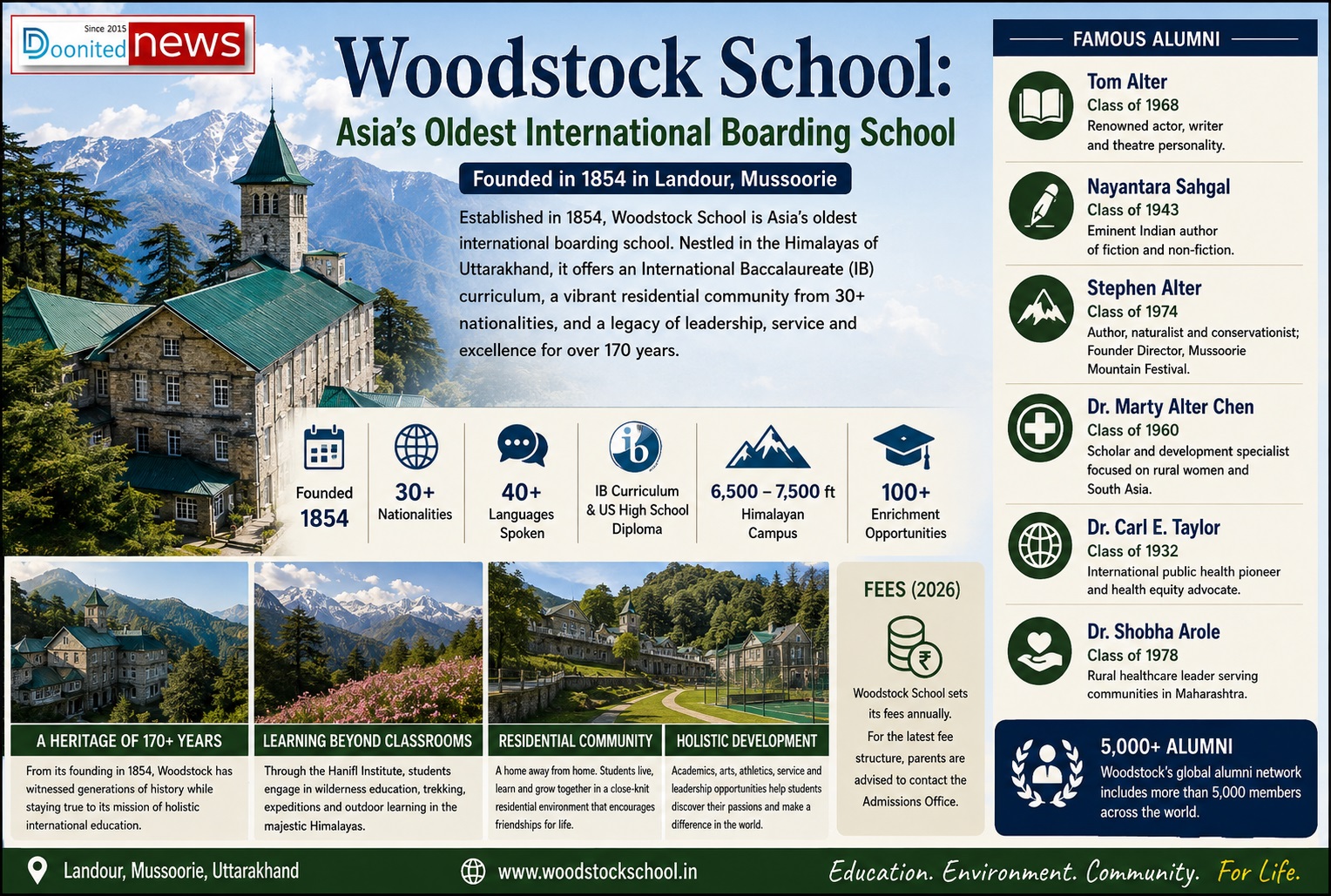
Woodstock School, founded in 1854, describes itself as Asia’s oldest international boarding school. Today it is an international, co-educational residential school educating students in Grades 6–12 and drawing its community from countries around the world.
More than 170 years after its establishment, Woodstock’s identity is shaped by an unusual combination: Himalayan surroundings, international education, residential life, outdoor learning and a remarkably diverse student community.
But how did a school established in the nineteenth-century Himalayan hill station become an internationally recognized educational institution?
A School Founded in 1854
Woodstock’s story begins in 1854.
According to the school’s official history, Woodstock was the first international boarding school founded in India and Asia. Its long history means that generations of students at Woodstock have lived through some of the most consequential periods of modern Indian history — including the colonial era, two world wars, Indian independence and Partition, and India’s subsequent transformation into a modern global economy.
That historical continuity makes Woodstock unusual even among India’s celebrated residential schools.
The institution that exists today is naturally very different from the school of the nineteenth century, but its location in the Himalayan foothills remains central to its identity.

Founded in 1854, Woodstock School has been part of the educational landscape of Mussoorie and Landour for more than 170 years.
Education in the Mountains
The campus occupies a dramatic Himalayan hillside above Mussoorie, with buildings spread across steep, forested terrain. The school says its campus ranges from approximately 6,500 to 7,500 feet in elevation.
Students therefore do not simply look at the Himalayas from a classroom window.
The mountains become part of school life.
Walking between buildings, participating in outdoor programmes and experiencing changing Himalayan seasons all form part of living and studying at Woodstock.
This physical environment has also helped the school build a strong tradition of outdoor and experiential education.
An International Community in Uttarakhand
One of Woodstock’s defining characteristics is the diversity of its community.
The school’s current information says its community represents more than 30 nationalities, with approximately 40 languages spoken.
This makes Woodstock quite different from a residential school whose student body is drawn predominantly from one state or country.
Students can find themselves sharing classrooms, dormitories, meals and activities with classmates from very different cultural backgrounds.
That international environment is not simply a marketing label. In a residential school, students live together for much of the academic year, meaning cultural interaction becomes part of everyday education.
The school describes its purpose in terms extending beyond examination performance toward purpose, service and leadership.

Woodstock’s residential community brings together students from numerous nationalities and cultural backgrounds.
An International Baccalaureate World School
Woodstock is an International Baccalaureate World School.
Its current admissions material states that the school follows the IB curriculum and also provides students with an opportunity to obtain a US High School Diploma.
The IB approach places considerable emphasis on inquiry, critical thinking, research, communication and international-mindedness.
For a school such as Woodstock, the curriculum fits naturally with the international character of its student body.
The objective is not simply to prepare students for one national university system.
Woodstock says its graduates receive offers from universities around the world.
Education Beyond the Classroom
One of the strongest features of the Woodstock model is the importance given to learning outside conventional academic spaces.
The school operates a wilderness and outdoor education programme connected with the Hanifl Institute. Students have opportunities to experience the Himalayan environment through activities such as hiking, outdoor expeditions and other forms of experiential learning.
This is where Woodstock’s Uttarakhand location becomes an educational resource.
A mountain trail can become a classroom.
A forest can provide lessons in ecology.
An expedition can teach leadership, teamwork, resilience and decision-making in ways that are difficult to reproduce inside a conventional classroom.
The school also reports more than 100 enrichment opportunities for students.
— Himalayan Outdoor Education
Woodstock uses its Himalayan location for outdoor and wilderness education, making the surrounding landscape part of the learning experience.
Residential Life at Woodstock
Boarding education means that school does not end when classes finish.
Woodstock’s students live within residential facilities connected to the campus, where dormitory life becomes another important element of education.
Friendships, activities, sports, music, conversations and community responsibilities continue beyond formal school hours.
This is one reason residential schools can have such a lasting influence on their alumni.
Woodstock’s alumni network today includes more than 5,000 members around the world.
Famous Alumni of Woodstock School
Perhaps the clearest evidence of Woodstock’s international reach can be found in the extraordinary variety of careers pursued by its former students.
The school’s own Distinguished Alumni records document graduates who have made contributions to literature, cinema, medicine, public administration, development, science and social service.
Among its notable former students are:
Tom Alter — Actor, Writer and Theatre Personality
Tom Alter was a member of Woodstock’s Class of 1968.
He became one of the most recognizable actors of his generation, working extensively in Hindi cinema as well as theatre, television, literature and sports journalism.
Woodstock includes him among its Distinguished Alumni.
Tom Alter
Actor and theatre personality Tom Alter, Woodstock School Class of 1968, became one of the institution’s best-known alumni.
Nayantara Sahgal — Celebrated Indian Writer
Nayantara Sahgal, from the Class of 1943, became a prominent Indian author of fiction and non-fiction.
Woodstock recognizes her among its Distinguished Alumni for her lifetime achievement as a writer.
Her connection to the institution also provides an important reminder that Woodstock’s history stretches across the transition from colonial India to independence.
Stephen Alter — Author and Naturalist
Stephen Alter, Class of 1974, is another notable name closely connected with both Woodstock and Mussoorie.
An author, naturalist and conservationist, Alter has written extensively about the Himalayas and was founding director of the Mussoorie Mountain Festival.
Woodstock named him recipient of its 2020 Distinguished Alumni Award.
His story is particularly connected to the school: he attended Woodstock from first through twelfth grade, while members of his family also served the institution across generations.
Dr. Marty Alter Chen — Scholar and Development Specialist
Another distinguished graduate is Dr. Marty Alter Chen, Class of 1960.
Her academic and development work has focused particularly on poor working women and rural women in South Asia. Woodstock recognizes her among its Distinguished Alumni.
Dr. Carl E. Taylor — International Public-Health Pioneer
Dr. Carl E. Taylor, Class of 1932, devoted his professional life to international public health and health equity.
Woodstock’s Distinguished Alumni records recognize his contribution to improving healthcare internationally.
Dr. Shobha Arole — Rural Healthcare
Dr. Shobha Arole, Class of 1978, has been recognized by Woodstock for her contribution to rural healthcare and her work serving communities living in extreme poverty in Maharashtra.
More Than a Famous Alumni List
The diversity of these alumni is arguably more revealing than celebrity alone.
An actor.
A novelist.
A naturalist.
A public-health specialist.
A development scholar.
A civil servant.
Their careers demonstrate that Woodstock’s educational legacy cannot be measured through one profession or industry.
The school’s own Distinguished Alumni programme explicitly recognizes lifelong achievement, philanthropy and service reflecting the values it seeks to develop in its students.
Woodstock and Mussoorie’s Educational Heritage
Woodstock’s importance extends beyond the institution itself.
Mussoorie and neighbouring Landour have a long educational history shaped partly by the development of the Himalayan hill station during the nineteenth century.
Today, visitors generally associate Mussoorie with tourism — Mall Road, mountain views, Landour, cafés and colonial-era architecture.
But education is another important strand in the area’s identity.
Woodstock has occupied a place within that landscape since 1854.
Its continued existence connects modern Uttarakhand with a period more than a century before the state itself was created in 2000.
From 1854 to the Age of Artificial Intelligence
Consider how dramatically education has changed during Woodstock’s lifetime.
When the institution was established, India was still under East India Company rule.
There was no independent India.
No Uttarakhand state.
No internet.
No commercial aviation.
No computers.
And certainly no artificial intelligence.
Today, Woodstock educates students from around the world within an internationally oriented academic environment.
Yet some fundamental educational questions have remained surprisingly constant.
How should young people learn to think independently?
How do students from different cultures learn to live together?
How should education develop character alongside academic ability?
And how can knowledge eventually be used in service of society?
Those questions connect Woodstock’s past with its present.
A Himalayan School With a Global Story
It represents an unusual intersection of Uttarakhand’s Himalayan geography and international education.
Founded in 1854, it has survived enormous political, technological and social change while developing a worldwide alumni community.
Its graduates have entered cinema, literature, academia, healthcare, public service, development and numerous other fields.
And every new generation continues its education on essentially the same Himalayan slopes.
For Uttarakhand, institutions such as Woodstock add another dimension to the state’s identity.
The mountains attract pilgrims.
They attract trekkers.
They attract travellers.
But for more than 170 years, they have also attracted students.
That makes Woodstock School an important chapter in the educational heritage of Mussoorie, Landour and Uttarakhand.