
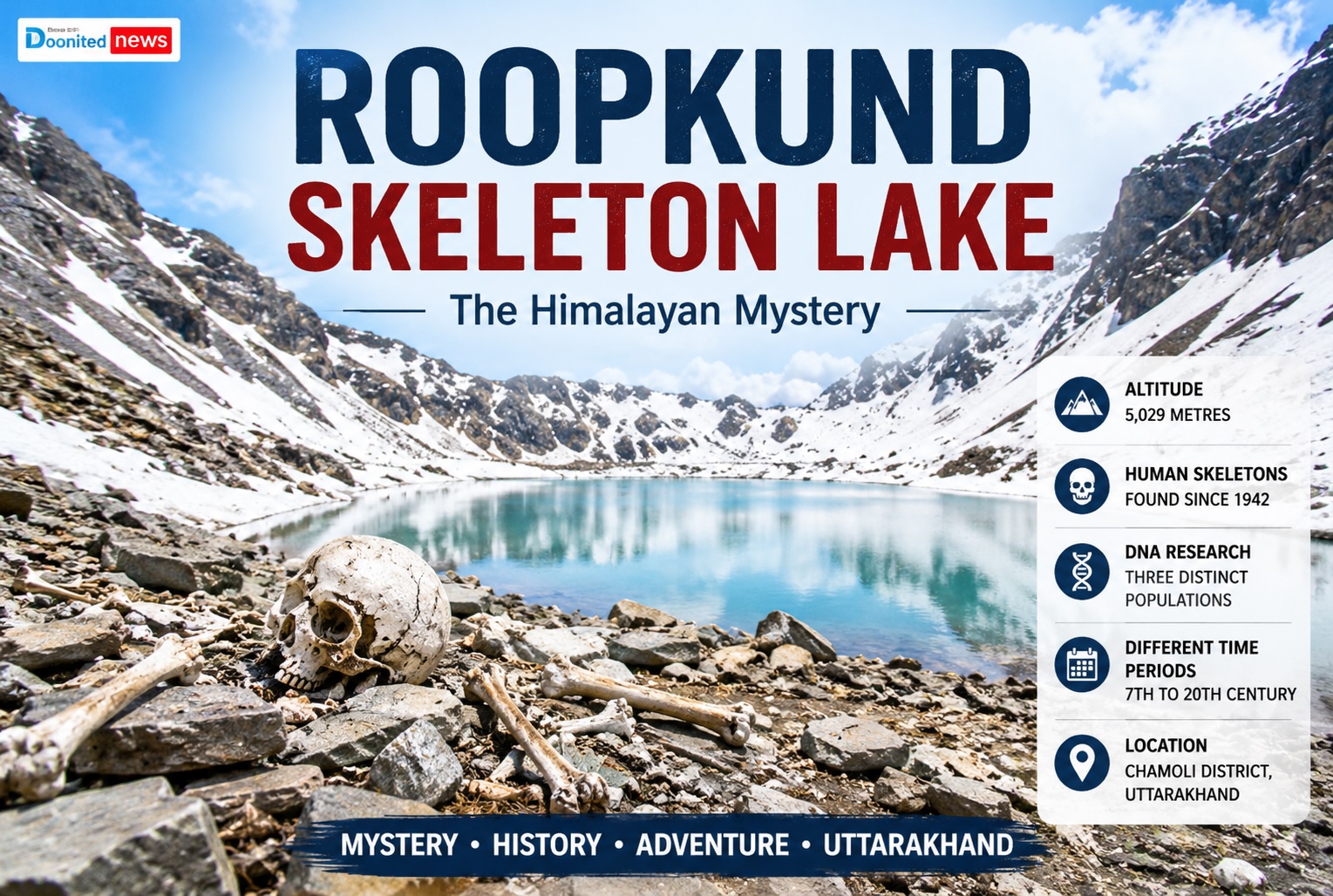
Roopkund Lake: The Mystery of Uttarakhand’s Skeleton Lake High in the Himalayas
By Doonited News | Adventure Uttarakhand
High in the Himalayas of Uttarakhand lies a small glacial lake with a mystery unlike almost anywhere else in India.
For much of the year, Roopkund Lake remains surrounded by snow and ice. But when conditions expose the lake and its shores, something extraordinary has historically appeared among the rocks:
human bones and skeletons.
Hundreds of human skeletal remains have been reported around this remote Himalayan lake, giving Roopkund its famous names — “Skeleton Lake” and “Mystery Lake.” Scientific research places the lake at approximately 5,029 metres above sea level.
For decades, one question fascinated explorers, scientists and travellers:
Who were these people, and how did they die at such an extreme altitude?
Modern DNA research has made the mystery even more fascinating.
Because the evidence indicates that they did not all die together.
Where Is Roopkund Lake?
Roopkund is located in the high Himalayas of Chamoli district, Uttarakhand.
At more than 5,000 metres, this is an extreme alpine environment where temperatures can fall sharply and weather conditions can change with little warning.
The lake itself is small — scientific literature describes it as roughly 40 metres in diameter. Yet its archaeological significance is extraordinary.
Its isolation is precisely what makes the discovery of so many human remains so puzzling.
Why would large numbers of people have travelled to this inhospitable location centuries ago?
The Discovery That Created a Himalayan Mystery
Roopkund’s skeletons became widely known after they were reported during the British period, commonly dated to 1942.
When the snow and ice receded, human skeletal remains could be seen around the lake.
The discovery immediately encouraged competing theories.
Were they soldiers?
Traders crossing the Himalayas?
Pilgrims?
Victims of an epidemic?
Or had an entire group been killed suddenly by extreme weather?
For decades, there was no convincing answer.
The Nanda Devi Connection
Roopkund is closely connected geographically and culturally with the tradition of the Nanda Devi Raj Jat, an important pilgrimage associated with Goddess Nanda Devi.
Local folklore tells a dramatic story.
According to the tradition recorded by researchers, a king, queen and their companions travelled through the mountains on pilgrimage. Their inappropriate celebratory behaviour angered Goddess Nanda Devi, and the group was destroyed by divine wrath.
This is an important part of local cultural tradition.
But folklore and archaeological evidence are not necessarily the same thing.
For scientists, the skeletons presented a different question:
Could modern technology determine where these people actually came from?
DNA Changed the Roopkund Story
In 2019, an international team published a major study in Nature Communications examining ancient DNA from 38 individuals whose remains were associated with Roopkund.
The results transformed scientific understanding of the site.
Instead of representing one population killed in one disaster, the individuals belonged to three genetically distinct groups.
The largest group consisted of 23 individuals with ancestry broadly associated with present-day South Asian populations.
But researchers discovered something completely unexpected.
Another 14 individuals showed ancestry characteristic of the eastern Mediterranean, while one additional individual had Southeast Asian-related ancestry.
The Mediterranean connection immediately deepened the mystery.
How had people with such ancestry reached a remote Himalayan lake?
They Didn’t Even Die in the Same Century
The radiocarbon dating produced an even greater surprise.
The South Asian-related individuals were broadly dated to the 7th–10th centuries CE, with evidence suggesting that even they may not all have died during one event.
The eastern Mediterranean-related group and the Southeast Asian-related individual dated approximately to the 17th–20th centuries.
That means human remains accumulated at Roopkund during events separated by roughly 1,000 years.
This effectively overturned one of the simplest explanations of the mystery:
There was no single catastrophe that explains all the skeletons.
Who Were the Mediterranean People?
This remains one of Roopkund’s most intriguing unanswered questions.
The DNA of 14 individuals was most closely associated with populations from the eastern Mediterranean. Researchers noted that this group did not simply resemble people living nearby in South Asia.
Yet the study could not establish exactly why these individuals travelled to Roopkund.
That distinction matters.
Science has provided evidence about their ancestry and approximate period.
It has not established their complete story.
Claims confidently identifying them as a particular group of travellers would therefore go beyond the available evidence.
The mystery has narrowed — but it has not disappeared.
Did a Massive Hailstorm Kill Them?
One of the most famous theories surrounding Roopkund proposes that people were killed by an exceptionally violent hailstorm.
Researchers have observed traumatic injuries on some remains, including skull damage. A Nature India report discussing the scientific investigation noted that researchers considered severe hailstorms a possible explanation for at least some deaths.
However, this should not be turned into a universal explanation.
Because we now know that the people at Roopkund died during different periods, one single storm cannot explain every skeleton found there.
Some individuals may have died during extreme weather.
Others may have died under entirely different circumstances.
The precise causes remain unresolved.
Why Were People Going There?
Roopkund is not located on a major historical trade route.
That makes the concentration of human remains particularly unusual.
However, the lake lies on a route associated today with the Nanda Devi Raj Jat pilgrimage.
Researchers noted that although reliable written descriptions of the pilgrimage are comparatively recent, inscriptions at nearby temples dating from roughly the 8th–10th centuries suggest the possibility of older religious traditions in the region.
This makes pilgrimage a plausible context for at least some of the earlier individuals.
But again, researchers have not proved that every person whose remains were found at Roopkund was a pilgrim.
A Mystery Damaged by Human Curiosity
Ironically, the popularity of Roopkund has also made solving its mystery more difficult.
Researchers have reported that the archaeological context was disturbed over the years.
Visitors moved bones and some objects were removed from the site. Rockslides and natural processes also affected the remains.
For archaeology, location matters enormously.
A bone lying beside a particular object may provide information about the person to whom it belonged.
Once visitors move bones or take objects away, some of that evidence can be lost permanently.
Roopkund is therefore not a collection of curiosities.
It is an archaeological site involving human remains and should be treated accordingly.
Adventure Meets Archaeology
Roopkund became famous among trekkers because the journey historically combined everything associated with Himalayan adventure:
high-altitude terrain, forests, alpine meadows, dramatic mountain scenery, snow and an extraordinary archaeological mystery.
But Roopkund should never be approached simply as a place to photograph skeletons.
The people whose bones remain there were real human beings.
They had families.
They travelled through these mountains for reasons that researchers are still attempting to understand.
Their remains deserve dignity.
The Danger of the High Himalayas
The Roopkund story also demonstrates how unforgiving the Himalayas can be.
At an altitude exceeding 5,000 metres, low oxygen, cold temperatures and rapidly changing weather can become serious hazards.
The beautiful Himalayan landscape can create a false sense of security.
High-altitude travel requires preparation, acclimatization, appropriate equipment and respect for local restrictions.
Visitors should also understand that trekking access and environmental regulations can change. Anyone planning travel toward the Roopkund region should verify the current permitted routes and restrictions with Uttarakhand’s official tourism and forest authorities rather than relying on old trekking blogs.
Roopkund Is Not Really a “Skull Mountain”
The dramatic term “Skull Mountain” sometimes appears in online descriptions, but it can be misleading.
Roopkund is actually a high-altitude lake and surrounding archaeological site, not literally a mountain composed of skulls.
The established popular names are:
Skeleton Lake
and
Mystery Lake.
Using accurate terminology is particularly important for responsible tourism and journalism.
The real story is already remarkable enough without exaggeration.
Science Solved One Mystery and Created Another
For decades, people imagined that hundreds of individuals had died together during one terrible Himalayan disaster.
DNA and radiocarbon dating changed that narrative.
Now we know that the remains represent people from different genetic backgrounds and different historical periods.
But that discovery created new questions.
Why did people with eastern Mediterranean ancestry travel into the high Himalayas centuries ago?
Why did different groups reach the same remote location across approximately a thousand years?
What exactly caused their deaths?
And how many separate events occurred at Roopkund?
Science has answered part of the mystery.
The rest remains hidden in the mountains.
The Real Adventure of Roopkund
Adventure does not always mean climbing the highest peak or walking the most difficult trail.
Sometimes adventure begins with a question.
At Roopkund, that question has survived for centuries:
Who were the people who never returned from this Himalayan lake?
Their bones revealed that they came from remarkably different backgrounds.
Their DNA revealed that they lived in different eras.
But the complete stories of their journeys remain unknown.
Perhaps that is why Roopkund continues to fascinate the world.
High above Uttarakhand, surrounded by the Himalayas, Skeleton Lake remains one of India’s most extraordinary intersections of adventure, archaeology, science and mystery.