
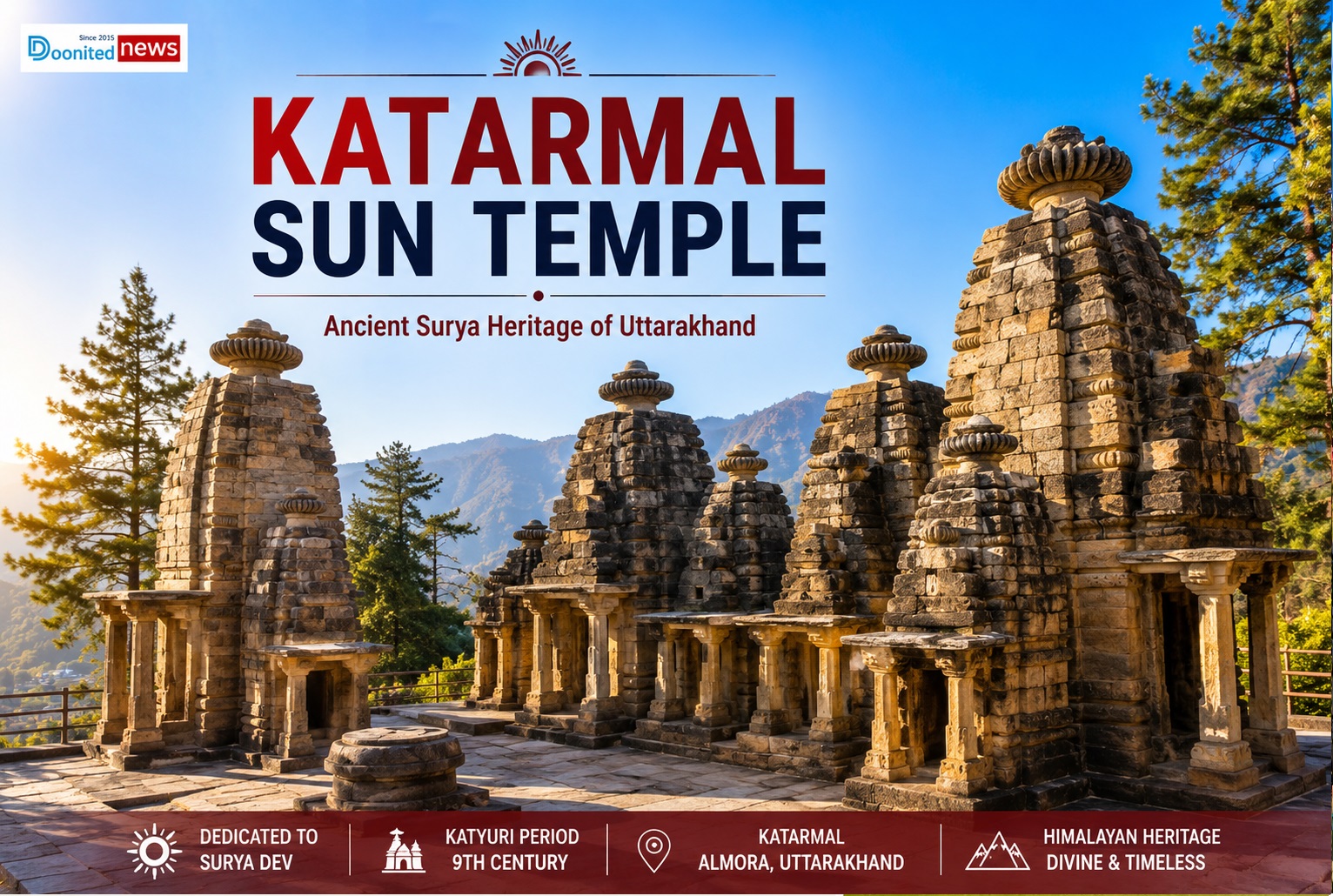
Katarmal Sun Temple: Uttarakhand’s Ancient Surya Temple Hidden in the Kumaon Hills
By Doonited News | Heritage Uttarakhand
High in the Kumaon hills near Almora stands an extraordinary monument that many travellers to Uttarakhand still know little about — the Katarmal Sun Temple.
While Uttarakhand is celebrated for its Shiva temples, Shakti shrines and Char Dham pilgrimage sites, Katarmal represents a different chapter of the state’s religious and architectural heritage. Dedicated primarily to Surya, the Sun God, the historic temple complex is notable for its stone architecture, hilltop setting and association with the Katyuri period.
Surrounded by mountains and overlooking the Kumaon landscape, Katarmal is not merely a place of worship.
It is a surviving reminder of the sophisticated temple-building traditions that once flourished in the central Himalayas.
Where Is Katarmal Sun Temple?
Katarmal is located in Almora district of Uttarakhand, in the Kumaon region.
The temple stands on an elevated site above the surrounding valleys. Its location is an important part of the experience: visitors encounter a historic stone complex framed by Himalayan hills and expansive views.
Unlike major pilgrimage centres surrounded by dense commercial development, Katarmal retains a comparatively quiet heritage atmosphere.
That isolation also helps visitors appreciate why ancient Himalayan temples cannot be understood separately from their landscapes.
Here, architecture, mountains and sunlight become part of the same visual experience.
Why Is Katarmal Dedicated to the Sun?
Surya worship has a long history in the Indian religious tradition.
The Sun is represented in Hindu traditions as a source of light, energy and life, and temples dedicated specifically to Surya survive in different parts of India.
Katarmal is particularly important because major surviving Sun temples are relatively uncommon compared with temples dedicated to deities such as Shiva or Vishnu.
The principal deity at Katarmal is commonly known as Burhadita or Vriddhaditya, forms associated with Surya.
This gives the temple a distinctive position within Uttarakhand’s religious heritage.
Who Built the Katarmal Sun Temple?
The temple is traditionally associated with the Katyuri rulers, who played an important role in the early medieval history of Kumaon and adjoining Himalayan regions.
Katarmal is commonly attributed to a Katyuri ruler named Katarmalla.
The main temple is generally dated to approximately the 9th century CE, although elements of the broader complex may reflect different phases of construction and alteration.
This point is important when discussing ancient monuments.
Historic temple complexes frequently develop over long periods. A main shrine may belong broadly to one era while smaller structures, repairs and modifications represent later generations.
Katarmal should therefore be understood as an evolving sacred complex rather than necessarily as a monument completed at one precise moment.
More Than One Temple
One of the most striking aspects of Katarmal is that visitors do not encounter only a solitary shrine.
The principal Surya temple is surrounded by numerous smaller shrines, creating an architectural group.
These subsidiary temples are associated with different deities and traditions.
The arrangement transforms Katarmal from a single religious building into a historic temple complex.
Walking among the stone structures gives visitors a sense of how important sacred sites could gradually develop as successive generations added shrines and continued worship.
Architecture of Katarmal
The architecture is one of the strongest reasons Katarmal deserves greater recognition as a heritage destination.
The temples were constructed primarily using stone, demonstrating the skills of Himalayan builders working centuries before modern transportation and construction technology.
The principal shrine displays characteristics associated with the Nagara tradition of North Indian temple architecture, adapted to the mountain environment.
Its tower rises vertically above the sanctum while smaller stone temples cluster around it.
Today, weathered stone surfaces add a powerful sense of age.
But these structures should not simply be viewed as picturesque ruins.
Each surviving architectural element is evidence of historical craftsmanship.
The Remarkable Wooden Doors
One particularly interesting chapter in Katarmal’s conservation history concerns its intricately carved wooden doors.
Important carved wooden elements from the temple were moved for protection and preservation and are associated today with the National Museum in New Delhi.
Their craftsmanship demonstrates that Katarmal’s artistic heritage was not restricted to stone.
Wood carving formed another sophisticated component of Himalayan temple architecture.
This is especially significant because wood is far more vulnerable than stone to fire, moisture, insects and deterioration.
Surviving wooden architectural elements can therefore provide rare evidence of artistic traditions that might otherwise disappear completely.
The Mystery of Sunlight and the Temple
Popular accounts frequently emphasize the relationship between sunlight and the Katarmal temple.
This is understandable.
A temple dedicated to Surya standing prominently on a Himalayan slope naturally invites interpretations concerning solar orientation and the movement of sunlight.
However, claims that particular astronomical alignments or specific rays illuminate the deity on exact dates should be treated carefully unless supported by reliable archaeological or scientific documentation.
The verified significance of Katarmal does not depend on exaggeration.
Its age, architecture, Surya tradition and association with the Katyuri period already make it an exceptional heritage monument.
The Katyuris and Kumaon’s Temple Heritage
To understand Katarmal, we also need to understand the broader history of Kumaon.
The Katyuri dynasty exercised influence across parts of the central Himalayan region during the early medieval period.
Numerous temples and religious centres in present-day Uttarakhand are associated, directly or through later traditions, with periods of Katyuri influence.
Temple construction was not merely religious.
It also demonstrated political authority, economic organization, artistic patronage and connections between rulers and sacred landscapes.
Katarmal therefore provides evidence of a Kumaon that possessed organized centres of architecture and religious culture centuries ago.
Katarmal and Jageshwar: Two Windows Into Ancient Kumaon
Katarmal can be particularly interesting when considered alongside Jageshwar, another major historic temple complex in Almora district.
The two places are very different in atmosphere.
Jageshwar stands dramatically among deodar forests and is overwhelmingly associated with Shiva traditions.
Katarmal occupies an open Himalayan hillside and is distinguished by its dedication to Surya.
Yet both demonstrate the richness of early medieval temple architecture in Kumaon.
Together they challenge the idea that Uttarakhand’s heritage consists only of the state’s internationally famous pilgrimage destinations.
There are layers of history scattered throughout these mountains.
Why Is Katarmal Still Less Known?
Compared with Kedarnath, Badrinath, Rishikesh or even Jageshwar, Katarmal receives considerably less mainstream attention.
Accessibility has historically played a role.
The temple’s hill location means that reaching the monument involves travelling away from the major mass-tourism circuits and, depending on current access arrangements, walking part of the approach.
But this relative isolation is also part of its appeal.
Katarmal offers something increasingly difficult to find at famous tourist destinations — an opportunity to experience Himalayan heritage without the overwhelming commercial environment of a major pilgrimage town.
Heritage Tourism Can Help Almora
Katarmal also demonstrates the potential of responsible heritage tourism in Kumaon.
Visitors travelling to Almora could explore a broader circuit incorporating traditional settlements, local cuisine, museums, temples, natural landscapes and historic architecture.
This can create opportunities for local guides, homestays, transport providers, restaurants and small businesses.
But development must remain sensitive to the monument.
Building indiscriminately around a historic temple would eventually destroy the landscape that makes the destination special.
Heritage tourism works best when conservation comes first.
Visitors Have a Responsibility
Ancient monuments are irreplaceable.
A damaged modern building can usually be rebuilt.
A carved stone or wooden element created a thousand years ago cannot simply be replaced with something new and retain the same historical value.
Visitors should therefore avoid touching fragile carvings unnecessarily, scratching names into stone, climbing on protected structures or leaving litter around the site.
Photography should document heritage rather than damage it.
Respect for the monument is particularly important at places such as Katarmal, where religious worship and archaeological heritage exist together.
Uttarakhand Beyond the Char Dham
Uttarakhand’s international religious identity is understandably dominated by Kedarnath, Badrinath, Gangotri and Yamunotri.
But the state’s heritage map is much larger.
Ancient temples, traditional villages, archaeological remains and historic routes extend across Garhwal and Kumaon.
Katarmal Sun Temple is an excellent example.
It tells us that the cultural history of Uttarakhand cannot be understood through a handful of famous pilgrimage sites alone.
The mountains contain hundreds of smaller stories waiting to be documented.
When Stone Meets Sunlight
Perhaps the most memorable aspect of Katarmal is its simplicity.
There are no enormous marble courtyards.
No modern monumental gateway is required to create an impression.
Instead, there is weathered stone, Himalayan sky, surrounding mountains and sunlight.
For centuries, generations have stood on this hillside while the sun crossed the same Kumaon landscape.
Dynasties disappeared.
Political boundaries changed.
Modern Uttarakhand was eventually created.
Yet the temple survived.
That continuity gives Katarmal its power.
A Heritage Treasure Uttarakhand Must Protect
Katarmal Sun Temple deserves recognition not merely because it is old.
Its importance comes from what it represents.
It connects Surya worship, Katyuri history, Himalayan architecture, craftsmanship and the cultural landscape of Kumaon.
For historians, it is evidence.
For devotees, it remains sacred.
For travellers, it is a remarkable destination.
And for Uttarakhand, it is part of an inheritance that cannot be recreated once lost.
The great monuments of India do not exist only in famous cities.
Some stand quietly on Himalayan hillsides.
Katarmal Sun Temple is one of them — an ancient stone witness to the extraordinary heritage of Uttarakhand.