
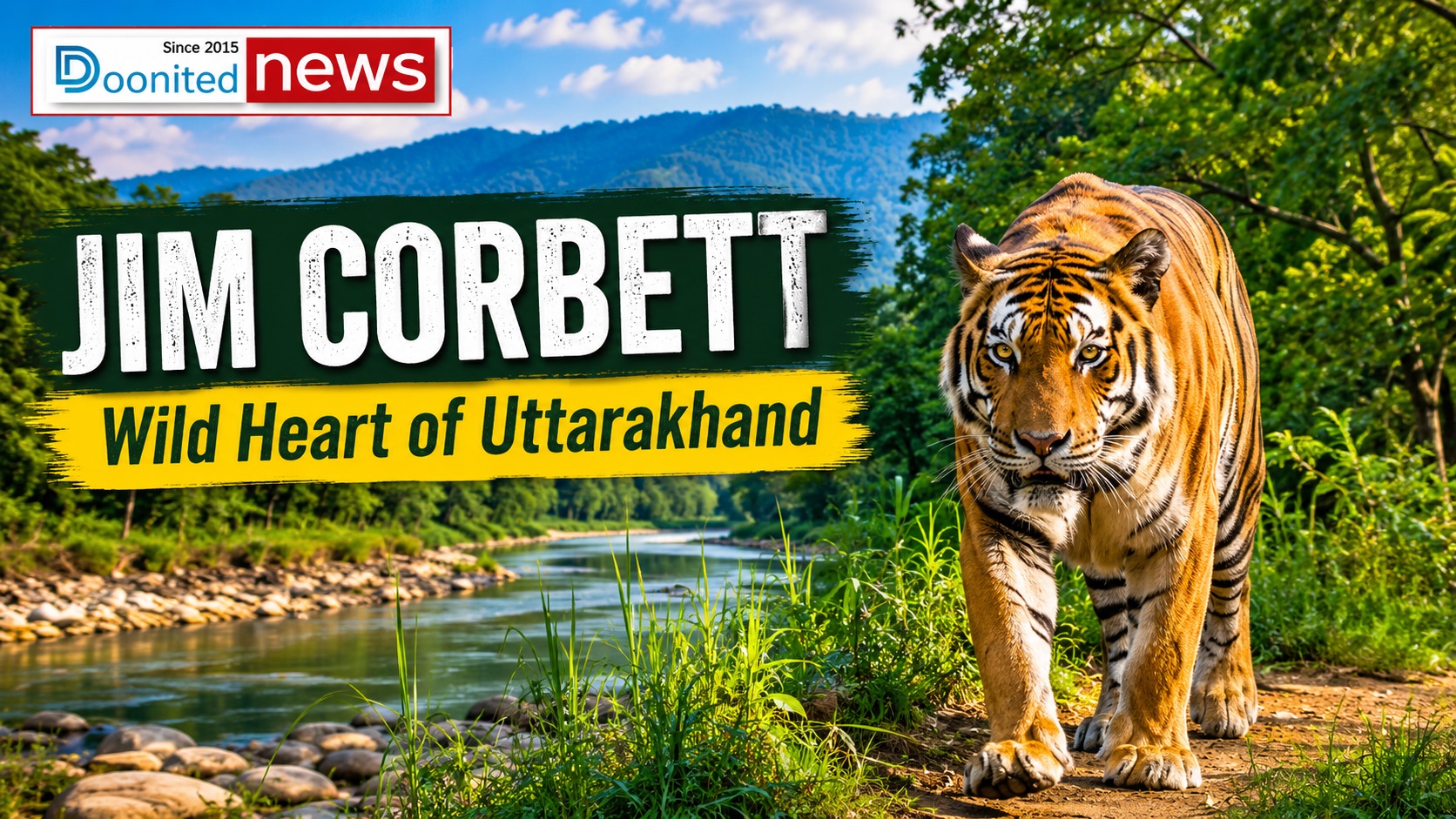
Jim Corbett National Park: Exploring Uttarakhand’s Legendary Wildlife Kingdom
By Doonited News | Nature & Wildlife Uttarakhand
In the foothills of the Himalayas, where dense forests meet grasslands and river valleys, lies one of India’s most famous wildlife landscapes — Jim Corbett National Park.
Located primarily in Uttarakhand’s Nainital and Pauri Garhwal districts, Corbett is renowned for its forests, elephants, rich birdlife and, above all, its association with the Royal Bengal tiger.
But Corbett is much more than a destination for tourists hoping to photograph a tiger.
Its real importance lies in the ecosystem it protects.
Forests, rivers, grasslands, hills and wildlife together make Corbett one of the defining natural landscapes of Uttarakhand.
India’s Oldest National Park
The history of Corbett gives it a particularly important place in Indian conservation.
The protected area was established in 1936 as Hailey National Park during the British period and is widely recognized as India’s first national park.
Its name changed over time before it eventually became known as Corbett National Park, commemorating Jim Corbett, the hunter-turned-conservationist and author who had a deep connection with the Kumaon region.
This history means Corbett represents more than wildlife tourism.
It reflects the evolution of India’s approach toward protecting forests and wild animals.
Who Was Jim Corbett?
Edward James “Jim” Corbett was born in Nainital in 1875 and became closely associated with the forests and communities of Kumaon.
He became famous for tracking and killing several man-eating tigers and leopards that had terrorized communities in the region.
However, reducing Corbett’s story to hunting would be incomplete.
Over time, he became an advocate for wildlife and forest conservation. His observations of the Himalayan environment and wildlife were also documented through books such as Man-Eaters of Kumaon.
His name eventually became permanently associated with the national park.
Today, that association presents an interesting historical transition: from an era when dangerous animals were hunted to an era in which their habitats are actively protected.
The Royal Bengal Tiger
For many visitors, one animal dominates expectations when entering Corbett — the tiger.
Corbett forms part of an important tiger conservation landscape and was among the areas associated with the early implementation of India’s Project Tiger, launched in 1973.
The tiger is an apex predator.
Protecting tiger habitat therefore has consequences far beyond protecting one charismatic species. A landscape capable of supporting tigers must also sustain prey animals, vegetation, water sources and interconnected ecological processes.
This is one reason tiger conservation can help protect entire ecosystems.
However, visitors should understand an important point:
A safari does not guarantee a tiger sighting.
Corbett is a natural forest, not a zoo.
Wild animals move according to their own behaviour and environmental conditions.
Sometimes the most authentic wildlife experience is hearing an alarm call in the forest without ever seeing the predator responsible.
The Asian Elephant
Corbett is also an important landscape for the Asian elephant.
Seeing elephants moving through forests or grasslands can be one of the most memorable experiences in Uttarakhand wildlife tourism.
But elephants require substantial habitat and movement corridors.
Roads, settlements and fragmented forests can interfere with traditional movement routes, sometimes increasing human-elephant conflict.
Conservation therefore cannot stop at the administrative boundary of a national park.
Wildlife needs connected landscapes.
Protecting corridors around major forest areas is consequently an important part of long-term conservation planning.
More Than Tigers and Elephants
The fame of tigers can sometimes overshadow Corbett’s broader biodiversity.
The landscape supports numerous species of mammals, reptiles, birds and other wildlife.
Visitors may encounter animals such as spotted deer, sambar, barking deer, wild boar and langurs, depending on the area and conditions.
The rivers and aquatic habitats add another ecological dimension.
The wider Corbett landscape is also associated with species such as the gharial and other riverine wildlife.
Each species occupies a particular position within the ecosystem.
The forest works because these relationships exist together.
A Paradise for Birdwatchers
Corbett is also particularly attractive to bird enthusiasts.
The diversity of forests, grasslands, rivers and foothill habitats supports an impressive variety of resident and migratory birds.
Visitors who concentrate only on searching for tigers may therefore miss a substantial part of the experience.
Kingfishers, woodpeckers, raptors and numerous woodland and water-associated species can make a safari rewarding even without a large-mammal sighting.
Birdwatching also encourages a different style of tourism.
Instead of rushing through the forest searching for one famous animal, visitors begin observing sounds, trees, water and smaller movements within the landscape.
That is often when the forest becomes truly interesting.
The Ramganga River: Lifeline of the Landscape
Water is fundamental to Corbett’s ecosystem.
The Ramganga River is one of the defining geographical features of the landscape.
River systems provide water to wildlife and create habitats that differ considerably from surrounding forests and grasslands.
They also support aquatic species and influence vegetation.
In a wildlife reserve, a river is therefore not simply scenery.
It is part of the ecological infrastructure on which the entire landscape depends.
Understanding Corbett’s Tourism Zones
Wildlife tourism in Corbett is regulated through designated tourism areas and entry systems.
Names commonly associated with tourism include zones such as Dhikala, Bijrani, Jhirna and Dhela, among others.
Different zones provide different landscapes and wildlife experiences.
Availability, seasonal access, entry regulations and safari arrangements can change.
Travellers should therefore verify current information through the appropriate official Uttarakhand forest or Corbett authorities rather than relying solely on travel agents, social-media posts or old online articles.
Advance planning is particularly important during popular tourism periods.
When Is the Best Time to Visit Corbett?
There is no single “best” season for every visitor.
Wildlife behaviour, vegetation, temperature and accessibility vary throughout the year.
Certain tourism zones may operate seasonally, particularly because monsoon conditions can affect forest roads and river levels.
Winter can provide pleasant conditions for visitors and is attractive for birdwatching.
As temperatures rise later in the season, wildlife movement around water sources may change.
But nature does not operate according to a tourism timetable.
Anyone promising a guaranteed tiger sighting should be treated cautiously.
Responsible Wildlife Tourism
Corbett’s popularity creates economic opportunities for local communities, guides, drivers, accommodation providers and tourism businesses.
But popularity can also create pressure.
Noise, traffic, litter, irresponsible driving and visitors demanding close encounters with animals can undermine the purpose of a protected landscape.
Responsible wildlife tourism means accepting that the forest comes first.
Visitors should follow official speed limits and safari rules, avoid shouting, never feed animals and never pressure drivers or guides to chase wildlife for photographs.
A photograph is not worth disturbing an animal.
Never Treat Wildlife as a Photo Prop
Social media has changed wildlife tourism.
The desire for dramatic photographs and videos can encourage irresponsible behaviour.
Wild animals should never be approached simply to obtain a better photograph.
A tiger resting near a track does not owe tourists a performance.
An elephant crossing a road should be given space.
Animals should be allowed to determine the encounter.
The best wildlife photography documents natural behaviour rather than forcing an interaction.
Human Communities and Conservation
Protected areas do not exist independently of people.
Communities have lived around Uttarakhand’s forests for generations and interact with these landscapes in complex ways.
Conservation policies therefore have to consider both ecological protection and human realities.
Livelihood opportunities linked with responsible tourism can create incentives for conservation, but benefits should reach local communities rather than being concentrated entirely in outside businesses.
Long-term wildlife protection becomes stronger when people living around forests see tangible value in maintaining healthy ecosystems.
Why Corbett Matters to Uttarakhand
Uttarakhand is often marketed through temples, pilgrimage and Himalayan scenery.
Corbett reveals another identity.
The state is also home to globally significant forests and wildlife.
This natural heritage has economic value through tourism, but its ecological value is much greater.
Healthy forests store carbon, protect watersheds, support biodiversity and contribute to environmental stability.
Wildlife conservation is therefore not simply about saving photogenic animals.
It is about protecting functioning ecosystems.
The Real Corbett Experience
Many tourists enter Corbett asking one question:
“Will we see a tiger?”
Perhaps the better question is:
“Will we experience the forest?”
A safari may reveal deer listening nervously to an alarm call.
An elephant herd may cross a distant grassland.
A kingfisher may flash across the river.
Fresh pugmarks may indicate that a tiger passed only minutes earlier.
Sometimes the animal itself appears.
Sometimes it does not.
Both experiences are authentic.
Because Corbett’s greatest attraction is not one tiger.
It is the fact that a landscape still exists where tigers, elephants, deer, birds, rivers and forests can live together in the wild.
Protecting Uttarakhand’s Wild Heritage
Jim Corbett National Park has survived enormous changes in India since its establishment in 1936.
Tourism has expanded.
Road networks have grown.
Nearby towns have developed.
Pressure on Himalayan landscapes has increased.
That makes conservation more important, not less.
Future generations should inherit Corbett as a functioning wilderness rather than merely a famous name on a tourism map.
The tiger may be its most recognizable symbol.
But the real treasure is the entire ecosystem behind it.
That is why Jim Corbett National Park remains one of the greatest natural heritage landscapes of Uttarakhand.