
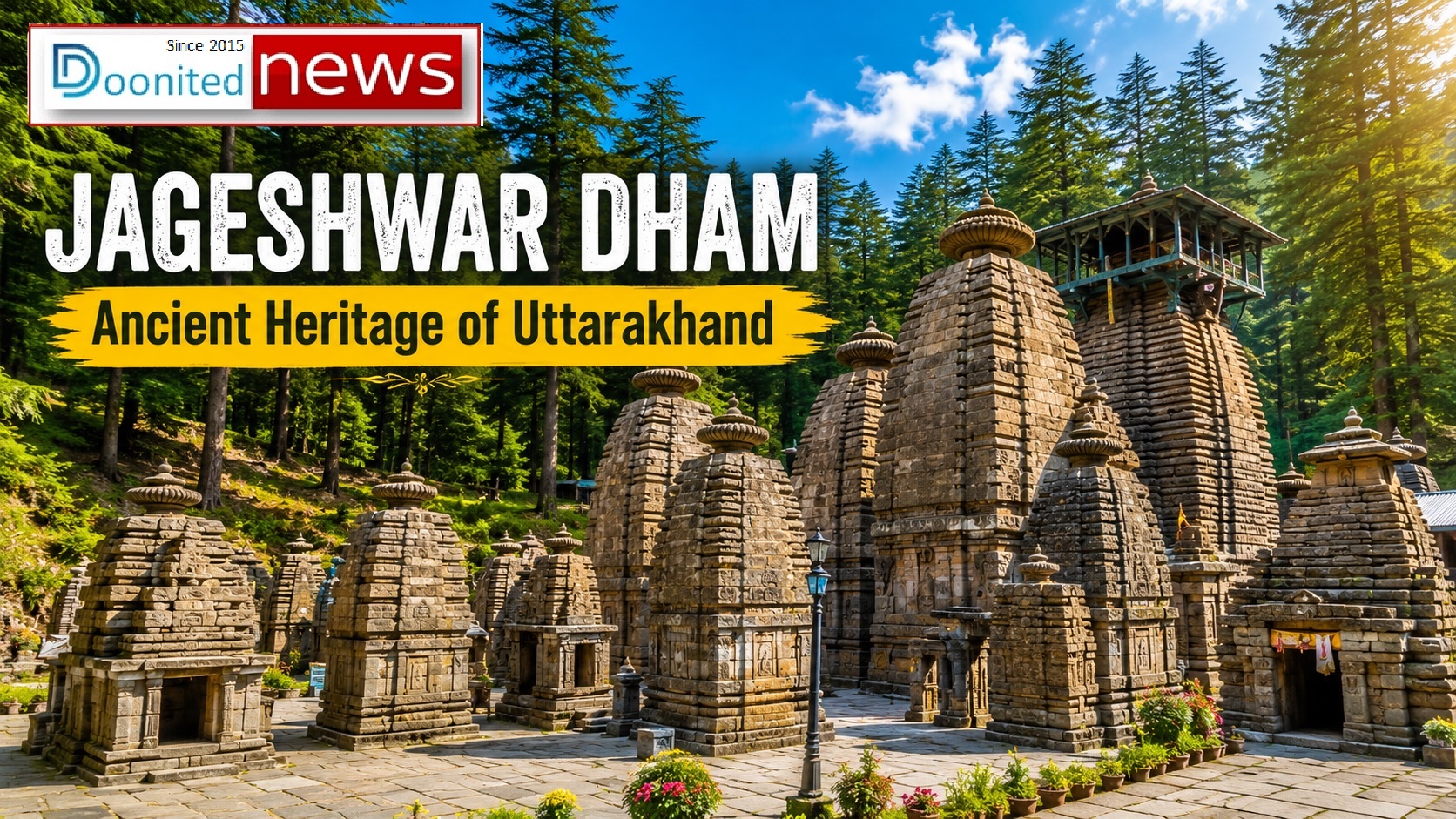
Jageshwar Dham: The Ancient Temple Heritage Hidden in Uttarakhand’s Deodar Forests
By Doonited News | Heritage Uttarakhand
Deep in the Kumaon Himalayas of Uttarakhand, surrounded by towering deodar trees and mountain silence, stands one of the state’s most remarkable collections of historic stone temples — Jageshwar.
Located in Almora district, the Jageshwar temple complex represents an important part of Uttarakhand’s architectural, religious and cultural heritage. Instead of a single monumental structure, visitors encounter a remarkable cluster of stone shrines of different sizes standing close together in a forested Himalayan valley.
For many visitors, Jageshwar is primarily a sacred destination associated with Lord Shiva. But look beyond its devotional importance and another story emerges.
Jageshwar is also a window into the medieval history, stone architecture and artistic traditions of the Kumaon Himalayas.
A Heritage Landscape in the Kumaon Himalayas
The setting is one of the first things that distinguishes Jageshwar.
Unlike temples surrounded by dense modern development, the historic shrines stand within a landscape dominated by deodar forest, mountains and the Jata Ganga stream.
This relationship between architecture and landscape is fundamental to the character of the site.
The Archaeological Survey of India protects a substantial group of temples at Jageshwar, and official tourism information describes the area as containing a large cluster of ancient shrines.
The temples were not necessarily constructed at one moment in history. The complex developed over an extended period, which helps explain variations in their scale and architectural details.
How Old Are the Jageshwar Temples?
Popular descriptions sometimes assign extremely ancient dates to Himalayan temples without sufficient historical evidence.
Jageshwar deserves a more careful approach.
The surviving temples are generally associated with the early medieval and medieval periods, with construction and modification occurring across different centuries.
The site is particularly associated with the historical development of Kumaon and with ruling traditions including the Katyuri period, while later patronage and renovation also contributed to the complex.
Rather than thinking of Jageshwar as a structure built on one particular date, it is more accurate to understand it as a sacred architectural landscape that developed over generations.
That makes the site historically even more interesting.
The Architecture of Jageshwar
The temples immediately attract attention because of their stone construction and distinctive towers.
Many display forms associated with the Nagara tradition of North Indian temple architecture, adapted to the Himalayan environment.
The vertically rising stone towers create a dramatic visual rhythm when dozens of shrines are seen together.
Individual temples vary considerably in size.
Some are substantial structures with prominent towers, while others are much smaller shrines positioned around the principal temples.
Stone doorways, sculptural elements and architectural details provide evidence of the craftsmanship that existed in the region centuries ago.
For historians and archaeologists, these structures offer valuable material for understanding the development of Himalayan temple architecture.
Important Temples at Jageshwar
Several shrines within the broader Jageshwar complex have particular religious and architectural importance.
Among the best known are temples associated with Jageshwar, Mahamrityunjaya, Pushti Devi and other deities.
The Mahamrityunjaya Temple is especially significant within the complex and is dedicated to Lord Shiva in his death-conquering form.
The concentration of so many shrines within a relatively compact landscape makes Jageshwar different from many other Uttarakhand pilgrimage destinations.
Visitors are not simply entering one temple.
They are walking through a historic sacred settlement.
Jageshwar and Lord Shiva
Jageshwar’s religious identity is strongly connected with Lord Shiva.
Local traditions and devotional narratives surrounding the site are extensive, and Jageshwar has been a centre of Shiva worship for generations.
Some popular accounts also associate Jageshwar with the Jyotirlinga tradition.
However, claims regarding its precise status within competing lists and traditions should be presented as religious belief rather than uncontested historical fact.
This distinction is important when documenting Uttarakhand’s heritage.
Religious traditions form an essential part of a site’s cultural history, but archaeology, documentary history and faith traditions do not always answer the same questions.
Both can be respected without confusing one for the other.
The Katyuri Connection
The Katyuris occupy an important position in the early medieval history of the central Himalayas.
Their political influence extended across significant parts of the region, and numerous temples and architectural traditions in Kumaon have been associated with the period of Katyuri influence.
Jageshwar’s development is commonly linked with this broader historical environment.
Later rulers and communities continued to patronize sacred sites, meaning that what visitors see today represents layers of history rather than the work of a single dynasty.
This layered development is typical of important religious centres.
A sacred site survives because successive generations continue to use, repair, modify and protect it.
Sculptures and Archaeological Heritage
Jageshwar’s significance extends beyond its temple buildings.
Sculptures and other archaeological remains associated with the complex provide additional evidence of the artistic traditions that flourished in the region.
The Archaeological Museum at Jageshwar, maintained by the Archaeological Survey of India, preserves important sculptures recovered from the surrounding temple group.
For visitors interested in heritage rather than pilgrimage alone, the museum is an important part of understanding the site.
A temple complex tells one part of history through architecture.
Sculptures reveal another through iconography, artistic technique and religious practice.
Together, they provide a richer picture of medieval Kumaon.
Why Deodar Forests Matter to Jageshwar
Remove the forest from Jageshwar and the experience would be fundamentally different.
The tall deodar trees surrounding the temples create an extraordinary atmosphere, but their importance is not merely visual.
The landscape demonstrates how Uttarakhand’s historic sacred sites frequently developed in close relationship with forests, rivers, springs and mountains.
In Himalayan culture, nature and spirituality have often occupied the same geography.
This relationship is visible throughout Uttarakhand — from high-altitude pilgrimage routes to forest temples and river settlements.
Jageshwar is one of the clearest examples.
Stone architecture created by humans stands within an environment dominated by trees that have become part of the identity of the place itself.
Heritage Beyond Famous Monuments
When people discuss Indian heritage, attention often goes to enormous forts, royal palaces and monumental urban temples.
Uttarakhand’s heritage has a different character.
Much of it is distributed across mountain villages, ancient pilgrimage routes, temples, traditional houses, forests and remote archaeological sites.
Jageshwar demonstrates why this heritage deserves greater attention.
The complex provides evidence that sophisticated architectural and religious centres developed within the Himalayan region centuries before modern roads connected these valleys with India’s major cities.
Transporting and shaping stone in mountainous terrain required knowledge, organization and skilled craftsmanship.
The surviving temples are therefore not simply religious monuments.
They are evidence of the societies that built them.
Preserving Jageshwar for Future Generations
Heritage tourism creates both opportunity and risk.
Greater awareness can generate employment, encourage conservation and bring visitors to lesser-known parts of Uttarakhand.
But uncontrolled construction, traffic, waste and inappropriate development can damage precisely what attracts visitors in the first place.
At Jageshwar, conservation must consider more than individual temple walls.
The architectural complex and its surrounding natural landscape together create the heritage value of the destination.
Visitors also have responsibilities.
Historic stone structures should not be scratched, marked or treated as backgrounds for careless tourism. Archaeological objects must remain untouched, and litter should never be left around the temple or forest.
Heritage survives only when each generation decides that it is worth protecting.
Jageshwar: A Living Chapter of Uttarakhand History
Jageshwar is unusual because it is simultaneously ancient and alive.
The temples are historical monuments, but worship continues.
Pilgrims come because of faith.
Travellers arrive because of the landscape.
Researchers study the architecture and sculptures.
Photographers are drawn to the extraordinary sight of stone temples rising between Himalayan deodar trees.
All of these experiences exist within the same place.
That is what makes Jageshwar an ideal representation of Heritage Uttarakhand.
It is not history locked behind museum glass.
It is history that continues to breathe.
The Heritage of Devbhoomi
Uttarakhand’s identity cannot be explained through mountains and pilgrimage alone.
Its temples, traditional settlements, archaeological remains, folk traditions and historic landscapes preserve the stories of generations that lived in the Himalayas long before the formation of the modern state.
Jageshwar is one remarkable chapter in that larger story.
Its stone temples remind us of ancient craftsmanship.
Its sculptures preserve artistic traditions.
Its religious practices demonstrate continuity.
And its deodar forests connect human heritage with the Himalayan environment.
To preserve Jageshwar is therefore to protect more than a group of temples.
It is to protect a part of the historical memory of Uttarakhand.