
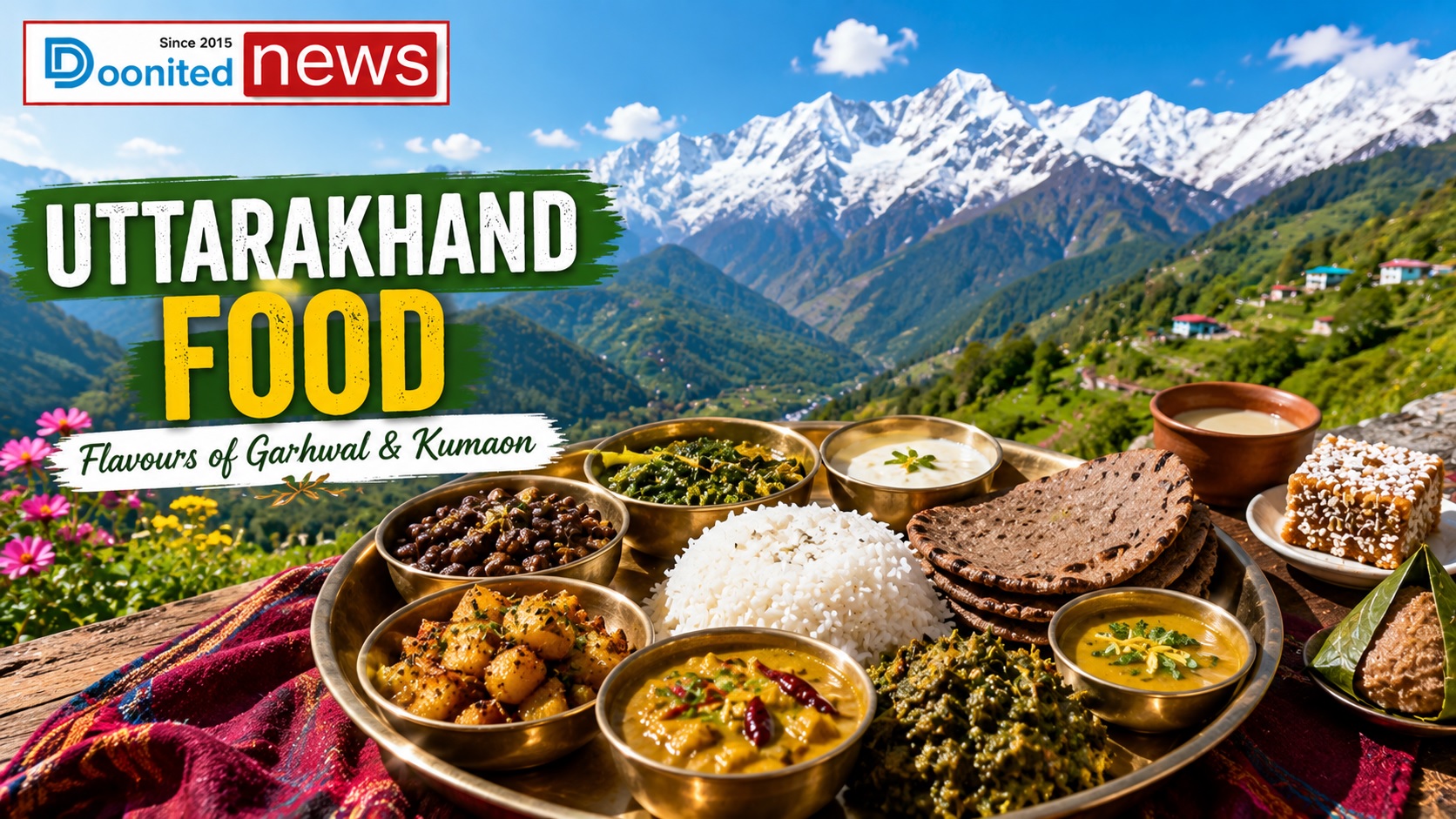
Uttarakhand Food: Discover the Traditional Flavours of Garhwal and Kumaon
By Doonited News | Food Uttarakhand
When people think of Uttarakhand, images of snow-covered Himalayan peaks, ancient temples, forests and sacred rivers often come first.
But there is another side of Devbhoomi that deserves equal attention — its food.
Traditional Uttarakhand cuisine developed in a mountain environment where communities historically depended heavily on locally available grains, pulses, vegetables, dairy products, herbs and seasonal produce.
The result is a cuisine that is generally straightforward in preparation but distinctive in flavour and deeply connected to the geography and culture of the state.
From Kafuli and Chainsoo in Garhwal to Bhatt Ki Churkani and Bal Mithai in Kumaon, the food of Uttarakhand tells the story of people who learned to create memorable dishes from ingredients suited to Himalayan life.
Two Regions, Many Flavours
Uttarakhand’s traditional cuisine is commonly discussed through its two major cultural regions — Garhwal and Kumaon.
Although they share several ingredients and culinary practices, each region has developed dishes and variations associated with its own communities and local produce.
Traditional foods frequently make use of pulses, leafy greens, grains and locally cultivated ingredients.
This is one reason Uttarakhand cuisine can feel quite different from the rich restaurant-style gravies commonly associated with North Indian food outside the Himalayan region.
Its character comes from the mountains.
Kafuli: The Green Flavour of Garhwal
One of the dishes most closely associated with traditional Uttarakhand cuisine is Kafuli.
It is generally prepared using leafy greens, with spinach and local greens commonly appearing in different versions.
The greens are cooked into a thick preparation and eaten with rice or roti.
Kafuli is a good example of how Uttarakhand cuisine transforms relatively simple ingredients into food strongly associated with regional identity.
For visitors interested in understanding Garhwali food beyond restaurant menus, Kafuli is an excellent place to begin.
Chainsoo: A Traditional Garhwali Favourite
Chainsoo is another well-known dish associated with Garhwali cuisine.
It is traditionally prepared from black gram, or urad dal, which is roasted and ground before cooking.
Roasting gives the dish its characteristic flavour and separates it from an ordinary dal preparation.
Like many traditional mountain foods, recipes may differ between households and locations. There is therefore no reason to assume that every family prepares Chainsoo in exactly the same way.
That variation is itself part of a living culinary tradition.
Phaanu: A Dish Built Around Pulses
Another traditional Garhwali preparation is Phaanu, which is made using pulses.
Different dals may be used depending on the recipe and local practice. The preparation usually involves soaking pulses before cooking them into a substantial dish.
Pulses have long played an important role in Indian diets, and their prominence in several Uttarakhand dishes reflects the importance of ingredients that could be cultivated, stored and incorporated into everyday mountain meals.
Aloo Ke Gutke: Simple but Unmistakably Pahadi
Few dishes demonstrate the simplicity of Uttarakhand food better than Aloo Ke Gutke.
Potatoes are cooked with spices to produce a dry preparation that has become strongly associated with Kumaoni food.
It may be served with other local accompaniments and is commonly encountered in discussions of traditional Kumaoni cuisine.
There is nothing extravagant about the basic concept.
And that is precisely its strength.
Aloo Ke Gutke demonstrates that regional food identity does not depend on a long ingredient list. Technique, seasoning and tradition can turn an everyday vegetable into a dish people immediately associate with a particular place.
Bhatt Ki Churkani: A Taste of Kumaon
Bhatt Ki Churkani is one of Kumaon’s distinctive traditional dishes.
It is prepared using bhatt, a type of black soybean widely associated with Himalayan cuisine.
The beans are cooked into a gravy-like preparation that is typically eaten with rice.
For anyone exploring Kumaoni cuisine, Bhatt Ki Churkani is particularly significant because its identity is closely linked with a regional ingredient rather than simply a cooking style imported from elsewhere.
It represents the relationship between agriculture and food culture in the mountains.
Mandua: The Traditional Himalayan Grain
Traditional Uttarakhand food cannot be discussed without mentioning mandua, commonly known as finger millet or ragi.
Mandua has historically been cultivated in Himalayan regions and is used in preparations such as mandua roti.
Millets have received renewed attention across India in recent years, but for mountain communities these grains are not simply a modern health-food trend.
They form part of much older agricultural and dietary traditions.
This distinction is important.
Foods that may now appear fashionable in urban markets have been part of rural Himalayan diets for generations.
Jhangora: Another Grain of the Mountains
Another ingredient associated with Uttarakhand cuisine is jhangora, or barnyard millet.
It can be used in different preparations, including the well-known sweet dish Jhangora Ki Kheer.
Cooked with milk and sweetened, it demonstrates how a traditional grain can move from an everyday agricultural ingredient into a dessert.
Together, mandua and jhangora illustrate the importance of mountain grains in Uttarakhand’s culinary heritage.
Bal Mithai: Kumaon’s Famous Sweet
When the conversation turns from savoury dishes to sweets, Bal Mithai is difficult to ignore.
Strongly associated with Kumaon and particularly with Almora, Bal Mithai is a brown, fudge-like milk sweet traditionally coated with small sugar balls.
Its distinctive appearance makes it immediately recognizable.
Over time, Bal Mithai has become more than a local dessert. It has developed into one of the food products popularly associated with Kumaon’s identity.
For travellers visiting Almora, tasting Bal Mithai has become almost part of the experience of visiting the town itself.
Singori: Sweetness Wrapped in a Leaf
Another distinctive Kumaoni sweet is Singori, also spelled Singodi in some contexts.
It is traditionally a milk-based sweet wrapped in a leaf, giving it a particularly recognizable presentation.
The use of natural wrapping also reflects an older food culture in which locally available materials played a role not just in cooking but in serving and preserving food.
Like Bal Mithai, Singori has become associated with the culinary identity of Kumaon.
Food Shaped by Geography
What makes Uttarakhand cuisine particularly interesting is the relationship between food and landscape.
Mountain agriculture is not the same as farming on large plains.
Altitude, climate, terraced fields, seasonal availability and historically difficult transportation all influenced what communities could grow, preserve and cook.
This encouraged reliance on locally suitable ingredients.
Traditional cuisine therefore provides another way of understanding Uttarakhand’s history.
A plate of food can tell us something about the crops people cultivated, the environment in which they lived and the resources available to previous generations.
Why Traditional Uttarakhand Food Matters Today
Modern diets are changing rapidly.
Improved transport, migration, tourism, restaurants, packaged foods and changing lifestyles have brought cuisines from across India and the world into Uttarakhand.
That exchange is natural.
But it also creates a reason to document and preserve regional food traditions.
When younger generations stop preparing a traditional dish, something more than a recipe can disappear.
Knowledge about local ingredients, preparation techniques, seasonal eating and family traditions can disappear with it.
Preserving Uttarakhand cuisine therefore does not mean rejecting modern food.
It means ensuring that traditional knowledge continues alongside it.
Food Tourism: An Opportunity for Uttarakhand
Uttarakhand already attracts enormous numbers of visitors for pilgrimage, nature, wildlife, adventure and hill tourism.
Traditional food can become another meaningful part of that experience.
A visitor who travels to Kumaon should have opportunities to understand Kumaoni cuisine.
Someone exploring Garhwal should be able to discover authentic Garhwali dishes.
Local restaurants, homestays, village tourism initiatives and food festivals can help make this possible.
Done responsibly, food tourism can also create economic opportunities for local cooks, farmers, small businesses and communities.
Instead of offering visitors the same generic menu everywhere, destinations can celebrate what makes their own region distinctive.
A Taste of Devbhoomi
Uttarakhand’s food does not need to compete with elaborate restaurant cuisine.
Its strength lies elsewhere.
It comes from mountain grains, pulses, leafy vegetables, local produce and recipes carried through generations.
Kafuli tells one story.
Chainsoo tells another.
Bhatt Ki Churkani connects the plate with Kumaon’s agricultural traditions, while Bal Mithai has become a sweet symbol of Almora.
Together, these foods create a culinary map of Uttarakhand.
Temples tell us about the state’s faith.
Historic places tell us about its past.
Mountains and forests reveal its natural heritage.
And its traditional food tells us how generations of people actually lived.
That makes Uttarakhand cuisine an essential part of the cultural identity of Devbhoomi.