
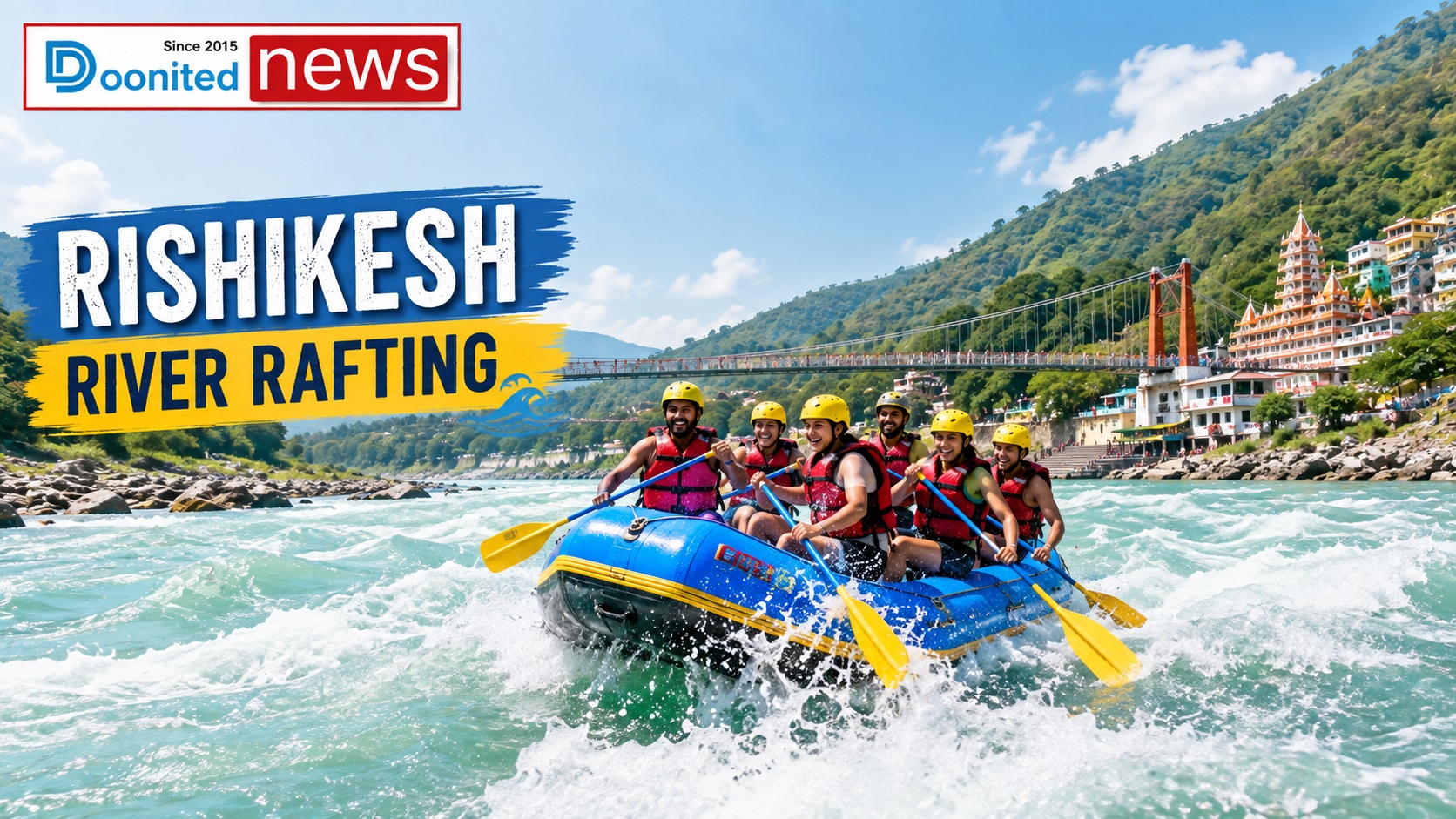
Rishikesh River Rafting: Why Uttarakhand Is India’s Adventure Capital
By Doonited News | Adventure Uttarakhand
The Ganga is revered across India as a sacred river. But as it descends from the Himalayas toward the plains, its fast-flowing waters also create one of Uttarakhand’s most popular adventure experiences — white-water rafting in Rishikesh.
Rishikesh is internationally known for yoga, spirituality and its association with the Ganga. Yet over the years, the region has also emerged as a major centre for river rafting, trekking, camping and other outdoor activities.
For adventure seekers, rafting through the Himalayan foothills offers an unusual combination: rapids, forested hills, rocky riverbanks and the powerful current of the Ganga.
But river rafting is not simply about excitement. It is an adventure activity that requires trained operators, appropriate equipment, suitable weather and strict attention to safety.
Why Is Rishikesh Famous for River Rafting?
Geography provides much of the answer.
Before the Ganga reaches the flatter terrain around the plains, it travels through mountainous landscapes where changes in gradient, rocks and river channels create stretches of turbulent water.
These conditions produce the rapids that make rafting possible.
The Rishikesh region provides access to rafting stretches of different lengths and difficulty levels, allowing both beginners and more experienced participants to experience white-water rafting under appropriate conditions.
The surrounding Himalayan foothills make the experience even more distinctive.
Unlike an artificial adventure park, the river is a living natural environment. Water levels, currents and conditions can change.
That is precisely why rafting should always be approached with respect.
The Famous Rapids of Rishikesh
The rafting stretches around Rishikesh include several rapids that have become well known among adventure enthusiasts.
Names commonly associated with rafting routes include Roller Coaster, Golf Course and Double Trouble, among others.
Rapids are generally classified according to their technical difficulty, although the actual challenge of any rapid can vary depending on water level and river conditions.
For beginners, the important issue is not memorising rapid names.
It is choosing a properly authorised operator and a route appropriate to one’s experience and physical ability.
A professional river guide should provide a safety briefing before the rafting trip begins.
What Happens Before You Enter the River?
A responsible rafting experience begins before the raft touches the water.
Participants should be provided with appropriate safety equipment, particularly a personal flotation device (life jacket) and helmet.
The guide normally explains how to:
- hold and use the paddle,
- sit securely in the raft,
- respond to commands,
- react if the raft encounters strong turbulence, and
- behave if someone falls into the water.
These instructions are not formalities.
White-water rafting involves moving water, rocks and unpredictable natural conditions. Participants should listen carefully to the guide throughout the journey.
Is Rishikesh Rafting Safe?
No outdoor adventure activity involving white water can honestly be described as completely risk-free.
Safety depends on several factors: river conditions, weather, equipment, operator standards, guide experience and participant behaviour.
This makes choosing an authorised and experienced rafting operator particularly important.
Participants should not ignore safety instructions simply because they know how to swim. Swimming in a pool and dealing with a fast Himalayan river are entirely different situations.
People with medical conditions or physical limitations should seek appropriate professional advice before participating.
Government or local-authority restrictions may also apply depending on river and weather conditions.
When Is the Best Time for Rafting?
Rafting operations in Uttarakhand are seasonal and dependent on weather and river conditions.
The monsoon can dramatically increase river flow and risk. Consequently, rafting may be suspended when conditions are considered unsafe.
The exact operational season should therefore not be treated as permanently fixed.
Before travelling, visitors should check the latest information from Uttarakhand tourism authorities and authorised local operators regarding rafting availability, permitted stretches and weather conditions.
This is especially important in the Himalayas, where conditions can change rapidly.
Rishikesh: Where Spirituality Meets Adventure
What makes Rishikesh particularly unusual is the contrast between its two identities.
On one side are temples, ashrams, yoga centres, meditation and the evening Ganga Aarti.
On the other are rafts, paddles, trekking trails and adventure camps.
Yet the two identities are not necessarily contradictory.
Both depend heavily on the same landscape — the Ganga and the Himalayan foothills.
One visitor may arrive seeking spiritual reflection. Another may come looking for an adrenaline-filled rafting experience.
Many experience both.
This combination has helped make Rishikesh one of Uttarakhand’s most recognizable destinations.
Adventure Tourism and Uttarakhand
Rishikesh rafting is part of a much larger adventure landscape.
Uttarakhand’s geography makes the state suitable for numerous outdoor activities, including trekking, mountaineering, skiing, camping and river-based adventure sports.
Auli is particularly associated with skiing.
High-altitude routes across Garhwal and Kumaon attract trekkers.
The Himalayan peaks have a long association with Indian mountaineering.
Rishikesh provides another entry point into this adventure ecosystem because it is considerably more accessible than many high-altitude destinations.
For travellers who have never attempted a Himalayan expedition, rafting can provide their first experience of adventure tourism in Uttarakhand.
Adventure Must Not Damage the Himalayas
Popularity also creates a serious responsibility.
Adventure tourism can generate employment for guides, drivers, accommodation providers and other local businesses. But poorly managed tourism can also generate plastic waste, river pollution, traffic and pressure on fragile landscapes.
The Ganga cannot be treated merely as an adventure facility.
It is simultaneously a river ecosystem, a source of water, a culturally sacred landscape and an essential part of Uttarakhand’s natural heritage.
Visitors should avoid leaving plastic, food packaging or other waste along riverbanks and trekking areas.
Operators also have a responsibility to ensure that tourism activities comply with environmental and safety regulations.
The long-term future of adventure tourism depends on protecting the environment that makes the adventure possible.
More Than an Adrenaline Rush
For many people, the most memorable part of rafting in Rishikesh is not simply crossing a difficult rapid.
It is the landscape around them.
There are forest-covered slopes, Himalayan air, rocky cliffs and the Ganga moving rapidly beneath the raft.
For a few hours, participants experience the river differently.
They are not watching it from a bridge or standing beside it during an aarti.
They are travelling with its current.
That experience helps explain why rafting has become such an important part of Rishikesh’s modern tourism identity.
Rishikesh and the Future of Adventure Uttarakhand
Uttarakhand possesses an extraordinary natural advantage for adventure tourism.
Its mountains, rivers, forests and snow-covered landscapes provide opportunities that few regions can replicate.
But the objective should not simply be to attract increasing numbers of tourists.
The stronger model is safe, regulated and environmentally responsible adventure tourism that supports local livelihoods while protecting Himalayan ecosystems.
Rishikesh demonstrates both the opportunity and the responsibility.
The Ganga provides the adventure.
The Himalayas provide the landscape.
It is up to visitors, operators and authorities to ensure that both remain protected.
For those prepared to follow the rules and respect the river, rafting in Rishikesh can be far more than another tourist activity.
It can be an unforgettable introduction to the adventurous side of Devbhoomi Uttarakhand.