
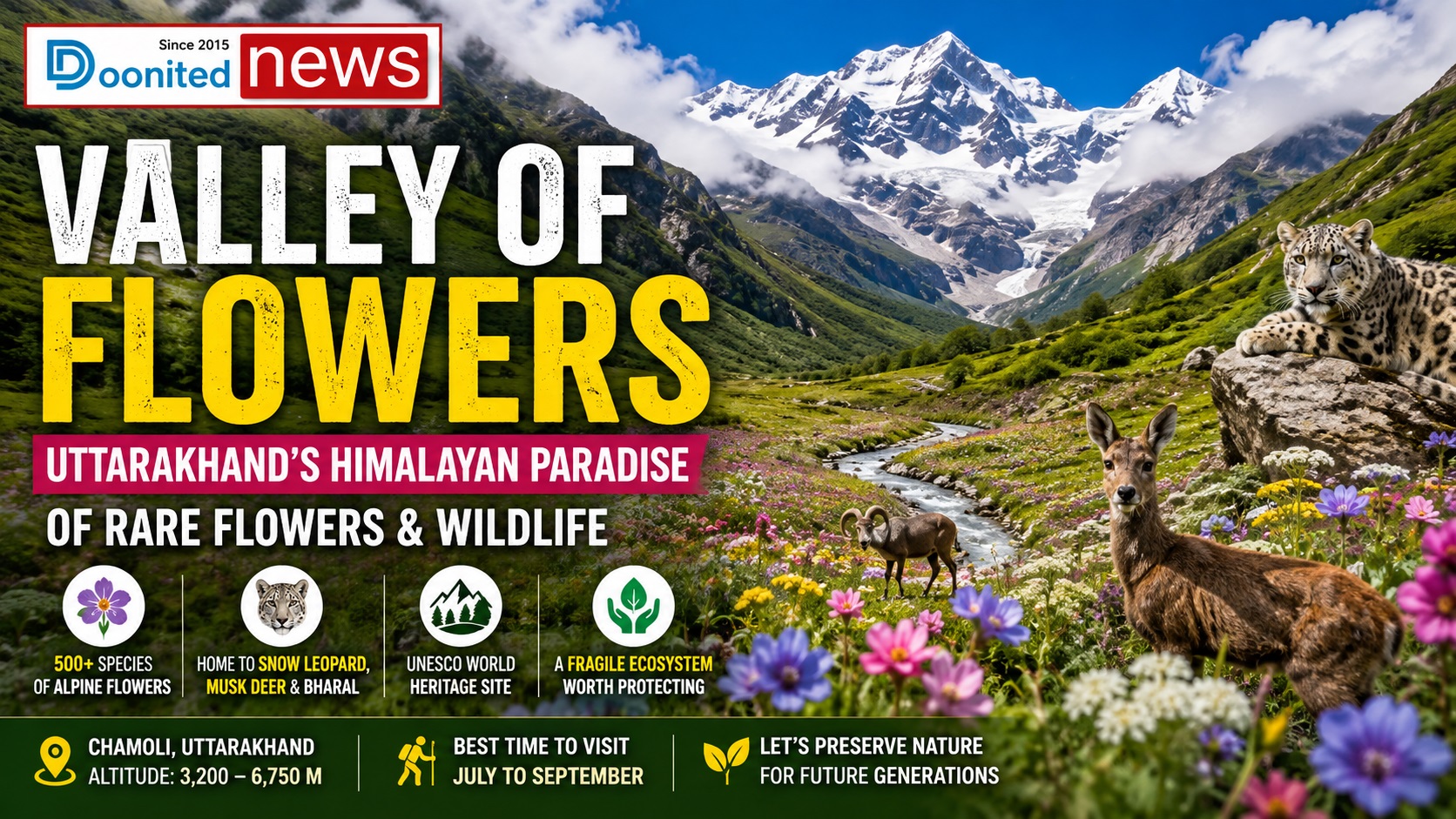
Valley of Flowers: Uttarakhand’s Himalayan Paradise of Rare Flowers and Wildlife
By Doonited News | Nature & Wildlife Uttarakhand
High in the Garhwal Himalayas lies a landscape that, for a few months every year, transforms into a spectacular carpet of alpine flowers.
The Valley of Flowers National Park, located in Chamoli district of Uttarakhand, is one of India’s most celebrated high-altitude natural landscapes. Surrounded by rugged mountains and alpine terrain, the valley is renowned for its extraordinary seasonal flowering, Himalayan biodiversity and dramatic scenery.
But the Valley of Flowers is more than a beautiful trekking destination. It forms part of an internationally important protected landscape and represents the fragile ecology of the Himalayan region.
A Natural Treasure in Chamoli
The Valley of Flowers National Park covers 87.50 square kilometres, according to UNESCO. It lies within the Western Himalayas and is characterized by alpine meadows, forests, streams, waterfalls and high mountain landscapes.
The park is part of the Nanda Devi and Valley of Flowers National Parks UNESCO World Heritage Site.
UNESCO describes the Valley of Flowers as being renowned for its meadows of endemic alpine flowers and outstanding natural beauty.
During the flowering season, numerous species bloom across the valley, creating the colourful landscape for which it has become internationally famous.
Why Is It Called the Valley of Flowers?
The name itself tells much of the story.
When snow retreats and Himalayan summer arrives, the alpine meadows begin to bloom. Different species appear during different stages of the season, meaning the appearance of the valley can change considerably within a matter of weeks.
The landscape may display shades of blue, purple, pink, yellow and white against a backdrop of mountains and clouds.
This seasonal transformation has made the valley one of Uttarakhand’s most recognizable natural attractions.
But its flowers are not merely decorative.
Alpine plants have adapted to demanding environmental conditions, including low temperatures, high altitude and a relatively short growing season. Their presence is part of a complex Himalayan ecosystem.
More Than Flowers: A Wildlife Habitat
The word “Flowers” in its name sometimes overshadows another important aspect of the national park — wildlife.
UNESCO notes that the wider Nanda Devi and Valley of Flowers protected landscape provides habitat for threatened mammals including the snow leopard, Himalayan musk deer and bharal, or blue sheep.
These animals inhabit an environment very different from the forests and plains found at lower elevations.
The region also supports Himalayan birdlife and other species adapted to mountainous ecosystems.
This makes the Valley of Flowers important not only for botany but also for wildlife conservation.
The Valley and Nanda Devi National Park
The ecological significance of the area becomes even clearer when viewed alongside neighbouring Nanda Devi National Park.
The two parks together form the UNESCO World Heritage property known as Nanda Devi and Valley of Flowers National Parks.
Nanda Devi National Park contains spectacular wilderness surrounding Nanda Devi, one of India’s highest mountains, while the Valley of Flowers is distinguished by its gentler alpine meadows and extraordinary floral diversity.
UNESCO first inscribed Nanda Devi National Park on the World Heritage List in 1988. The property was extended in 2005 to include the Valley of Flowers National Park.
Together, they protect an exceptional section of the Western Himalayas.
A Landscape That Demands Protection
The beauty of the Valley of Flowers also makes it vulnerable.
High-altitude ecosystems can be sensitive to human pressure and environmental change. Plants in these environments have short growing seasons, while wildlife depends upon habitats that may already be geographically restricted.
This is why the Valley of Flowers is managed as a national park, rather than simply as an unrestricted tourist attraction.
Visitors should therefore see themselves not only as tourists but also as temporary guests in a protected ecosystem.
Responsible behaviour — staying on permitted routes, avoiding litter, respecting wildlife and following park regulations — is essential to preserving the valley.
How Do Travellers Reach the Valley of Flowers?
The journey itself is part of the experience.
Visitors generally approach the region through Govindghat in Chamoli district. From there, the route proceeds towards Ghangaria, which serves as the principal base for visiting the Valley of Flowers.
The final approach is made on foot.
Unlike many hill destinations that can be reached directly by vehicle, reaching the valley requires trekking through Himalayan terrain. Weather and trail conditions can also change rapidly in the mountains.
Anyone planning the journey should therefore check the latest official information regarding opening dates, weather, road conditions, registration requirements and park regulations before travelling.
The Best Time to Experience the Flowers
The Valley of Flowers is strongly seasonal.
Winter snow keeps the high-altitude landscape inaccessible for a significant part of the year. During the warmer and monsoon months, the vegetation comes alive and different flowering species emerge.
For travellers primarily interested in seeing the famous floral landscape, the monsoon-period flowering season is generally the principal attraction.
However, Himalayan weather can be unpredictable, and heavy rainfall may affect roads and trekking routes in Uttarakhand.
Visitors should prioritize safety over a fixed itinerary.
Why the Valley Matters to Uttarakhand
Uttarakhand is widely known as Devbhoomi because of its sacred temples and pilgrimage traditions. Yet its identity is equally connected to its forests, glaciers, rivers, mountains and wildlife.
The Valley of Flowers represents this other extraordinary face of Uttarakhand.
It combines natural beauty, biodiversity, conservation, Himalayan geography and responsible tourism in a single landscape.
It also reminds us that some of Uttarakhand’s greatest treasures cannot be recreated once damaged.
Roads, hotels and infrastructure can be rebuilt. A fragile alpine ecosystem shaped over thousands of years is far more difficult to restore.
A Himalayan Paradise Worth Protecting
The Valley of Flowers deserves to be seen, but more importantly, it deserves to be protected.
Its spectacular flowers may attract visitors from around the world, but the deeper story is the ecosystem beneath them — plants adapted to extreme conditions, threatened Himalayan wildlife, mountain streams, forests and an interconnected landscape protected for future generations.
For Uttarakhand, the Valley of Flowers is therefore much more than a tourist destination.
It is part of the state’s natural heritage.
And protecting that heritage is ultimately what will allow future generations to experience the Himalayan valley in all its extraordinary beauty.